A bloody Chicago weekend left more than 20 people shot as President Trump again offers federal help that city leaders still do not seem eager to accept.
Story Snapshot
- At least 12 people were wounded in a single drive-by mass shooting on Chicago’s Far South Side.
- Police say more than 20 people were shot citywide over the same weekend, with several killed in separate attacks.
- President Trump is offering federal help while Chicago’s progressive leadership leans on the same talking points and “programs.”
- Official data show some homicide metrics down, but shootings remain high and heavily concentrated in troubled neighborhoods.
Drive-by Mass Shooting Turns South Side Street Into War Zone
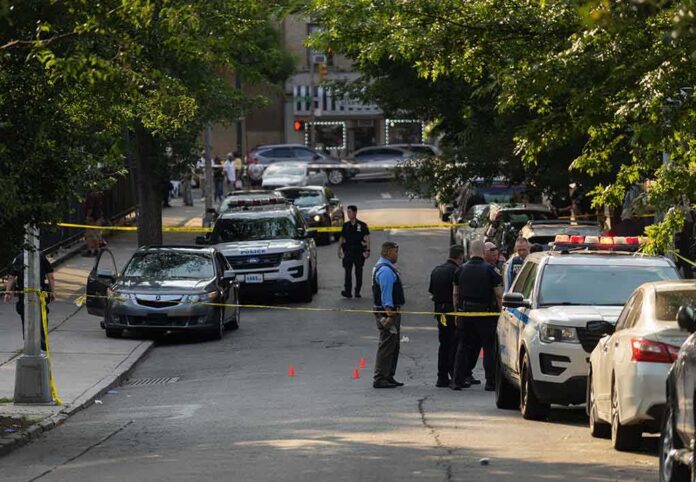
Chicago police say a red sport utility vehicle rolled up to a large crowd on the Far South Side late Friday night, and two people inside opened fire into the group before speeding away.[3] Officers called to West 95th Street around 11 p.m. found multiple victims in the street, including a woman with gunshot wounds to her back and a man with several graze wounds.[4] In all, at least 12 people between 17 and 47 years old were shot, with two in critical condition.[1]
Reporters on scene described a classic drive-by attack, with shell casings scattered across the pavement and stunned residents trying to help the wounded until ambulances arrived.[4] Police say the shooters targeted a crowd gathered outside in the Princeton Park area, then vanished into the night before officers could get a plate number.[2] As of the latest reports, no arrests have been made, and detectives are still working leads, a familiar pattern after major South Side shootings.[2]
Weekend Toll: Over 20 Shot, City Leaders Repeat Old Lines
That single attack was only part of a violent stretch that saw at least 21 people shot across Chicago since Friday evening, with several of those victims dying in separate incidents.[3] The Chicago Police Department’s public safety reporting shows that shootings this year remain ahead of last year’s pace, even as some homicide numbers have improved.[7] This means families in certain neighborhoods still hear gunfire weekly, despite press conferences that talk about progress and new “holistic” strategies.[4]
Mayor Brandon Johnson called the mass shooting “heartbreaking” and said every act of violence is unacceptable, language Chicago residents have heard many times before.[2][6] He again pushed ideas like youth jobs, mental health services, and affordable housing as the main tools to reduce shootings, even as police continue to respond to scenes with dozens of evidence markers on the ground.[6] Johnson also tried to connect current problems to past federal budget choices, including claims that Trump-era cuts hurt violence prevention programs, but he has not publicly produced detailed budget proof for the specific number he cites.[6]
Trump Offers Help While Data Show a Mixed but Troubling Picture
As images of the South Side shooting spread, Trump allies highlighted the weekend numbers—more than 20 shot citywide—as proof that Democrat-run Chicago still cannot keep its people safe. They argue that federal agencies like the Federal Bureau of Investigation (FBI) and the Bureau of Alcohol, Tobacco, Firearms and Explosives (ATF) should surge agents, help track illegal guns, and support tougher prosecutions for repeat trigger-pullers. Supporters say this respects local control but gives overwhelmed neighborhoods backup.
Chicago saw multiple shootings over the weekend; the AP reported that at least seven people were killed and dozens were injured. This has once again sparked debate in the United States over public safety, gun control, and whether to deploy federal forces
— Lina (@Linapyi) June 21, 2026
City data do offer a more complex picture, but not the clean win Chicago leaders suggest. Public reporting shows May homicides hit their lowest level in decades, with 36 killings, yet shootings overall are still running ahead of last year.[4] Chicago Police Department crime reports confirm that gun violence is highly concentrated in certain neighborhoods and social networks, where a small number of dangerous people drive most of the bloodshed.[7][9] That kind of concentrated violence is exactly where a focused, joint federal–local crackdown could make the fastest difference for law-abiding families.
What Conservatives Should Watch Next
For conservatives, the core issue is not sound bites but basic government duty: can leaders protect citizens’ right to live in safe neighborhoods and raise their families in peace? Chicago’s current strategy leans heavily on long-term social programs and messaging, while bullets are flying into crowds today. Federal help under Trump would likely stress tougher enforcement against the worst offenders, support for proven targeted policing strategies, and backing for community groups that actually cut shootings rather than just run meetings.[10][19]
Key questions now are simple. Will Chicago’s leadership accept serious federal assistance, or keep blaming Washington while crime stays high in their own backyard? Will any joint plan focus on known shooters and gangs, or get bogged down in politics and “woke” rhetoric that treats enforcement as the problem instead of the answer? For families on Chicago’s South Side, those are not talking points. They are life-or-death choices every weekend as they pray their kids are not the next ones caught in the crossfire.
Sources:
[1] Web – More Than 20 Shot in Chicago Over Weekend As Trump Offers Help
[2] Web – 7 wounded, 2 fatally, in mass shooting on South Side
[3] YouTube – Drive-by shooters fire into crowd, injuring at least 12 …
[4] Web – Chicago police say at least 12 people were shot when an SUV …
[6] Web – List of mass shootings in the United States in 2026 – Wikipedia
[7] Web – Chicago leaders are optimistic that violence in the city could be …
[9] Web – Chicago Police Department – We Serve & Protect
[10] Web – News – Chicago Police Department
[19] Web – Studying Gun Violence Is Hard. But Intervention Programs Need …