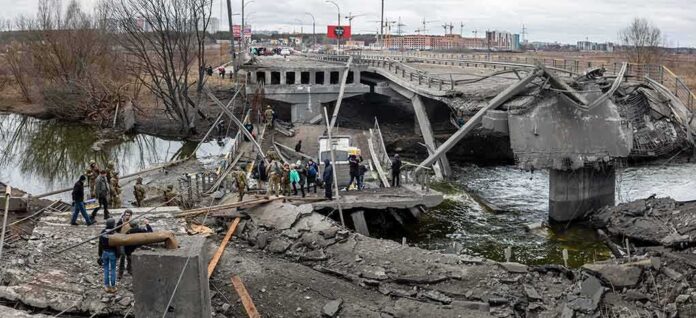
The U.S. military struck at least six bridges near Bandar Abbas, Iran’s most vital port city, in a direct move to cut off the Islamic Revolutionary Guard Corps’ ability to threaten the Strait of Hormuz — the chokepoint for one-fifth of the world’s oil supply.
Story Snapshot
- U.S. Central Command struck multiple bridges near Bandar Abbas to degrade Iran’s military logistics and its ability to threaten commercial shipping through the Strait of Hormuz.
- Defense Secretary Pete Hegseth confirmed the strikes publicly, sharing footage of an Islamic Revolutionary Guard Corps maritime surveillance tower collapsing after a direct hit.
- The strikes mark the sixth consecutive day of U.S. military action against Iran, targeting coastal radar sites, air defenses, and military supply routes.
- Iran retaliated with attacks on U.S. military bases in Qatar, Kuwait, Bahrain, and other Gulf states, while Iranian state media reported civilian casualties from the bridge strikes.
Cutting Off Iran’s Military Lifeline
U.S. Central Command confirmed the strikes targeted bridges leading to Bandar Abbas, home to a major Iranian naval base, as part of a campaign to shut down Iran’s ability to close the Strait of Hormuz. A White House spokesperson told the BBC the U.S. “carried out strikes exclusively on military targets, including military logistics infrastructure.” Defense Secretary Pete Hegseth posted video on social media showing an Islamic Revolutionary Guard Corps maritime surveillance tower collapsing in real time.
The Strait of Hormuz is one of the most important waterways on earth. About one-fifth of the world’s oil passes through it. Iran has repeatedly threatened to shut it down. Shipping in the strait has nearly stopped due to Iranian attacks on vessels in the region. The U.S. strategy, described by retired Admiral James Stavridis as “escalate to deescalate,” aims to hit military and economic pressure points hard enough to force Iran back to the negotiating table.
What the U.S. Actually Struck
Beyond the bridges, U.S. Central Command hit a key railway junction near Bandar Abbas, coastal surveillance infrastructure, and a maritime control tower used by Iran’s Islamic Revolutionary Guard Corps to monitor commercial ships passing through the strait. The strikes marked the sixth straight night of U.S. military action against Iran. U.S. forces have now hit more than 90 Iranian military targets across multiple waves, including air defense systems, radar stations, anti-ship missile sites, and over 60 Islamic Revolutionary Guard Corps small boats.
At least six bridges were struck in Iran’s Hormozgan province, including one still under construction. Iranian provincial authorities named several specific crossings, including the Gariveh bridge linking Bandar Abbas with nearby cities and bridges along the Kahoorestan–Lar route. The bridge network connects Bandar Abbas — Iran’s top commercial port — to the rest of the country, making it a key artery for military resupply as well as trade.
Iran Retaliates, Media Pushes Civilian Narrative
Iran struck back hard. Iranian forces launched attacks on U.S. military installations in Qatar, Kuwait, Bahrain, Jordan, and Syria. Kuwait reported a strike on a desalination facility. Qatar’s Interior Ministry reported a child was injured by debris. Bahrain activated air raid sirens. Iran also targeted a tanker in the Strait of Hormuz. The Iranian regime warned that “the entire region will pay the price” for U.S. strikes.
#IranWar : An alternate road linking Rodan and Bandar Abbas has reopened after a #US #military strike damaged the main road and bridge, allowing traffic to resume. #USIRAN pic.twitter.com/mqgNOoABO1
— Sajjad Tarakzai (@SajjadTarakzai) July 18, 2026
Iranian state media, including IRNA and Fars News, reported that eight people were killed and roughly 20 injured in the bridge strikes, with some casualties occurring when vehicles were caught on bridges during the attacks. Iran’s Foreign Ministry called the strikes a violation of its sovereignty. Much of the mainstream media quickly picked up Iran’s “civilian infrastructure” framing. But the U.S. has not backed down, and the White House has flatly denied that any non-military targets were hit. The broader context matters: Iran started this escalation by attacking commercial ships and blocking one of the world’s most critical shipping lanes.
Sources:
youtube.com, nbcnews.com, easternherald.com, telegraph.co.uk, aa.com.tr, themedialine.org, i24news.tv, reuters.com, israelhayom.com, bankingnews.gr, rt.com, timesnownews.com, bbc.com, facebook.com, aljazeera.com, chinadailyhk.com, nytimes.com, timesofisrael.com, bernama.com, wsj.com, arabtimesonline.com, apnews.com, npr.org, washingtonpost.com, congress.gov, britannica.com, ajc.org