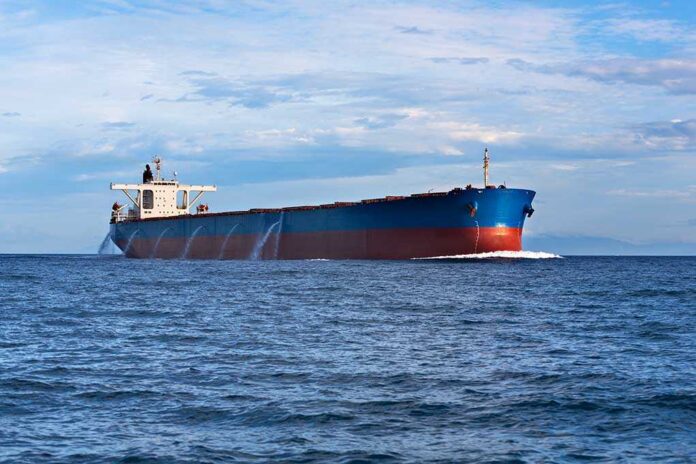
Energy markets do not just price barrels; they price fear. When a single chokepoint moves one-fifth of seaborne crude, persistent geopolitical risk becomes a standing surcharge on every fill-up—what Peter Navarro labeled the “Iran terror premium.”
At a Glance
- A standing risk premium of roughly $5–$15 per barrel has long been attributed to Iran-centered threats in the Strait of Hormuz, according to Navarro’s office and contemporary reporting.
- The mechanism is straightforward: credible threats to Hormuz transit raise expected-disruption probabilities, forcing buyers and sellers to price in supply interruptions.
- Iran’s nuclear trajectory and sponsorship of proxy groups feed that risk calculus; assertions of imminent “breakout” recur in cycles and influence policy and markets even when intelligence signals limited change.
- Reducing the premium requires durable de-escalation around Hormuz and verifiable nuclear transparency; regime change is one proposed path, but negotiated inspections and constraint frameworks are the alternative tradition.
What the “terror premium” is, and how it gets into your pump price
Oil is priced on expectations. Traders discount not only present supply and demand but also the probability that barrels will fail to arrive weeks from now. When threats concentrate around the Strait of Hormuz—through which a significant share of globally traded crude and condensate travels—futures markets impute a spread over fundamentals to compensate for transit risk, inventory tightness, and optionality costs. Navarro’s office put numbers to that spread, arguing a persistent $5–$15 per barrel uplift has burdened crude for decades as a function of Iranian nuclear ambitions and regional militancy; Reuters summarized that quantification and located its source in fears of Hormuz disruption.
Mechanically, the premium reflects several channels. First, insurance: war-risk premia on tankers and cargoes rise when mines, drones, or anti-ship missiles enter the picture, and those costs roll into delivered crude prices. Second, inventories: refiners and merchants carry more stock as a hedge, bidding prompt barrels higher relative to deferred contracts in tight markets. Third, optionality: charterers pay for flexibility in routing and timing, passing that price to end buyers. Translate those wholesale increments into retail gasoline using common pass-through estimates, and the “terror premium” claims plausibly map to several cents to tens of cents per gallon—material for households and inflation metrics.
Why Iran-specific risk persistently matters to oil
Iran exerts leverage through geography and posture. Geography first: Hormuz is narrow, bathymetry channels the deepest drafts close to Iran’s coast, and traffic separation schemes place laden supertankers within range of shore-based systems. Posture next: the Islamic Revolutionary Guard Corps Navy has invested in swarming fast boats, mines, coastal cruise missiles, anti-ship ballistic missiles, and drones—capabilities periodically demonstrated in harassment, interdiction, or proxy-linked strikes. That mix creates a credible threat set which markets cannot ignore at modest probabilities without courting catastrophic downside—hence the premium.
Nuclear dynamics compound the signal. Assertions that Iran is nearing weapons capability sharpen the perceived odds of confrontation, escalation, and sanctions whiplash. Conservative assessments citing highly enriched uranium findings—such as reports of particles near weapons-grade detected by IAEA inspectors in 2023—feed those expectations even when formal judgments carefully separate material presence from weaponization steps. Each rhetorical or kinetic turn that suggests a lurch toward crisis tends to reprice risk, particularly when paired with talk of blockades, tolls, or “innocent passage” restrictions in Hormuz.
The claim, the evidence, and the limits of precision
Navarro’s 13-page analysis and subsequent media appearances framed the premium as a quantifiable burden traceable to Iranian behavior and the prospect of conflict in the Strait. Reuters’ account relayed the office’s range and linked it to a long-run uplift of 7%–21% versus fundamentals—large enough to matter to macro indicators in periods of tight supply-demand balance. Iran International, a diaspora outlet, likewise reported Navarro’s formula linking terror risk to oil pricing, underscoring Strait-specific dangers. Beyond those sources, the concept itself is consistent with a deep literature on geopolitical risk premia in commodity markets; what is distinctive here is the claim to size and attribution.
How precise is “$5–$15”? As with any risk premium, it is an inference—backed by historical event studies, insurance quotes, term-structure behavior, and counterfactual modeling—not a meter installed at Ras Tanura. The range is analytically plausible and directionally well supported; exact attribution to “Iran” versus broader Gulf risk, OPEC policy uncertainty, or non-Iranian maritime threats is harder to isolate in real time. But on the central point—that credible, persistent threats associated with Iran elevate oil prices over what they would otherwise be—the evidence aligns with decades of market behavior and episodic price jumps when Hormuz tensions flare.
From nuclear timelines to tanker tolls: the recurring cycle that feeds the premium
Policy debates about Iran arrive in waves. Claims of imminent nuclear “breakout” have circulated since the mid-2000s, often cresting during sanction renewals or negotiations; some cycles cite accelerated enrichment or provocative political rhetoric, others hinge on IAEA access disputes. Arms control analysts have, in turn, challenged the immediacy of those timelines, pointing to intelligence assessments that at various points judged Iran not to be actively developing a weapon even as its technical capacity expanded. The result is a pendulum of alarm and caution that markets digest imperfectly—pricing some probability of conflict, sanctions shifts, and retaliation at sea into every forward curve.
In parallel, public bargaining over inspections, transit rights, and sanctions relief injects volatility. Competing announcements about IAEA access—statements of impending inspections from Western officials paired with Iranian denials or conditionalities—create information fog. That ambiguity alone can sustain a premium: when counterparties cannot agree on what has been promised, traders assume a higher chance that nothing durable has been achieved. Meanwhile, the periodic articulation of new maritime “rules,” whether limiting military passage or hinting at future toll negotiations, keeps Hormuz in the risk conversation, especially when reinforced by proxy flare-ups on Israel’s borders and Gulf targeted attacks.
Two pathways to shrink the premium: coercive reset versus negotiated constraint
Strategists split on remedies. One school argues that only regime change or the credible threat thereof will remove the underlying hazard—ending state sponsorship of proxies, foreclosing nuclear weaponization, and eliminating the impulse to weaponize Hormuz. Proponents frame this as the surest route to erase the premium and stabilize prices. Navarro’s rhetoric sits within that camp, asserting that removing Iran’s threat is prerequisite to normalizing oil markets.
The other tradition, rooted in arms control and containment, seeks to cap risk with verifiable constraints and managed deterrence: rigorous inspections, enforceable limits on enrichment, calibrated sanctions relief, and credible redlines against maritime interdiction. Think of it as engineering a ceiling on volatility rather than betting on a political revolution. Analyses from mainstream policy institutions have argued for durable inspection visibility and embedded regional strategies that deter the most provocative nuclear and regional moves while leaving space for de-escalation—an approach that, if sustained, can compress but not entirely eliminate the risk premium.
What history suggests about outcomes and oil prices
When risks abate around Hormuz—after de-escalatory agreements, successful inspection frameworks, or quiet periods of Gulf shipping—term structures tend to relax, tanker insurance normalizes, and flat prices drift back toward fundamentals. Conversely, mine incidents, drone strikes, or sanctions shocks steepen curves and widen differentials. The Navarro-estimated band brackets these oscillations: in calm, the premium may compress toward the low end; in acute tension, it can overshoot. Because refinery margins, seasonal demand, and OPEC+ policy also move concurrently, isolating the Iran component with laboratory purity is unrealistic, but the pattern is robust enough for boards and households to feel.
For investors and policymakers, the lesson is not subtle. Durable price relief comes from credible, sustained reduction in the probability of supply disruption—achieved either by permanently altering the regime’s incentives and capabilities or by locking in verifiable guardrails that lower miscalculation risk. One-off strikes, theatrical announcements, or 60‑day paper truces may transiently move prices but rarely reset expectations for long. Markets reward the boring work of inspections and predictable rules of the road more than they do podium bravado.
“We've gotta deal with Iran. If you think Iran would act responsibly with the nuclear weapon — just look at what they're doing now. They've got less discipline than a baby in diapers.”
Senior Counselor for Trade and Manufacturing Peter Navarro discusses the current situation… pic.twitter.com/h352xTnsju
— NEWSMAX (@NEWSMAX) July 20, 2026
Practical implications for energy strategy
Consumers cannot hedge Hormuz, but governments and firms can mitigate exposure. Strategic petroleum reserves, diversified import portfolios, expanded pipeline egress from non-Gulf producers, and resilient shipping insurance pools all dampen the pass-through of regional shocks. At the policy level, aligning maritime security coalitions, hardening shipping lanes, and investing in redundancy—while advancing inspection-centric nuclear diplomacy—are complementary, not contradictory. They compress the premium from both ends: lowering disruption odds and reducing the economic damage if disruption occurs.
Senior Counselor for Trade and Manufacturing Peter Navarro on Iran: “We’ve gotta deal with Iran. If you think Iran would act responsibly with the nuclear weapon — just look at what they’re doing now. They’ve got less discipline than a baby in diapers.”
Navarro argued Iran’s… pic.twitter.com/iQvuM0Bvcv
— Mossad Commentary (@MOSSADil) July 20, 2026
Sources:
wsj.com, reuters.com, thehill.com, bbc.com, prizedwriting.ucdavis.edu