
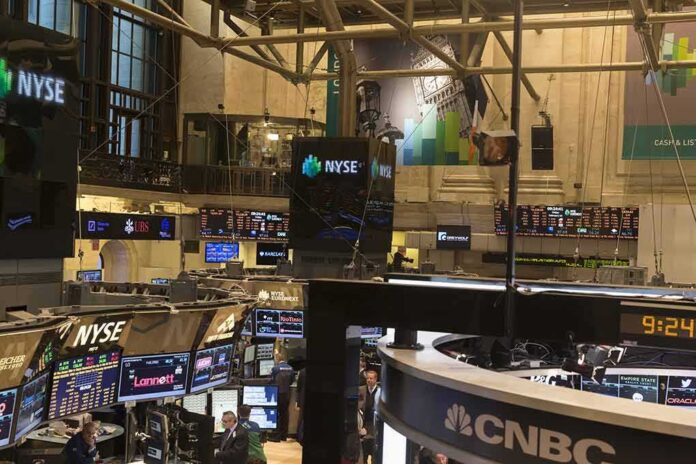
Brent crude’s jump above the mid-90s shows how fast Middle East war fears can hit energy prices and ripple through American wallets.
Quick Take
- Market reports tied the rally to renewed Middle East fighting and shipping risk.
- Reuters and Bloomberg said Brent moved sharply higher as war fears spread.
- Reports also pointed to the Strait of Hormuz and Red Sea threats.
- The record supports a war premium, but not a clean single-cause explanation.
War Fears Push Oil Higher
Oil prices rose as renewed fighting in the Middle East raised fears about supply cuts and tanker delays. Trading reports said Brent moved to the highest level in months as investors watched the Strait of Hormuz, a chokepoint that carries a large share of global oil traffic. That route matters because even the threat of disruption can force traders to bid prices higher before any actual shortage hits.
Reuters reported that Brent later hit a four-year high on concern over US-Iran war escalation, then gave some of those gains back. Bloomberg coverage also said Brent and West Texas Intermediate rose after all-out war began, while one segment noted the market response was still muted on the day of the breakout. That mix fits a familiar pattern: war headlines move oil fast, but traders still weigh how much risk is already priced in.
Chokepoints Matter More Than Headlines Alone
The strongest market reason for the jump is not just the fighting itself. It is the fear that conflict could block key shipping lanes and export routes. Reports pointed to the Strait of Hormuz and the Red Sea as pressure points, and one Reuters report said Iranian action there drove Brent futures up sharply in March. Another market report said shipping companies began rerouting vessels away from the strait as tensions rose.
Bloomberg Television said Iran-backed Houthis threatened to block Saudi shipping through Bab el-Mandeb, while Iran also tried to tighten control over Hormuz. That matters because oil markets react quickly when a chokepoint looks less safe. Even without a total shutdown, higher insurance costs, slower tanker traffic, and rerouted cargoes can lift prices. For readers worried about fuel costs, this is the kind of government- and war-driven instability that punishes households first.
The Exact $95 Claim Needs Care
The supplied record supports a conflict-driven rise in Brent, but it does not cleanly prove that one specific print above $95 was the single key event. Some cited reports place Brent above $90, above $91, or far higher later in the escalation. That leaves the exact inherited framing weaker than the broader point. The broader point still stands: war risk helped push oil higher, but the evidence does not isolate war as the only driver.
Side-by-side market coverage also shows why caution is needed. Reuters reported that oil sometimes fell when inflation worries and other economic concerns outweighed supply fears. Other reports noted inventory levels, refined-product tightness, and trader positioning as additional forces. So the right reading is narrower and more accurate: the war added a strong risk premium to oil, but the move was likely shaped by several market forces at once.
What This Means for Drivers and Consumers
For American consumers, the lesson is simple. Oil prices can spike fast when foreign wars threaten shipping routes and energy flows. That kind of volatility feeds directly into gasoline, diesel, freight, and heating costs. The reporting here shows how a conflict far from home can still reach the pump in a hurry. It also shows why energy security remains a national issue, not just a Wall Street trade.
BREAKING: Brent North Sea crude soars above $95 a barrel on Middle east war pic.twitter.com/I5dVfwz8FV
— Liberty Pinnacle (@LibertyPinnacle) July 22, 2026
The same reporting also shows how quickly a headline can harden into a market story before the full data is in. Reuters, Bloomberg, and other outlets linked the rally to war risk, but the record still lacks exchange-level proof that would separate pure fear from other trading forces. That matters because families pay the bill either way. When war and energy policy collide, ordinary people absorb the cost long before the experts agree on the cause.
Sources:
insiderpaper.com, nytimes.com, intellectia.ai, reuters.com, oilprice.com, aljazeera.com, tradingeconomics.com