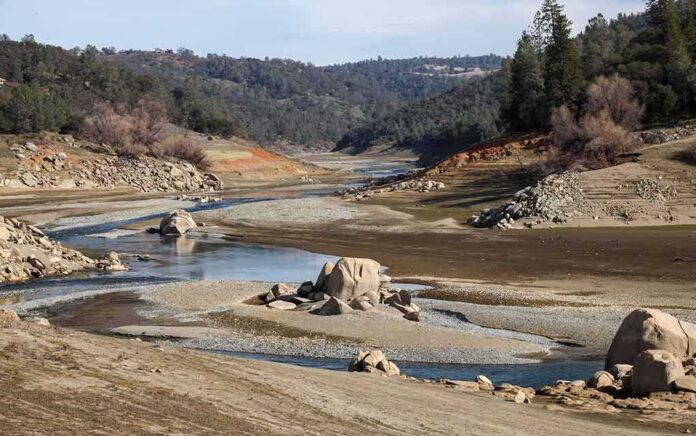
Europe’s drought has pushed major rivers to record lows, and the damage is already hitting shipping, power, and industry.
Quick Take
- The Rhine and Danube have dropped to record or near-record lows in several places.
- Official satellite images show unusually low water along four major European rivers.
- Low water is disrupting freight, energy output, and river travel.
- The pattern is part of a wider summer drought and heat wave across Europe.
Major Rivers Hit Historic Low Water
European waterways are drying up fast under a mix of heat and drought. The European Union Space programme said Copernicus Sentinel-2 images from August 1 to 3 showed exceptionally low water levels along parts of the Loire, Po, Rhine, and Danube rivers. BBC reporting said the Rhine fell to record low levels in several locations in Germany and the Netherlands, including Cologne and Lobith.
The Danube has also suffered steep drops in several countries. CNN reported that Budapest’s water level sank to 4 inches, breaking the previous record low set in 2018, while other reports described record or near-record lows across Hungary, Serbia, and Romania. Reuters said the drought has cut transport, lowered power output, and squeezed company earnings across Europe.
Shipping, Energy, and Trade Feel the Squeeze
Low river water does more than change the view. CNBC said Rhine water levels near Kaub, a key chokepoint for barges, fell to 24 centimeters and reached the lowest level since records began in 1880. Bloomberg reported that the Rhine’s low water is disrupting trade arteries and raising freight costs, while power plants along rivers are facing cooling limits during the same dry spell.
That matters because these rivers are not scenic extras. They are working transport routes for coal, chemicals, fuel, food, and factory parts. Reuters said the shrinking rivers have curtailed the movement of goods and reduced electricity output across major parts of the continent. When water gets this low, barges carry less cargo, shipping slows down, and costs rise for businesses already under pressure.
Heat and Rainfall Deficits Drive the Crisis
The current crisis does not come out of nowhere. Multiple reports tie it to persistent heat waves and weak rainfall across central and eastern Europe. The pattern is broad, but the record labels still depend on location and gauge. Some places are described as “record low,” while others are “lowest since records began” or “near record lows,” which is common in river reporting.
Wildfires, drought and heat waves in Europe this summer limited river shipping, cut crop yields and forced nuclear plants to reduce output, costing hundreds of billions of euros https://t.co/0i74g41sfg pic.twitter.com/av6NCJCj4Y
— Reuters (@Reuters) August 10, 2026
That distinction matters, but it does not soften the bigger picture. The overall trend is clear: Europe’s major rivers are running low enough to hit transport, energy, farming, and tourism at the same time. For countries that depend on river freight and reliable power, the costs are real. The drought also exposes how fragile Europe’s energy and supply systems can be when weather turns harsh.
What This Means Going Forward
Forecasts in the reporting suggest more trouble ahead if dry weather continues. The Rhine often bottoms out later in summer, which means the worst could still be ahead for river traffic and industrial supply chains. In the meantime, governments and water officials are being forced to manage lower flows, tighter shipping limits, and rising pressure on power systems already strained by the weather.
For readers watching the bigger picture, the lesson is simple. When Europe’s rivers fall this far, the impact reaches far beyond the banks. It touches fuel prices, factory output, farm water use, and the cost of moving goods. This is not just a climate talking point. It is a real-world supply problem with direct economic consequences.
Sources:
insiderpaper.com, eu-space.europa.eu, youtube.com, bbc.com, cnn.com, cnbc.com, apnews.com, theguardian.com, finance.yahoo.com