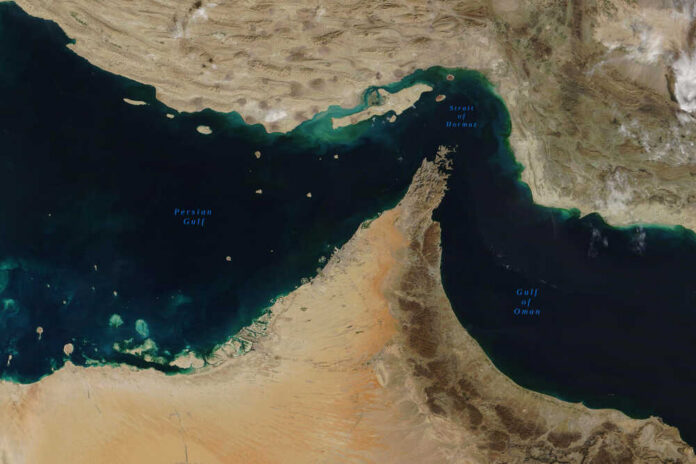
Trump warns Tehran that closing Hormuz means the U.S. will hit back hard to keep the world’s oil flowing.
Story Highlights
- Trump links Iran’s actions in the Strait of Hormuz to swift, stronger U.S. retaliation [1].
- Reports describe a 48-hour ultimatum to fully reopen the waterway or face strikes on power plants [2].
- Analysts say Iran struggles to fully shut the strait for long, despite threats [22].
- Conflicting claims persist over whether Iran actually closed the strait in recent days [10].
Trump’s Red Line: Keep the Sea Lanes Open
President Donald Trump tied Iran’s behavior in the Strait of Hormuz to direct U.S. action. He said future attacks would be “far greater” if Iran refused peace, after U.S. strikes took out key nuclear sites. That message set a clear line: maritime choke points stay open, or the cost goes up fast for Tehran [1]. This stance matches decades of U.S. policy that freedom of navigation is non‑negotiable when global energy and American security are on the line [18].
Trump’s pressure campaign included a reported ultimatum. If Iran did not fully reopen the strait within 48 hours, the United States would strike Iranian power infrastructure, starting with the largest plant. The warning focused on restoring safe, threat‑free transit, not endless brinkmanship. It told Iran’s leaders that holding the world economy hostage would invite consequences they could not control [2].
Does Iran Control the Chokepoint? Mixed Signals and Market Jitters
Iranian state claims and Western reports have sent mixed signals about the strait’s status. Iran’s joint military command has said the waterway was closed, while U.S. officials countered there was no evidence of a shutdown. The gap fuels confusion and market fear, which is part of Tehran’s playbook. A disputed “open” versus “closed” narrative lets Iran raise costs without proving it can actually block traffic for long [10].
Historical analysis shows Iran can harass ships and spike insurance rates, but sustaining a true closure is hard. Mines, small boats, and missiles can hurt, yet tankers are tough and modern defenses are strong. Studies estimate even large Iranian efforts would struggle to stop most transits or cripple oil flows for long. The United States and partners can clear threats and reopen lanes, though timelines vary with risk and scale [22].
Why This Fight Matters at Home: Energy, Deterrence, and the Constitution
Every American sees the stakes at the pump and in the grocery aisle. When Iran toys with Hormuz, energy prices jump, shipping costs climb, and families pay more. Trump’s approach aims to stop that pain by restoring deterrence fast. The message is simple: no tolls, no blockades, and no “pay‑to‑pass” games. Free seas support free markets, and free markets support American households and small businesses that are already tired of high costs.
Analysts also frame this as a test of endurance, not just firepower. Iran tries to outlast political will by raising global costs, while the United States aims to keep trade moving and pressure focused. That contest rewards steady resolve. It also calls for clear rules tied to real action, so Tehran cannot win with bluffs and noise alone. Strong deterrence shortens crises and helps avoid larger wars that nobody wants [19].
What Victory Looks Like: Safe Transit Without New Quagmires
U.S. policy makers have long planned ways to reopen Hormuz if attacked. Options range from clearing mines to striking launch sites and seizing offshore nodes that Iran uses to threaten ships. The point is not endless occupation. It is to break choke points, remove the most dangerous tools, and restore safe passage. Past plans and exercises show the United States can do this if needed, and do it quickly when the mission is clear [18].
🇺🇸🚨BREAKING | Beyond the markets, Trump has just issued a stern warning on Truth Social demanding that Iran immediately rein in its allies in Lebanon.
He asserts that the Strait of Hormuz will open TOLL-FREE due to the ceasefire, but if Tehran fails to comply, "the U.S. will… https://t.co/aOpmnoRKOb
— hash_v06.7c6 ⌖ (@v06_7c6) June 22, 2026
For conservatives, the core test is simple. Does policy protect Americans’ freedom, energy security, and prosperity without dragging us into open‑ended wars? Trump’s warnings put the burden on Tehran to stand down or face real costs. The research record suggests Iran cannot keep Hormuz closed for long if challenged. That gives leverage to the United States. Resolve, targeted force, and coalition help where useful can keep the lanes open and the costs to families down [22].
Sources:
[1] Web – Iran-US war latest: Trump warns Tehran ‘we will take over your …
[2] Web – President Donald Trump addresses nation after US strikes on Iran
[10] Web – CSIS | Center for Strategic and International Studies
[18] Web – U.S. DENIES IRAN’S CLAIM OF HORMUZ STRAIT CLOSURE U.S. …
[19] Web – [PDF] Iran’s Threat to the Strait of Hormuz – UM Carey Law
[22] Web – “It has long been known that the Strait of Hormuz is a really …