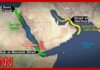
Iran-backed Houthi fighters have pushed to the Bab al-Mandab chokepoint and seized Perim Island, tightening their grip on a sea lane that keeps American supply lines and global trade moving.
Story Highlights
- Houthi forces reached Perim Island in the middle of the Bab al-Mandab Strait, raising the stakes for U.S. and allied shipping.
- Reports say the group advanced from Mocha to Dhubab and out to nearby Red Sea islands, shifting control toward a critical corridor.
- Analysts warn the Houthis can disrupt traffic without holding every shoreline mile, using missiles, drones, and sea mines.
- Camp Lemonnier in Djibouti remains vital for U.S. operations as pressure builds across the narrow waterway.
Houthi Advance Reaches the Strait’s Centerline
Reuters reported that Houthi militants reached Perim Island, which sits in the middle of the Bab al-Mandab Strait between Yemen and Africa. The advance followed gains along Yemen’s Red Sea coast, including the capture of Mocha, a key port city that anchors approaches to the chokepoint. Yemeni government sources also said fighters pushed to Dhubab, a coastal town that faces the strait’s narrowest span, underscoring the group’s growing reach over the passage used by energy and container ships.
Multiple outlets described a rapid push to nearby Red Sea islands and positions that shape who can move through the strait and when. The National reported claims that the Houthis took control of Perim and the western coastline, signaling unmatched leverage at the gate to the Red Sea and Suez Canal. France 24 also detailed the capture of strategic islands during a lightning offensive, linking territorial gains to real power over maritime movement. These facts point to a new stage in the conflict around the chokepoint.
Why This Chokepoint Matters to America’s Security
Bab al-Mandab connects the Mediterranean Sea to the Indian Ocean through the Suez Canal and the Red Sea. When threats rise here, shipping costs jump, delivery times slip, and energy prices can spike. That hits American families and businesses fast. The Houthis have shown they can strike ships and threaten naval escorts, using missiles, drones, and mines to scare traffic and force reroutes around Africa, which adds time and cost to every voyage. Those tactics can bend markets without firing every day.
Research from the Washington Institute explains how the group uses “selective sea denial” to block or harass targets while avoiding a full-scale blockade. That playbook worked during the Gaza war after 2023, when attacks in and near the strait drove a sharp drop in traffic and oil flows. Control of Perim and nearby coastal points increases leverage to repeat that play. It lets the group watch, threaten, and, at moments, close lanes long enough to move prices and policy. That pressure lands on U.S. allies and on our own economy.
Djibouti’s Role and the U.S. Response Options
Across the water, Djibouti hosts Camp Lemonnier, the hub for United States Africa Command missions in the region. That base supports counterterrorism, maritime security, and logistics for operations that protect shipping and American citizens. Analysts note it offers key reach but with limits compared to larger U.S. facilities elsewhere, which means Washington must prioritize how it uses assets from there during a fast-moving crisis. The base’s location keeps eyes and aircraft close to the strait when minutes matter.
Reuters reporting links parts of the Houthi surge to support from Iran’s security apparatus, raising the stakes for deterrence and signaling. That connection fits the wider pattern of Tehran using partners to raise costs on U.S. and allied forces. President Trump’s team now faces a clear choice set: maintain freedom of navigation, harden convoys, and expand patrols while pushing partners to share the load. That means stronger rules of engagement at sea, faster interception of drones and missiles, and tighter coordination with regional navies to keep traffic flowing.
What Conservatives Should Watch Next
Conservatives should track three things: shipping flows through the strait, insurance rates on vessels, and the tempo of Houthi launches. If traffic drops or premiums rise, prices at home will feel it. If strike pace climbs, escorts and air defense must scale up to match. The facts show the Houthis can slow the strait even without a formal blockade. A firm American posture, backed by allies, can keep lanes open and deny Iran a cheap win against our economy and our Navy.
The lightning quick Houthi advances have created a dilemma for the US as it transitions from global to regional hegemon.
The Houthis are now less than 100 miles from Camp Lemonnier, in Djibouti. That's similar to the distance from Iran to Bahrain, where the Iranians pounded
1/— Labrador Skeptic (@SaysSimulation) September 12, 2026
This is not a far-off problem. The chokepoint is narrow, the targets are crowded, and the tools to disrupt are cheap. The United States can and should lead with strength: protect ships, hold sponsors of attacks to account, and keep pressure on the networks moving weapons to Yemen. Order at sea is not a luxury. It is a core national interest that guards our paychecks, our energy, and our freedom to trade on our terms.
Sources:
redstate.com, reuters.com, thenationalnews.com, aljazeera.com, france24.com, theguardian.com, africa.businessinsider.com, hornreview.org, sofrep.com, csis.org