
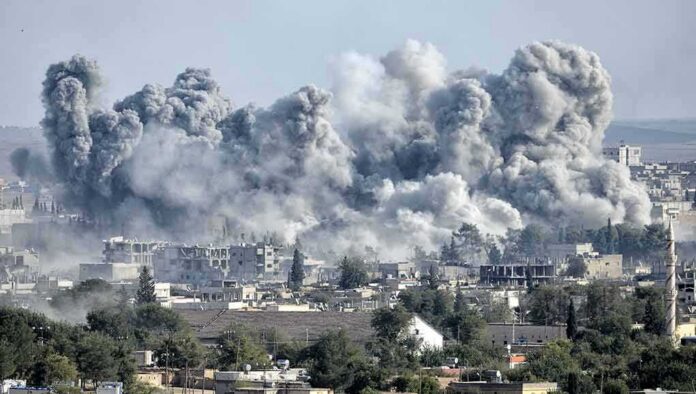
Israel acknowledged striking Gaza’s Bureij camp after issuing evacuation orders, saying it targeted Hamas weapons and command sites.
Story Snapshot
- Israeli military confirmed strikes in and around Bureij after evacuation warnings, citing Hamas targets.
- Multiple outlets reported deaths and injuries in residential areas of Bureij across several dates.
- Reports vary on casualty counts, but the strike pattern on Bureij is consistent over time.
- Airwars keeps incident records, showing ongoing civilian-harm tracking amid the conflict.
Confirmed Strikes And The Stated Target In Bureij
The Israeli military said it hit targets in Bureij after issuing evacuation orders, and described the sites as Hamas weapons storage and a launch position in central and northern Gaza. That public acknowledgment places the strike on the record and ties it to a stated military goal of stopping attacks planned from dense urban areas. The same posture continued into 2025, when the spokesperson said a Hamas command-and-control compound near Bureij was struck based on specific intelligence.
Israeli officials framed the operations as aimed at Hamas infrastructure embedded in civilian zones. That claim matches a broader campaign narrative that militants use homes, mosques, and aid sites as cover, which increases risk to civilians and responders. The Israeli military also urged civilians in Bureij to evacuate during separate operations, warning of new strikes. These warnings underscore an intent to clear civilians but also show the reality of repeated combat in the same district.
Documented Impacts On Residential Areas
Local and regional outlets reported that strikes hit residential structures in the Bureij camp across several dates. Reports from June and November 2024 and April 2025 described homes destroyed, with deaths and injuries among families. One outlet said Israeli warplanes bombed a house, killing four and wounding others. Another account said a home belonging to the Aqel family was hit, with more damage reported nearby. These accounts place civilians in the blast zone repeatedly.
Later reporting kept the same pattern. Stories from central Gaza cited more deaths in Bureij and nearby camps during air operations. Some reports linked the timing to earlier evacuation calls from the Israeli side, reflecting a predictable cycle: warnings, strikes, and then efforts to dig people from rubble. While not every incident drew an immediate comment from Israeli officials, the strike tempo around Bureij stayed part of the public record through 2024 and 2025.
Pattern Over Time And What We Can Say With Confidence
Across many months, three facts stand firm. First, Israel carried out repeated strikes in and around Bureij and sometimes issued warnings before doing so. Second, Israel said the targets were Hamas weapons and command sites used to plan and launch attacks. Third, multiple outlets documented deaths and injuries in residential areas tied to those strikes. Together, these facts show a sustained fight against Hamas in a crowded camp, with civilians at risk during each phase.
🔴🇵🇸 “The children kept crying, ‘Mama, what about our clothes? Our things?’ I told them, ‘We don’t want them. We just need to escape with our lives.’”
Israeli forces issued at least five displacement orders across Gaza on Tuesday morning, in Bureij and Nuseirat refugee camps in… pic.twitter.com/58T7DhzuFQ
— Drop Site (@DropSiteNews) September 8, 2026
Casualty counts differ across outlets and dates, which often happens in war reporting. But the existence of strikes, the presence of civilian harm, and Israel’s stated rationale remain well established in the record. Civilian-harm monitors, including Airwars, maintain incident logs that track the conflict’s scale and effects. That reinforces the need for clear corridors for civilians, steady pressure on Hamas leadership, and accountability for how combat unfolds in tight urban spaces like Bureij.
Sources:
youtube.com, bbc.com, english.news.cn, standard.co.uk, aa.com.tr, english.wafa.ps