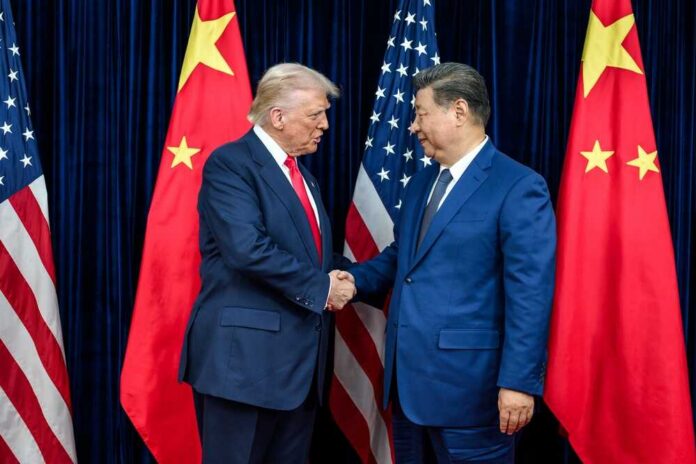
President Trump promises a “long talk” with China’s Xi Jinping about the Iran war while simultaneously insisting America doesn’t need Beijing’s help to win—a diplomatic dance that highlights the tangled web of trade negotiations, military conflict, and global power politics that defines Washington’s relationship with both adversaries and supposed partners.
Story Snapshot
- Trump departed for China to meet Xi Jinping, prioritizing trade deals while planning Iran war discussions as a secondary agenda item
- President praised Xi as “relatively good” on respecting the U.S. naval blockade of Iranian ports despite China’s historic oil dependence on Tehran
- Trump declared the U.S. will win the Iran conflict “peacefully or otherwise” without Chinese intervention, even as Beijing labels the war “illegitimate”
- Analysts skeptical China will pressure Iran, noting Beijing benefits strategically from America’s Middle East distraction and maintains a $400 billion partnership with Tehran
Mixed Messages on Iran Cooperation
President Trump told reporters aboard Marine One before departing for China that he and President Xi would engage in a “long talk” about the ongoing Iran war during their summit. This acknowledgment came with contradictory assurances that the United States does not require Chinese assistance to achieve victory. Trump characterized Xi as “relatively good” regarding compliance with the U.S. blockade of Iranian ports, noting China’s oil imports from the region face “no problem” under current arrangements. This rhetorical balancing act reflects the complexity of seeking cooperation from a nation that maintains substantial economic ties with America’s adversary.
Trade Takes Priority Over Security Concerns
The summit’s primary focus remains economic rather than military, with trade negotiations dominating the agenda despite the active conflict with Iran. U.S. business executives accompanied Trump on the journey, signaling expectations for potential breakthroughs on tariff reductions and market access agreements that have been contentious since 2018. Trump emphasized positive economic indicators, suggesting oil prices and broader market conditions remain favorable despite regional instability. This prioritization reveals the administration’s calculation that economic wins matter more to domestic constituencies than securing Chinese pressure on Iran, particularly when Trump projects confidence about winning militarily regardless of Beijing’s stance.
China’s Strategic Ambivalence
Beijing’s position on the Iran conflict exposes the limitations of expecting genuine cooperation from a strategic competitor. China has publicly labeled the U.S. military action against Iran as “illegitimate” while maintaining its role as Tehran’s largest trading partner through approximately $400 billion in Belt and Road investments since 2013. Analysts observe that China benefits from America’s Middle East entanglement, which diverts U.S. attention and resources from the Asia-Pacific region where the two powers compete for influence. The minimal compliance China offers on the blockade appears calculated to avoid secondary sanctions rather than genuine support for U.S. objectives, underscoring the transactional nature of great power relationships.
The Ceasefire That Wasn’t
Trump’s departure for China followed his Monday assessment that a potential Iran ceasefire remained “on life support,” suggesting diplomatic efforts have stalled while military operations continue. The president boasted that Iran’s navy and air force are “gone,” emphasizing U.S. military dominance in the Gulf region through naval superiority and air power. This confident posture raises questions about why Iran discussions merit summit time if victory seems assured without Chinese involvement. The apparent contradiction may serve domestic political messaging—projecting strength to supporters while maintaining diplomatic optionality with Beijing. For Americans frustrated with endless Middle East conflicts, the promise of victory “peacefully or otherwise” offers reassurance even as the war’s actual trajectory remains uncertain.
The summit encapsulates the frustrations many Americans feel about government priorities and elite decision-making. While ordinary citizens struggle with inflation resulting from years of fiscal mismanagement and trade disruptions, political leaders pursue complex diplomatic gambits that mix economic self-interest with military adventurism. The spectacle of courting cooperation from a nation that simultaneously arms and finances our adversaries highlights the contradictions inherent in globalized power politics, where yesterday’s trade partner becomes today’s strategic competitor while remaining tomorrow’s necessary negotiating counterpart. Whether Trump’s personal rapport with Xi yields tangible results on either trade or Iran, the American people remain skeptical that Washington’s elite truly prioritize their prosperity and security over preserving the international arrangements that benefit multinational corporations and foreign governments.