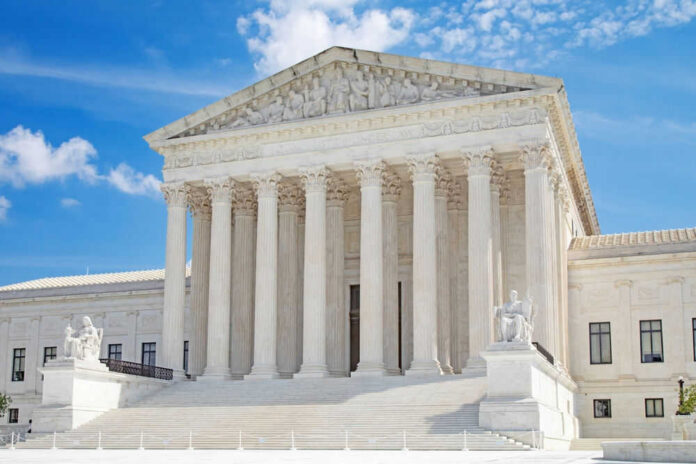
The Supreme Court just told Alabama it can ditch a court-drawn “equity” map and go back to districts chosen by its own elected lawmakers, and the left is furious.
Story Snapshot
- The Supreme Court allowed Alabama to use its 2023 Republican-drawn congressional map for the 2026 elections, blocking a lower court’s attempt to force a different plan.[1]
- A three-judge federal panel had called that 2023 map intentionally discriminatory against Black voters and ordered the state to keep using a court-imposed map with two Black-opportunity districts.[1][4]
- The Supreme Court criticized the lower court for inserting itself into Alabama’s election process and said convenience was not a valid reason to override the legislature’s map.[1]
- Civil rights groups and progressive media are blasting the ruling as a “racial gerrymander,” while Alabama argues the map is lawful and respects state control of redistricting.[1][2][4]
Supreme Court Reins In Lower Court’s Election Interference
The United States Supreme Court’s unsigned emergency order cleared the way for Alabama to use its 2023 congressional map in the upcoming 2026 elections, pausing a lower court ruling that had blocked the plan.[1] The high court agreed to freeze the district court’s decision and criticized the three-judge panel for “interpos[ing] itself into Alabama’s ongoing efforts to conduct its imminent 2026 congressional elections under maps that its elected representatives selected.”[1] Justices stressed that mere administrative convenience for officials is not a valid justification for overriding the map enacted by the state’s legislature.[1]
The Supreme Court also signaled that Alabama is likely to succeed on its argument that the 2023 map is lawful, which helped justify allowing the state to use it while the case continues.[1] Alabama Republican officials had turned to the Court after the district court again labeled the map unlawful, insisting it was “lawful then, and it is lawful now.”[1] For many conservatives, this was a welcome reminder that federal judges are not supposed to micromanage state elections every time activists demand a different partisan outcome, especially on the eve of voting.[1][2]
Competing Maps: One Court-Drawn, One Legislature-Drawn
The dispute centers on two competing maps: a court-selected plan used in 2024 that created two districts where Black voters could elect their preferred candidates, and the 2023 legislature-enacted plan that includes just one majority-Black district out of seven.[1][2] Under the court-drawn map, Alabama’s delegation was split five Republicans and two Democrats, but under the 2023 plan, analysts expect a six-to-one Republican advantage after the district currently held by Democrat Shomari Figures is reconfigured.[1] Civil rights groups describe the shift as diluting Black voting strength, while the state says its mapmakers focused on helping Republicans and keeping the Gulf Coast region together, traditional political and geographic goals.[1][2]
A three-judge federal court has already found, after a full trial, that Alabama’s 2023 map was enacted with racially discriminatory intent and violated both the Voting Rights Act and the Constitution.[2][4] That panel’s ruling, and a similar earlier finding in 2023, prompted the court to impose its own “remedial” map that boosted Black opportunities at the ballot box.[1][2] The Supreme Court did not erase those trial findings in its emergency order, but it did block the lower court from forcing its preferred map onto Alabama voters right before another federal election.[1][4] This leaves the legal merits for another day while restoring—at least temporarily—control to the elected legislature.
Progressive Outrage Meets Conservative Concerns About Judicial Overreach
Voting-rights organizations such as the American Civil Liberties Union and the NAACP Legal Defense Fund blasted the Supreme Court’s ruling, calling the 2023 plan a “racial gerrymander” and accusing the justices of enabling intentional discrimination against Black voters.[2][4] Their statements emphasize that multiple federal judges have already found intentional discrimination and that the new map shrinks Black representation from two effective districts back to one.[2][4] Commentators on the left are framing the decision as the Court “greenlighting discrimination” and “weakening” the Voting Rights Act, using charged language to suggest that Republican gains are inherently illegitimate.[2]
Since the cowardly Mr McBride is not allowing his states citizenry to reply to his lies, I have to quote them to respond.
The Supreme Court’s unsigned order on June 2, 2026, stayed a lower court injunction and allowed Alabama to use its 2023 legislatively enacted congressional… https://t.co/0rm0IZ52Rv
— CPUGuru (@cpuguru) June 3, 2026
Conservatives see a different story: federal courts once again tried to override state sovereignty by substituting a court-crafted map for the one chosen by accountable lawmakers, and the Supreme Court stepped in to stop it.[1][3] The justices’ criticism of the lower court for prioritizing administrative ease over deference to elected representatives fits a broader pattern of pushing back on last-minute judicial rewrites of election rules.[1][3] While the trial court’s discrimination finding still hangs over the case and will be litigated further, the current order limits unelected judges from endlessly redrawing maps whenever activists dislike the partisan balance.[1][2][4] For readers worried about government overreach, the ruling is an important reminder that the Constitution leaves redistricting primarily in state hands, not in the hands of ideological lawyers and federal panels.
The U.S. Supreme Court allowed Alabama to use a 2023 congressional map favoring Republicans despite lower court findings of racial discrimination. https://t.co/XLw35Xjhgy
— Missouri Lawyers Media (@MoLawyersMedia) June 3, 2026
Sources:
[1] Web – THEY MAD: SCOTUS Rules Alabama Can Use Map Lower Court Judge Called …
[2] Web – Supreme Court lets Alabama use House map that favors GOP in …
[3] Web – Allen v. Milligan FAQ – Legal Defense Fund
[4] YouTube – Supreme Court reinstates Alabama congressional map