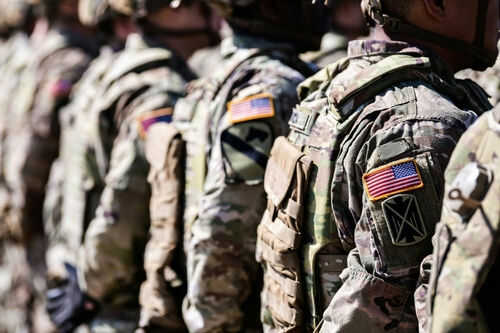
The Pentagon is betting that restoring armed self-defense on U.S. bases will make troops safer—while critics warn the Trump administration is moving fast without proving the threat is as severe as advertised.
Story Snapshot
- Defense Secretary Pete Hegseth issued a directive allowing off-duty service members to carry privately owned firearms on military installations, reversing longstanding restrictions.
- Installation commanders must now presume approval for carry requests, and any denial must be explained in writing on specific grounds.
- Hegseth framed the shift as a Second Amendment and force-protection measure tied to past active-shooter incidents at military facilities.
- The policy change landed alongside major Army leadership turbulence, including the abrupt retirement of Army Chief of Staff Gen. Randy George and an expected acting replacement aligned with Hegseth.
A new default: approve carry requests unless commanders can justify “no”
Pete Hegseth’s memorandum, described as “Non-Official Personal Protection Arming on Department of War Property,” directs base commanders to set up an approval process that starts from “yes,” not “no.” Commanders can still restrict carrying, but the burden shifts: denials require a written explanation citing specific reasons. The policy focuses on off-duty personnel carrying privately owned firearms for personal protection, with implementation tied to applicable state law requirements.
For conservative readers who have watched “gun-free zone” logic fail in schools, malls, and city streets, the Pentagon’s new posture is familiar: stop assuming a sign and a policy keep predators out. Hegseth’s argument is straightforward—service members already meet rigorous weapons standards, so denying them defensive carry on base leaves them vulnerable during the moments when military police cannot be everywhere at once.
What changed from the old system—and why it mattered to families
Previous Defense Department practice generally barred most personnel from carrying personal firearms on base without explicit command permission, and it often required weapons to be stored and checked in and out for limited purposes such as hunting or range use. That structure meant many law-abiding service members—despite their training—were effectively disarmed during day-to-day life on installations, including while commuting, shopping at on-base facilities, or spending time with family in housing areas.
Hegseth tied the policy rationale to the reality that threats can emerge inside secure perimeters, citing incidents at Fort Stewart, Holloman Air Force Base, and Pensacola Naval Air Station. The administration’s message is that “minutes are a lifetime” when violence breaks out, and that distributed defensive capability could reduce casualties before first responders arrive. The directive’s supporters see that as consistent with the core American principle of self-defense.
Critics dispute the “gun-free zone” framing and demand clearer proof
Not everyone in the Pentagon agrees with the administration’s description of the problem. One critical view quoted in reporting argues installations are already heavily guarded and not truly “gun-free,” given armed military police and weapon access in designated contexts. That critique raises a legitimate policy question: if the government is going to widen armed carry across daily base life, the public should be able to review clear, recent data about violent crime patterns on installations and how this specific change reduces risk.
From a constitutional perspective, Hegseth’s framing leans on the claim that service members deserve the same constitutional protections as civilians—especially when they are off-duty and acting in a personal capacity. From an operational perspective, the policy creates tradeoffs commanders must manage: a more armed population could deter attacks, but it also increases the stakes for training standards, storage rules, deconfliction during emergencies, and preventing negligent discharges or misidentification during a fast-moving response.
The leadership shakeup: policy rollout meets Pentagon power politics
The firearms policy arrived amid a broader Trump-era push to reshape Pentagon priorities and leadership. Reporting shows Gen. Randy George was asked to retire almost immediately after the policy’s rollout, and Gen. Christopher LaNeve—described as a former Hegseth aide—was expected to step in as acting Army chief. A senior Pentagon official characterized the leadership changes as seeking alignment with President Trump and Hegseth’s vision for the Army.
For voters already wary of “woke” bureaucracy and top-down social engineering, the administration’s posture signals a clear ideological pivot: empower the rank-and-file, elevate “lethality,” and unwind policies the team views as undermining readiness. Still, personnel upheaval also raises an accountability concern conservatives typically share: when leadership is changed quickly to ensure compliance, Congress and the public should insist the rollout is lawful, measurable, and transparent—especially on something as consequential as firearms on federal property.
Bottom line for constitutional conservatives: rights restored, but execution will decide outcomes
On its face, the directive is a major win for Second Amendment advocates who argue trained adults should not be forced into helplessness by blanket rules. The presumption-of-approval model also limits arbitrary decision-making by requiring commanders to justify denials in writing. The open question is whether the Department of War can implement this consistently across installations—balancing self-defense, base safety, and clear rules—without creating new liabilities or confusion during crises.
Gun-free zones on bases only turn our service members into soft targets.
This is a fantastic new policy 🇺🇸 https://t.co/4s1mnBqQxB
— Brandon Herrera (@TheAKGuy) April 2, 2026
The administration has offered a security-driven justification and cited prior attacks, but critics say more documentation is needed to prove bases face a broad, current threat requiring such a sweeping reversal. In 2026, many MAGA voters are exhausted by elite failures—whether overseas entanglements or domestic mismanagement—and they are increasingly demanding one thing from Washington: protect Americans, respect the Constitution, and deliver competent execution. This policy will be judged on those basics.
Sources:
US ends gun-free zones on US bases invoking Second Amendment
Hegseth says he will allow troops to take personal firearms onto military bases
Hegseth authorizes off-duty service members to carry private firearms on installations
Trump Defense Department, Iran, Hegseth, civilian casualties
Remarks by Secretary of War Pete Hegseth on the Arsenal of Freedom (as delivered)