A hypersonic claim, fireball footage, and shifting casualty counts turned one Kyiv night into a stress test of truth in wartime.
Story Snapshot
- Large overnight strike on Kyiv featured a claimed hypersonic ballistic missile amid drones and other missiles [2][3]
- Residential buildings, schools, offices, a shopping center, and a health facility reported damaged [1][2][5]
- Fatalities and dozens injured reported by Kyiv officials, with figures varying across outlets [2][3]
- Weapon identification remains disputed and linguistically inconsistent across reports [1][2][3][5]
What happened in Kyiv and why the label “hypersonic” matters
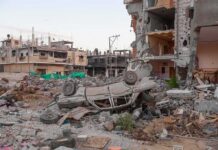
Ukraine’s capital endured one of the heaviest overnight barrages in recent months, with flaming debris, explosions, and fires across multiple districts. Broadcast summaries and city officials reported hits on residential buildings, schools, offices, a shopping center, and a health facility, which aligns with visible aftermath and emergency responses [1][2][5]. The strike’s headline hook came from claims that Russia included a rare hypersonic ballistic missile—branded “Oreshnik” by several outlets—within the larger package, injecting fear, prestige, and political messaging into an already lethal operation [2][3].
Hypersonic branding does two jobs at once: it signals technological superiority and suggests defenses may be futile. Kyiv’s claims and multiple outlet narrations emphasized a high-speed, medium-range ballistic profile, describing a system advanced enough to challenge interception windows and command decisions under pressure [2][3]. The footage of incandescent streaks and subsequent fireballs reinforced that narrative, even as technical confirmation lagged. As American conservatives would expect, deterrence and clarity matter; labeling must be anchored in verifiable evidence, not just spectacle or political utility [1][3].
Evidence that supports the hypersonic claim—and what falls short
Several reports assert Russia used a hypersonic ballistic missile and say Russians “admitted” the weapon’s role in a mass strike, tying the claim to public statements carried in broadcast segments [2]. Multiple outlets repeat “Oreshnik” or close variants, describe rare use, and connect the strike to visible urban damage [1][2][3][5]. Kyiv’s mayor cited casualties and listed struck sites, corroborating the citywide impact narrative [2][3]. These elements collectively support the picture of a large, mixed salvo with a high-end ballistic component that intensified both damage and public alarm [1][2][3].
The proof gap starts with Moscow’s silence on specifics. One transcript highlights that Russia’s Defense Ministry did not officially confirm targets or the weapon type, leaving the hypersonic label reliant on intermediaries rather than a formal communique [3]. Terminology varies—“Oreshnik,” “Oriishnik,” “Orionic,” or generic “hypersonic ballistic missile”—complicating precise identification and suggesting either transliteration noise or conflation with other systems [1][2][3][5]. Without debris-chain custody, radar telemetry, or serial-number analysis, the claim remains plausible but not forensically locked [3].
Damage, casualties, and the fog-of-war numbers problem
Reports concur that the barrage caused fires, smoke plumes, and significant civilian-area damage across Kyiv [1][3]. Officials cited fatalities and multiple injuries, with tallies varying across sources—from at least one dead and around twenty wounded to several killed and two dozen injured—reflecting a familiar early-hours uncertainty window [2][3]. Claims include debris blocking shelter entrances at a school and a business center, which amplifies the civilian impact narrative and underscores how urban critical functions can be paralyzed by even near-misses in a dense city grid [3].
🚨 Devastating attack in #Ukraine: #Russia missile strike leaves 4 dead, dozens injured. #Kyiv and other regions hit hard by #Oreshnik hypersonic missiles. Emergency services in action, as tensions escalate. #PrayForUkraine #UkraineUnderAttack pic.twitter.com/wnEEiHbkA2
— SINS (@sins_news) May 24, 2026
From an American conservative lens, two metrics should guide judgment while evidence matures: accountability for civilian harm and transparency about weapon types. The former rests on verifiable site assessments and emergency-service logs; the latter depends on traceable fragments and sensor data. If Russia used a true hypersonic ballistic system, that escalates both risk and cost assumptions for defenders. If media mislabeled a different system, that erodes trust and hands propaganda wins to both sides for opposite reasons [2][3][5].
How to move from narrative clash to technical clarity
Three steps would turn speculation into adjudicable fact. First, air-defense radar tracks and interceptor logs could map velocities and trajectories consistent with a hypersonic ballistic profile, differentiating it from cruise missiles or standard ballistic systems [3]. Second, debris with identifiable propulsion and guidance components could anchor an attribution through serial numbers and metallurgical matches. Third, synchronized geolocation of impact sites, timelines, and municipal records would solidify the battle-damage picture without reliance on sensational clips [1][2][3][5].
Sources:
[1] YouTube – Russian Overnight Attack Engulfs Kyiv Sky With Fire And …
[2] YouTube – Russia hits Ukraine with rarely-used Oreshnik missile in …
[3] YouTube – On Cam:Biblical Fireball In Kyiv After Russia’s Oreshnik …
[5] YouTube – Fires burn in Kyiv after Russia uses hypersonic missile in …