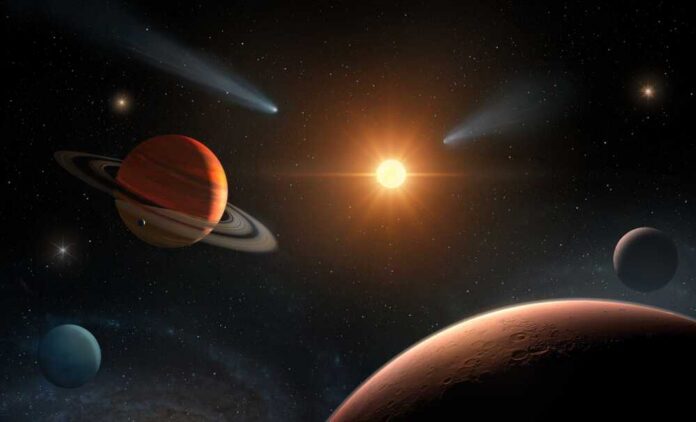
Einstein’s enduring theory of general relativity now stands accused of dooming Tatooine-like worlds to cosmic oblivion, challenging romantic visions of stable double-sun planets that capture conservative imaginations of orderly creation.
Story Highlights
- UC Berkeley study reveals Einstein’s relativity explains the extreme rarity of circumbinary planets around tight binary stars, resolving a long-standing astronomical puzzle.
- Kepler and TESS missions detected only 14 such planets out of over 6,000 exoplanets, far fewer than models predicted for close-orbiting binaries.
- Relativistic precession combines with stellar tides to destabilize planetary orbits, ejecting or destroying 80% of close-in worlds over millions of years.
- This discovery refines exoplanet searches and habitability models, emphasizing the harsh realities of cosmic dynamics over science fiction ideals.
The Circumbinary Planet Desert
Kepler and TESS missions, launched in the 2010s, surveyed thousands of stars and confirmed over 6,000 exoplanets. Yet they identified just 14 circumbinary planets orbiting two close suns, mostly around wider binaries with periods over 7 days. Tight binaries, comprising about 10% of systems, showed none. Astronomers dubbed this gap the “circumbinary planet desert.” Data revealed no close-in survivors, prompting questions about formation or survival rates in these dynamic environments.
Relativity and Tides Unleash Instability
UC Berkeley postdoc Mohammad Farhat led a 2025 study published in The Astrophysical Journal Letters. Simulations incorporated general relativity’s orbital precession, overlooked in prior Newtonian models. This precession aligns with stellar tidal forces in tight binaries, creating destructive resonances. Planetary orbits stretch into unstable ovals. Farhat explained: planets either collide with stars or get ejected into space. Models predict 8 out of 10 such planets lost over cosmic timescales.
Historical Oversight Meets Modern Data
Binary stars make up half of all stellar systems, yet circumbinary detections lagged until Kepler’s 2012 confirmation. General relativity, proven in 1919 via Mercury’s orbit, had been ignored in exoplanet simulations. Tidal evolution gradually shrinks binary orbits, worsening precession mismatches. Distant planets in wider orbits survive but rarely transit stars from Earth’s view, evading detection. This explains observations without assuming failed formation.
Implications for Astronomy and Beyond
The research refines predictions for ongoing surveys like JWST and TESS, focusing efforts on wider orbits. It alters habitability models: tight binary systems rarely retain close-in, potentially life-friendly worlds over billions of years. Astronomers update databases like NASA’s Exoplanet Archive. Culturally, it tempers expectations of ubiquitous Tatooine worlds, highlighting nature’s unforgiving order. No direct economic impacts emerge, though it optimizes telescope funding.
Why two-sun planets keep disappearing scientists blame Einstein
Astronomers have long been puzzled by a cosmic mystery: planets orbiting two stars—like Star Wars’ Tatooine—are surprisingly rare, even though they should be common. New research suggests the culprit is none other…
— The Something Guy 🇿🇦 (@thesomethingguy) April 19, 2026
Expert Consensus and Future Tests
Farhat noted the data offers a “skewed snapshot” hiding true formation rates, as relativity dooms close-in planets. Peer-reviewed models align across sources, with no contradictions. Uncertainties remain in exact loss fractions and unconfirmed distant survivors. Upcoming observations may validate predictions. This advance builds on relativity’s legacy, from Mercury to exoplanets, underscoring timeless physical laws governing the universe’s stability.
Sources:
Planets with Two Suns Are Almost Impossible to Find. General Relativity May Be Why.
Where Are the Planets With Two Suns? Einstein May Have the Answer
Einstein’s relativity could rewrite a major rule about what types of planets are habitable