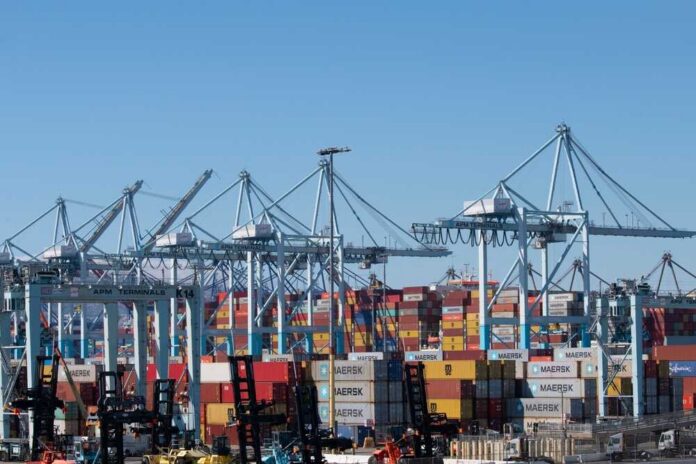
Viral claims that “not a single ship is getting through” collide with a very real, very visible maritime choke point: dozens of container ships stuck off Southern California with week-plus waits.
Story Snapshot
- U.S. Coast Guard video and port tracking show persistent congestion at Los Angeles–Long Beach, with roughly 30 container ships anchored on many days.
- Recent counts cited in reporting showed 25 ships at berth and 32 at anchor, with average waits around eight days and some vessels waiting 11–12 days.
- Evidence in the reporting points to landside bottlenecks—warehousing, trucking, and inland logistics—more than a lack of ships or cargo demand.
- Extended anchoring increases costs, triggers canceled sailings, and worsens air quality as ships idle offshore.
What the “Not a Single Ship” Line Gets Wrong—and What It Gets Right
Social media posts framing maritime disruption as total stoppage can be emotionally satisfying, but the available reporting in this case describes something more specific: an overloaded port complex with ships waiting offshore, not a complete shutdown of the sea. The Coast Guard footage and port data cited in industry coverage depict a backlog that has become routine, with average waits measured in days rather than hours.
BREAKING: Not a single ship is getting through.
CENTCOM announces that in the first 48 hours of the U.S. blockade on Iranian ports, ZERO vessels have made it past American forces – and 9 have already turned around after being directed back. pic.twitter.com/ti7Z57hofJ
— Fox News (@FoxNews) April 15, 2026
That distinction matters for Americans trying to interpret what they see online. “Not a single ship is getting through” suggests a blockade-style halt; the Port of Los Angeles and Port of Long Beach story is instead about throughput constraints after ships arrive. The frustration, however, is understandable: whether a ship is stopped at a chokepoint or stuck offshore awaiting a berth, the practical effect for stores, manufacturers, and families can still be delays and higher prices.
What the Coast Guard Video and Port Data Show Off San Pedro Bay
Reporting on the Southern California port complex described a “vast armada” of container vessels anchored in San Pedro Bay, with little sign of a lasting decline in backups. One snapshot described 57 total ships in the system, including 25 at berth and 32 at anchor, while average anchor time rose to about eight days—up from roughly 6.9 days earlier in the week. Individual ships were cited waiting 11–12 days.
Those numbers reflect a major change from pre-pandemic norms, when offshore anchoring was far less common. The reporting also placed the current congestion above the scale seen during the 2014–2015 ILWU labor dispute, an important benchmark for shippers who assumed that level of disruption was the worst-case scenario. Instead, industry observers quoted in coverage described a “new normal” of around 30 container ships at anchor, even without a single, decisive trigger event.
Landside Bottlenecks: The Hidden Failure Behind the Offshore Traffic Jam
The most consequential detail in the reporting is the cause: landside constraints. Port congestion is often blamed on too many ships, but the coverage emphasized warehouse shortages, trucking constraints, and inland transport delays that slow container pickup and yard turnover. When boxes can’t leave the terminal quickly, terminals fill up; when terminals fill up, ships can’t unload; and when ships can’t unload, they wait offshore—sometimes as long as the ocean crossing itself.
That chain reaction is also why carriers reportedly canceled sailings even as cargo demand stayed strong. If ships sit at anchor for days, the fleet effectively shrinks, disrupting schedules and reducing available capacity elsewhere. For a public that’s heard years of promises about “resilience” and “modernization,” this is a reminder that real-world capacity still depends on basic competence: space, labor, equipment, and a predictable flow from dock to warehouse to rail and road.
Economic Pressure and Air-Quality Costs Hit Working Communities First
Extended queues offshore are not just an abstract “supply chain” story. The reporting linked idling vessels to dirtier air in Southern California, as ships run auxiliary engines while waiting. Communities near the ports—often working-class and already burdened by industrial pollution—absorb much of the downside. Meanwhile, businesses face delay-related costs that tend to show up downstream as higher prices or fewer choices for consumers, especially when schedules become unreliable.
Politically, the moment lands in an era when voters across the spectrum are skeptical that government can execute core tasks. Conservatives often point to overregulation and mismanagement; liberals often focus on corporate practices and environmental harm. The available facts don’t resolve every argument, but they do underline a shared reality: when basic infrastructure and logistics don’t function smoothly, ordinary Americans pay in time, money, and health—while public institutions argue over who’s to blame.
What to Watch Next: Throughput, Transparency, and Whether “Normal” Becomes Permanent
Port tracking tools and daily ship counts will tell the story in the weeks ahead, especially whether average anchor times trend down meaningfully or remain stuck around a week or more. Executives cited in coverage expected disruptions to persist well into the future, suggesting this is not a short-lived surge. If that forecast holds, the policy focus will inevitably shift toward the unglamorous fixes: storage capacity, drayage and rail coordination, and faster container evacuation.
For readers trying to cut through online noise, the best approach is to separate dramatic slogans from verifiable bottlenecks. The evidence cited in mainstream shipping and environmental reporting supports a serious, ongoing jam at America’s busiest container gateway—not a total maritime stoppage. Yet the public anger behind those slogans is real: when systems break in plain sight, confidence in leadership—federal, state, and local—breaks right along with them.
Sources:
New video shows massive scope of California box-ship traffic jam
Cargo ship congestion is bringing more dirty air to Southern California
The supply chain is in trouble again: Attacks on cargo ships are causing delays