
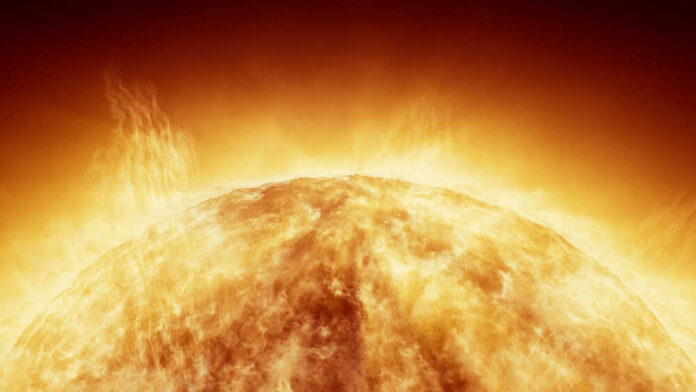
NASA’s groundbreaking maps of the Sun’s spiky outer boundary promise to shield America’s power grids and satellites from devastating solar storms.
Story Highlights
- Scientists produced the first detailed maps of the Alfvén critical surface using NASA’s Parker Solar Probe data, revealing a pufferfish-like structure that expands during solar maximum.
- These maps enable precise predictions of solar storms that threaten U.S. infrastructure, from power grids to GPS systems vital for national security.
- Direct measurements confirm long-held models, linking the Sun’s 11-year cycle to boundary changes amid Solar Cycle 25’s peak in 2025.
- Breakthrough protects astronauts, aviation, and telecommunications, aligning with conservative priorities for resilient American infrastructure.
Parker Probe’s Historic Crossings
NASA launched the Parker Solar Probe in 2018 to probe the Sun’s corona. The spacecraft first crossed the Alfvén surface in 2021 at about 13 million kilometers from the Sun’s surface. Between 2021 and 2024, it completed 16 crossings, with the closest approach at 6.1 million kilometers in December 2024. This data, combined with remote observations, yielded the first verified 2D maps published December 11, 2025, in Astrophysical Journal Letters. Lead author Sam Badman at Harvard-Smithsonian CfA drove the analysis, validating decades-old theories with in-situ evidence.
Alfvén Surface: Sun’s Point of No Return
The Alfvén critical surface, named for physicist Hannes Alfvén, marks where solar magnetic fields lose control over plasma, birthing the solar wind. Previously estimated from distant spacecraft like those at Earth’s 1 AU, the boundary’s true form eluded direct view due to extreme proximity. Parker Probe measurements reveal corrugated, spiky structures resembling a pufferfish. During solar maximum in Cycle 25, around 2025, the surface expands and disorders, accelerating plasma escape. This dynamic ties to sunspot peaks and flare activity, explaining solar wind origins and corona heating puzzles.
Watch: https://www.youtube.com/watch?v=FxOM-1Oh_p8
Protecting American Infrastructure from Solar Storms
Solar storms from coronal mass ejections disrupt satellites, GPS, power grids, and aviation communications, as seen in the 1859 Carrington Event that fried telegraphs. New maps refine space weather forecasts by tracking boundary shifts, safeguarding U.S. assets. Satellite operators, power companies, and airlines benefit directly, reducing blackout risks worth billions. Astronaut health faces radiation threats; enhanced predictions support NASA’s Artemis program under President Trump. Heliophysicists note this unlocks corona mysteries, bolstering grid resilience amid renewable energy pushes without government overreach.
Badman stated the spiky shape grows larger during maximum, confirming predictions and enabling navigation of solar influences. SWEAP instruments measured plasma density, speed, and temperature for precise mapping.
Long-Term Wins for Science and Security
Parker continues orbits into solar maximum decline, with plans to monitor through minimum around 2030 for full-cycle insights. Collaborations with ESA’s Solar Orbiter and NASA’s Wind spacecraft enrich global data. Long-term, maps template exoplanet habitability studies, revealing how close-orbit worlds endure stellar winds. For America, refined models counter storm damages, echoing Trump’s deregulation that slashed compliance costs and boosted energy independence. This pure scientific advance fortifies defenses without wasteful spending, prioritizing taxpayer value and national strength.
Sources:
First maps of the sun’s outer boundary may help predict solar storms
First Map of the Sun’s Outer Edge Demystifies the Escape Route of Solar Wind
Astronomers Create First Map of Sun’s Outer Boundary
Scientists Map the Sun’s Magnetic Surface