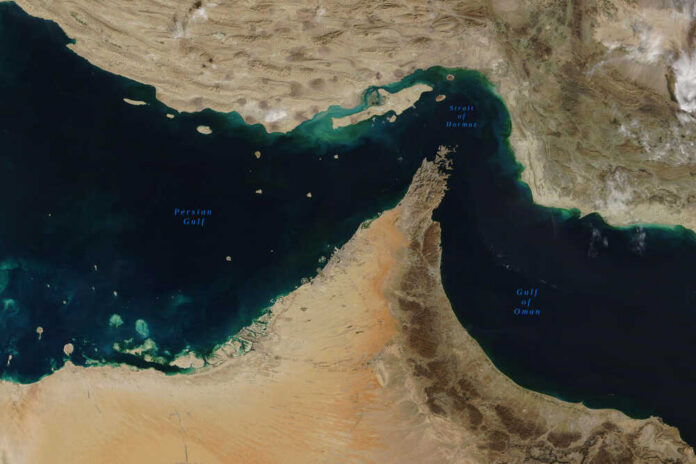
Iran’s blockade of the Strait of Hormuz is forcing the world to relearn an old lesson: when sea lanes close, ordinary families pay the price at the pump—and Washington’s room to maneuver shrinks fast.
Story Snapshot
- The Strait of Hormuz has been blocked since Feb. 28, disrupting a major share of global oil and petrochemical flows and pushing Brent crude above $100 per barrel.
- The Trump administration has paired diplomacy with force, extending a ceasefire while also issuing a “shoot-and-kill” order tied to naval enforcement after ship seizures.
- Markets are reacting in real time: Brent recently closed around $106 while WTI traded notably lower, reflecting a widening U.S.-to-global energy spread.
- Reports circulating about a “$24B Iraq trade corridor” highlight how quickly trade reroutes during crises, but specific, independently verified details on that dollar figure remain limited in the available research.
Hormuz Blockade Turns a Regional Fight Into a Global Energy Shock
Shipping disruption in the Strait of Hormuz has escalated from a geopolitical headline into a direct economic stressor. The available research indicates the strait has been blocked since Feb. 28, cutting off roughly 21 million barrels per day of oil flow and interrupting non-oil exports such as petrochemicals and metals. Brent crude, which sat near the low $70s before the crisis, has surged above $100—levels that typically ripple into freight, manufacturing, and household budgets.
For Americans, this matters even when U.S. production remains comparatively strong. A higher global benchmark tends to lift refined-product costs, and it can also pressure interest-rate expectations as inflation readings move. The research cites a CPI nowcast rising to about 3.7% and survey-based inflation expectations around 4.7%, which—if sustained—complicates any effort to ease monetary policy and can keep borrowing costs elevated for mortgages, autos, and small business credit.
Trump’s Two-Track Response: Deterrence at Sea, Talks via Pakistan
U.S. policy has combined escalation control with deterrence. The research describes an “indefinite ceasefire” extension alongside continued Iranian ship seizures, followed by a more aggressive posture that included a reported “shoot-and-kill” order affecting Navy rules of engagement. It also notes that U.S. envoys, including Steve Witkoff and Jared Kushner, were set to travel for Pakistan-mediated talks—an indication that the administration is seeking an off-ramp without conceding the principle of free navigation.
That combination reflects a reality conservatives and liberals often agree on, even if they describe it differently: global chokepoints expose how fragile modern supply chains can be, and how quickly elites’ policy mistakes land on working households. If a single waterway can spike prices worldwide, then energy policy at home—permitting, pipelines, refinery capacity, and strategic stockpile decisions—stops being an abstract partisan fight and becomes a kitchen-table issue.
Why the “$24B Iraq Corridor” Claim Needs Careful Handling
The headline idea that a Hormuz shutdown is “spurring” a $24 billion Iraq-centered trade corridor fits a broader historical pattern: when maritime routes become risky, commerce searches for land bridges and alternate ports. However, the research explicitly states there are no direct sources confirming a story with that exact premise, and that the $24B figure appears inferential rather than fully documented. Readers should treat the corridor price tag as a developing claim, not a settled fact.
What is supported is the underlying trend. The research points to disrupted Gulf shipping routes that normally handle a large share of global oil and petrochemicals, plus evidence of route fragmentation as exporters and shippers attempt workarounds. If alternative corridors through Iraq or neighboring states expand, the strategic center of gravity shifts toward whoever can secure roads, rails, and border crossings—often requiring government coordination, but also creating opportunities for rent-seeking and corruption in fragile states.
Market Signals Show the Costs—and the Political Stakes
Markets are offering a blunt scoreboard. The research cites Brent closing near $106.20 after a week of rapid moves tied to seizures, ceasefire announcements, and new U.S. directives. It also describes a widening gap between Brent and WTI, with U.S. crude trading lower—an outcome consistent with America’s relative insulation when inventories are ample, even as allies and trading partners face sharper price exposure. Energy equities reportedly gained, while broader economic sentiment weakened.
Hormuz crisis spurs $24B Iraq trade corridor as Gulf routes shift https://t.co/2XRMoaOKQp pic.twitter.com/Yl08Ce8VrM
— World News (@Worldnews_Media) April 27, 2026
Politically, the risk is that a prolonged blockade becomes an inflation accelerant just as voters demand relief from years of high prices and institutional failure. For conservatives, this episode reinforces why energy realism and secure supply lines matter more than symbolic climate targets. For liberals, it underscores how quickly global instability hits lower-income families first. Either way, the crisis tests whether Washington can act competently—or whether bureaucratic drift and factional obstruction keep turning preventable shocks into national stress.
Sources:
https://recessionalert.com/reflections-3/