A violent in-flight tirade forced an American Airlines jet to divert after crew and passengers restrained a man with duct tape.
Story Highlights
- An American Airlines flight from Dallas-Fort Worth to Newark diverted to Baltimore after a disruptive passenger’s outburst.
- Video and photos reportedly show the man duct-taped to his seat until landing.
- Airline staff framed the event as a safety issue, and law enforcement met the aircraft.
- Federal rules allow major fines and even prison time for interfering with crew.
Disruption Forces Diversion To Baltimore After Midair Meltdown
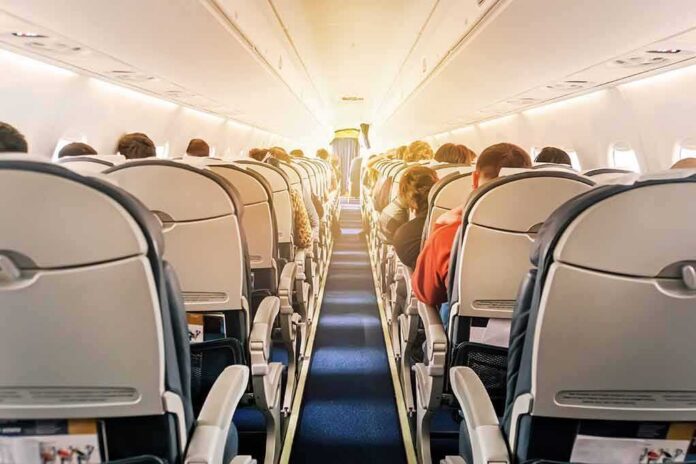
Witnesses and reports say an American Airlines flight from Dallas-Fort Worth to Newark diverted to Baltimore/Washington after a passenger erupted in a loud, abusive tirade. The man allegedly hurled racist and anti-gay slurs and refused to calm down, which escalated the situation for everyone on board. Flight crew treated the behavior as a safety issue and decided to land early. Law enforcement met the aircraft at the gate and assisted with deplaning the passenger after touchdown.
Images and a short video published by media show the passenger restrained with duct tape while seated. The tape bound his arms to prevent further disturbance until the plane could land. The airline later emphasized that the safety of customers and crew is the top priority and that violent or threatening behavior will not be tolerated on its aircraft. Reports indicate the passenger now faces charges tied to the incident, underscoring its seriousness.
Why Crews Restrain Passengers When Safety Is At Risk
Federal law makes it a crime to assault, threaten, or interfere with airline crew. The United States Department of Transportation warns that civil penalties can reach tens of thousands of dollars per violation. Criminal penalties can include fines and prison when crew interference occurs. These rules exist for a simple reason: at 35,000 feet, one person’s chaos endangers everyone on board. When disruption turns aggressive, the crew has legal authority to act to protect the flight.
Since the pandemic era, the Federal Aviation Administration (FAA) has enforced a “zero tolerance” posture toward unruly behavior. The FAA says it shifted away from warnings to strict enforcement, and that the rate of incidents dropped by nearly 60 percent from the peak after that policy and public outreach began. Even with that decline, the agency continues to announce new penalties and stresses that safety in the cabin is nonnegotiable for crews, families, and fellow travelers.
Pattern Of Viral Restraints, And How Airlines Handle Them
Viral “duct tape passenger” cases grab attention because they produce dramatic images. But they fit a broader pattern: rare, high-risk outbursts that force crews and even nearby passengers to restrain someone until the plane lands. Flight attendants train to use approved restraint tools in extreme cases. Some airlines have reminded crews to use designated devices, not household tape, but every incident is dynamic and safety-driven in the moment.
Past cases show that disturbing actions like trying to rush the aisle, lashing out at crew, or attempting to open a door trigger tough responses and stiff penalties. The FAA has highlighted record fines in similar unruly cases to deter copycats and keep order in the cabin. This latest diversion shows that the system still works when crews act fast, law enforcement meets the aircraft, and prosecutors consider charges that fit the facts reported by witnesses and the airline.
What This Means For Travelers And Public Safety
Most flights are calm, but when one person crosses the line, everyone pays. Families lose time to diversions. Crews face threats that no worker should have to face. Other passengers step in when needed, and they should not have to. The clear message here is simple and fair: obey crew instructions, keep your cool, and respect others, or face serious legal and financial consequences under federal law.
New images show an American Airlines passenger duct-taped to his seat and restrained with zip ties before the flight diverted to Baltimore.
The 67-year-old man was later arrested, and the FBI & FAA are investigating.
READ MORE: https://t.co/FGeR5Ky4yn pic.twitter.com/8DYqrFg3tp
— 7News DC (@7NewsDC) September 5, 2026
For conservatives who value law and order, this is common sense. A plane is not a playground for chaos or hate. It is a shared space where rules protect lives. When someone endangers that order, swift action by trained crew and strong follow-through by authorities keep the skies safe. That protects families, business travelers, and the freedom to move about our country without fear.
Sources:
the-independent.com, nypost.com, yahoo.com