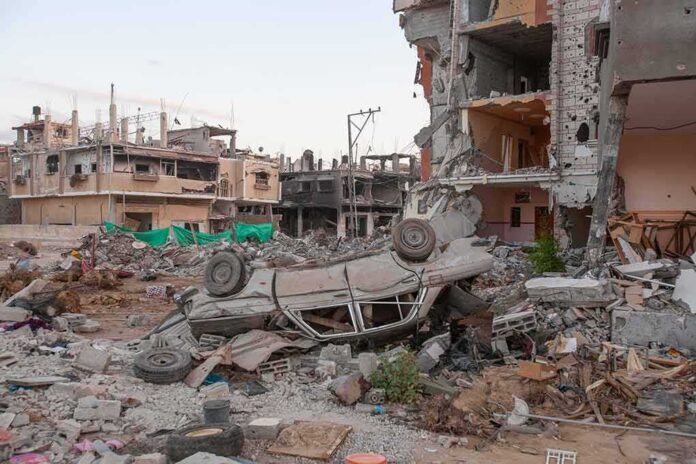
A United Nations fact-finding mission says there are reasonable grounds to believe a U.S. strike hit an Iranian girls’ school, killing scores of children.
Story Snapshot
- UN investigators link a U.S. strike to a deadly hit on a clearly marked school in Iran.
- Preliminary U.S. inquiry reportedly points to likely American responsibility, not intent.
- Casualty counts vary but point to massive child deaths, raising accountability demands.
- Pentagon has not released the full investigation, prolonging public uncertainty.
UN Mission’s Core Findings on the Minab School Strike
United Nations investigators reported “reasonable grounds to believe” U.S. forces were responsible for a strike on the Tree of Tayyiba Elementary School in Minab, Iran. The mission called the attack indiscriminate and identified the school as a clearly recognizable civilian site. The report did not present a final legal judgment but pressed for accountability. The United Nations update summarized the civilian toll and urged a complete U.S. review and disclosure of findings to the public.
International coverage underscored the mission’s cautious legal phrasing. Outlets detailed the “reasonable grounds” standard and stressed the need for transparent answers. Reports highlighted the school’s civilian status and the lack of evidence that it was used for military purposes. The findings focused on protecting civilians and the rules of war. They also pointed to gaps in public data about launch details and targeting steps that led to the blast in a school setting.
What U.S. Officials Have Said and What Early Probes Indicate
U.S. officials publicly said the incident remained under investigation and that the United States does not target civilians. A Reuters report said military investigators believed U.S. forces were likely responsible, though not intentionally, while the final review was still pending. A separate Reuters story quoted Senator Marco Rubio saying the United States would not deliberately target a school and that the Defense Department would investigate attribution before commenting further.
NBC News cited two U.S. officials who said American forces were targeting the area near the school and were examining whether bad intelligence or poor targeting caused the strike. Those officials’ statements matched public comments by senior leaders who emphasized that the United States never aims at civilians. All sides acknowledged that the investigation must determine what went wrong before drawing final legal conclusions.
Casualties, Evidence Gaps, and Why Clarity Still Matters
Reports vary on the number of victims, but all agree the deaths were large and included many children. The United Nations human rights chief urged Washington to finish and release the full probe. That request points to a broader problem: delayed findings weaken trust and allow confusion to grow. The public record still lacks full details on the launch platform, telemetry, and the full targeting chain that could explain how a school ended up in a strike path.
For readers who value strong defense and strict rules of engagement, the stakes are clear. America must defend itself and its allies while guarding innocent life. When a mishap kills children, the government must show the facts, fix failures, and prevent repeats. Publishing the full report, including intelligence timestamps, targeting reviews, and remedial steps, would honor that duty. It would back our troops, uphold our values, and deny enemies a propaganda win built on secrecy.
What Accountability Should Look Like Now
Congress can request the completed investigation, annexes, and after-action reviews. The Pentagon can brief families and the public with concrete timelines, methods, and corrective actions. If the probe confirms U.S. responsibility, leaders should outline training, intelligence, and process changes to reduce risk to civilians in complex fights. Clear action does not weaken American strength. It proves we hold ourselves to the standard we expect from our adversaries and restores trust at home and abroad.
Sources:
dw.com, asiae.co.kr, cbc.ca, news.un.org, reed.senate.gov, reuters.com