
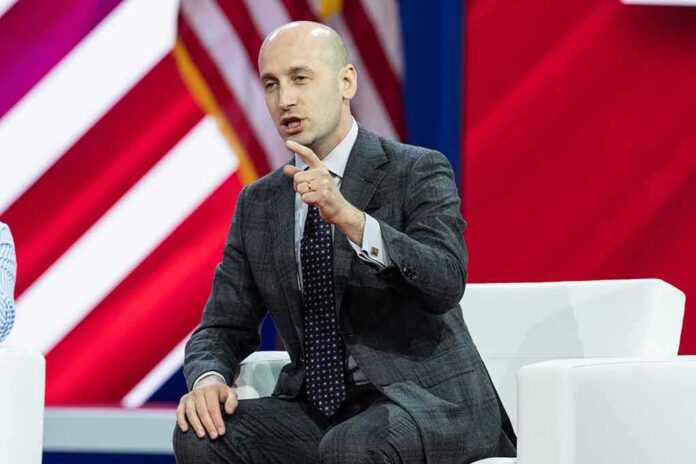
A White House official says Stephen Miller can now rejoin every policy meeting, after his wife reportedly cut all business ties that triggered past recusals.
Story Snapshot
- A White House official says Stephen Miller’s recusals are lifted and he may fully participate in policy matters.
- Report says Katie Miller left SpaceX, sold stock, and forfeited unvested equity tied to the company that owns Grok AI.
- Report says Katie Miller also ended a planned Paramount podcast deal at the same time.
- Earlier reports tied Stephen Miller’s recusals to his spouse’s interests in space, artificial intelligence, and media.
White House Says Recusals Are Over
A White House official said Stephen Miller “is no longer subject to any recusals and may fully participate in all meetings and policy matters.” The comments followed reporting that his wife, Katie Miller, ended business ties that had required him to step back from space and artificial intelligence issues. The earlier recusals tracked her work with companies affected by policy. The official’s statement signals a reset that lets a senior adviser engage on fast-moving technology and space topics.
Previous coverage documented that Stephen Miller stepped away from artificial intelligence and space decisions when Katie Miller consulted for an artificial intelligence venture and later worked at SpaceX. When SpaceX acquired the artificial intelligence firm, those interests joined under one corporate roof. The White House had also said he recused from matters touching a planned media podcast arrangement. Those steps reflected common executive-branch conflict rules for spouses and household finances.
What Katie Miller Reportedly Changed
The report says Katie Miller left SpaceX, sold her company stock, and gave up future shares that had not yet vested. The same report says she also ended a separate Paramount podcast arrangement. Those moves would remove the interests that triggered the earlier recusals. The timing was described as the weekend of November 7–8, 2026. These actions, if completed as described, fit the standard ways officials resolve conflicts through divestment or resignation from outside roles.
Federal ethics guidance explains how conflicts get fixed. The Office of Government Ethics says agencies often use resignations, selling assets, or recusal to handle risks tied to a spouse’s holdings. Law bars an employee from working on a particular matter that directly and predictably affects their or their spouse’s financial interests. When those interests are removed, the barrier can end. That is the process the reported changes appear designed to satisfy, based on ordinary practice.
Why This Matters For Policy Work Now
Lifting those recusals means Stephen Miller can speak, meet, and help shape policy on artificial intelligence and space without a standing conflict screen. That includes work that touches companies active in launch, satellites, and machine learning. The administration has pushed to secure supply chains, defend free speech online, and back American-led innovation. A full bench in the policy shop helps move faster on rules that protect the Constitution, jobs, and national security while resisting globalist pressure and censorship schemes.
She quit the job.
She sold the stock.
She walked away from shares she hadn't even been PAID yet.
Then she ended her own podcast.Katie Miller did all of it in the four days after her husband got the job. Her husband is Stephen Miller, and Monday was his first day as President… pic.twitter.com/mx92O4onAr
— Jewels Jones ® (@JewelsJonesLive) November 10, 2026
The report that describes Katie Miller’s divestment cites a person familiar with the moves, and the White House comment did not name a specific ethics memo. That said, the executive branch commonly resolves spousal conflicts through divestment. Guidance for nominees and appointees lists selling stock, forfeiting unvested equity, and resigning from positions among the standard tools, with agency ethics officials responsible for clearing participation once conflicts end. That is consistent with the sequence reported here.
What Comes Next Under Federal Ethics Practice
Designated Agency Ethics Officials are charged with reviewing conflicts and solutions, including recusals, divestiture, and reassignment. Federal guidance states that once an employee and their spouse have removed a conflicting interest, the employee may reengage on the covered matters. Agencies also track compliance through periodic certifications. In practice, this means calendars, meeting invites, and policy workstreams can now include Stephen Miller on space and artificial intelligence issues that were previously walled off.
Sources:
theatlantic.com, www2.oge.gov, extapps2.oge.gov