President Trump said Vladimir Putin “can” attend the Miami G20, challenging years of exclusion and forcing allies to choose engagement over boycott.
Story Highlights
- Trump said he is fine with Putin attending the upcoming G20 in Florida.
- Russia was suspended from the G8 after the 2014 Crimea crisis, not from the G20.
- Several G7 governments have pushed to exclude Russia from G20 events since 2022.
- The G7 framed Russia’s earlier suspension as conditional on Moscow changing course.
Trump’s Invitation Signals a Return to Hard-Nosed Dialogue
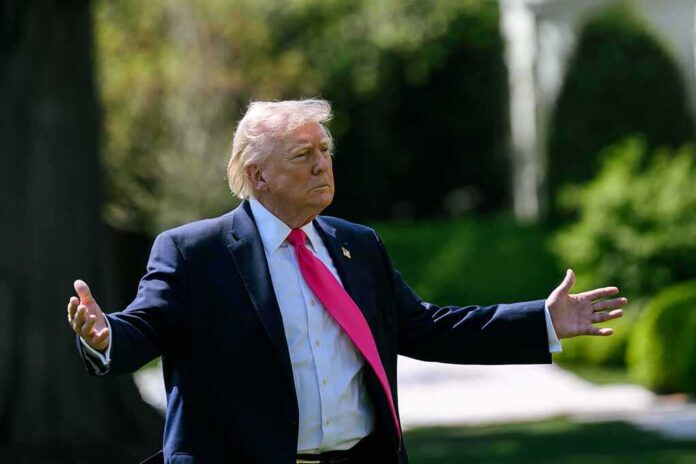
President Trump said, “If he wanted to come, he certainly can,” when asked about Vladimir Putin attending the G20 in Miami next month. He added the forum was “more powerful” with Russia inside. The comments mark a clear break from years of isolation moves that sidelined Moscow from elite meetings. The message is simple: talk directly, even with rivals, to test deals and reduce risk. Reuters and the Washington Examiner captured the remarks on the record.
Trump’s stance clashes with leaders who prefer to shun Russia at summits. After Russia seized Crimea in 2014, the Group of Seven governments halted the G8 track and tied any return to changes in Russia’s behavior. That was a political freeze, not a formal expulsion rulebook. The original joint statement said meetings would not proceed until “the environment” allowed “meaningful discussion,” which left a door open in principle, if facts on the ground changed.
G8 Suspension Versus G20 Membership: Different Forums, Different Rules
The G8 and G20 are not the same thing, and the 2014 action did not remove Russia from the G20. The Group of Seven decision targeted the smaller political club and linked the step to Ukraine’s sovereignty and territorial integrity. The G20, a broader economic forum, continued to include Russia as a member. That is why the current debate is about attendance and optics, not a legal expulsion from the G20 itself. The 2014 record spells out the G7’s reasoning and limits.
Trump’s comment does not by itself create a formal invitation. Hosts and member governments still manage protocol and logistics. But the United States wields major influence as summit chair and security provider. Trump’s public green light signals that Washington would not block Russia’s presence. That matters for agenda-setting and turnout. It also puts pressure on allies who threatened boycotts or statements if Putin shows up, raising the cost of symbolic walkouts.
Allied Pushback and the Political Risk Calculus
Since the 2022 invasion, several Group of Seven governments, including France, Germany, Italy, the United Kingdom, and Canada, have urged keeping Russia out of G20 gatherings. European Union voices have said they would condemn the war at the summit even if Putin attends. Those positions make a joint photo and communique harder, and they raise the odds of staged snubs. Reports have tracked those warnings across past minister meetings and leader summits.
That pushback has a clear anchor in earlier statements. The Group of Seven leaders tied Russia’s earlier suspension to its actions in Ukraine and said meetings would not resume until Moscow changed course. Supporters of isolation argue that attendance grants legitimacy and blunts pressure. Supporters of engagement counter that direct talks test cease-fire chances and reduce miscalculation. The 2014 documents show the suspension was conditional, not permanent, which leaves room for pragmatic contact when in the national interest.
What It Means for U.S. Interests, Security, and Energy Prices
A full G20 in Miami could give the United States a stage to press for de-escalation, energy stability, and fair trade. Sitting leaders in one room can force plain talk on oil supplies, grain routes, and sanctions relief paths if behavior changes. That can help lower energy costs that hit family budgets. Trump’s team can leverage the host role to focus on outcomes. The factual record supports that engagement and exclusion are both tools, used as leverage at different times.
Trump reiterated during a press conference that he believes Putin wants the war in Ukraine to end, insisting that it takes two to tango. He defended his record on sanctions against Russia, said Putin would be welcome at the G20 summit and suggested that the war might not have… pic.twitter.com/ZbJuXpFkYx
— NOELREPORTS 🇪🇺 🇺🇦 (@NOELreports) November 27, 2026
Conservatives expect strength and clarity. Welcoming an adversary to the table is not weakness if it advances American goals. It is a means to demand results in person, under the lights, with allies watching. The message to readers is simple: keep America in charge of the agenda, defend our sovereignty, secure our economy, and do not let global forums become stage plays for moral posturing with no gains. Trump has put the ball in play; now the G20 must decide whether to show up.
Sources:
youtube.com, business-standard.com, govinfo.gov, gov.uk, themoscowtimes.com, fakti.bg