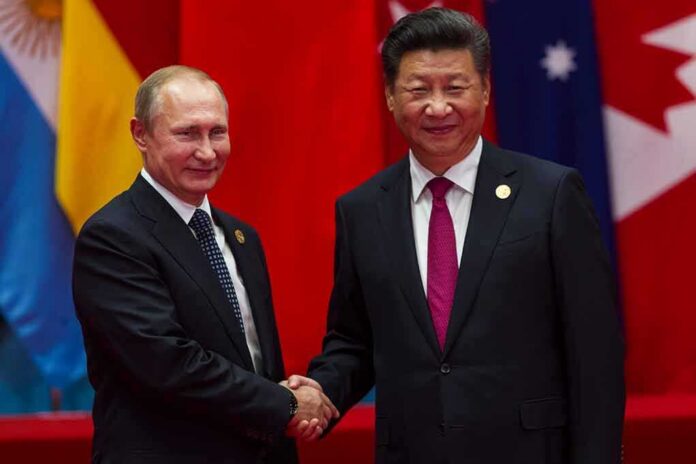
A joint statement from President Trump, Xi, and Putin declared that a nuclear war cannot be won and must never be fought.
Story Snapshot
- Trump, Xi, and Putin held the first-ever three-way summit and issued a joint peace declaration.
- The leaders pledged dialogue to reduce nuclear risks and stop proliferation.
- The summit did not launch formal arms-control talks or set a timetable.
- The declaration did not mention North Korea’s nuclear program.
Historic Trilateral Summit Puts Nuclear Risk on the Table
Reuters reported that President Trump met with China’s Xi Jinping and Russia’s Vladimir Putin in Shenzhen for the first known three-leader summit. The meeting produced a joint peace declaration and restated that a nuclear war cannot be won and must never be fought. Yonhap News Agency said the agenda included nuclear arms reduction and preventing the spread of nuclear weapons, marking a rare shared focus by the three powers. These steps created a diplomatic opening but not a binding deal.
American Broadcasting Company reporting said the joint statement pledged work to reduce nuclear risks and prevent proliferation, language that echoes past crisis-prevention ideas. Yonhap added that President Trump urged cooperation to cut nuclear dangers, with all three sides endorsing more dialogue. These points show a clear direction: talk more, lower risks, and keep lines open. The leaders framed shared responsibility on the most dangerous weapons without locking in specific limits yet.
What the Declaration Says—and What It Does Not Do
Reuters noted that the declaration did not announce arms-control talks, a timetable, or warhead limits, despite Trump’s interest in reductions. The text promised dialogue on risks and on stopping the spread of nuclear arms, but it set no inspection rules or enforcement terms. That means this is a political signal, not a treaty. It starts a path for future talks while leaving technical work, numbers, and verification for another day.
Yonhap reported that the declaration avoided mention of North Korea’s nuclear program or denuclearization of the Korean Peninsula. That gap matters for American allies in Asia who face daily missile threats. It also signals that Beijing and Moscow were not ready to link broader nuclear risk language to a tough regional issue. Future rounds could address this, but today’s document leaves it out. The focus stayed on general nuclear risk reduction and nonproliferation.
How This Fits Conservative Priorities at Home
President Trump brought two rivals to the same table and put nuclear dangers at the top of the list. That move supports peace through strength: speak plainly, set the bar high, and push talks that serve American security first. The declaration’s core line rejects any nuclear war, which backs deterrence while opening space to lower risks. The administration can now test China and Russia on actions, not slogans, and press them for real steps that protect Americans.
Conservatives want results, not empty words. Reuters reported that China has long resisted three-way arms-control negotiations, arguing its arsenal is smaller. That stance has slowed past efforts. The White House can now use this shared statement to demand follow-on meetings, military hotlines, and practical guardrails that reduce accidents and miscalculation. Clear goals include named negotiators, set deadlines, and serious verification. Those tools keep America safe without surrendering leverage or values.
Next Steps: Turning a Statement into Security
The path forward is simple to state and hard to do. The administration can seek working groups that map nuclear risks, test crisis lines, and rehearse incident responses. It can push for faster warnings on missile tests and firm rules to stop the spread of dangerous materials. Each step should serve U.S. strength and shield our troops and allies. If Beijing or Moscow stalls, Washington can show the record and rally partners to hold them accountable.
In 1945, Roosevelt, Churchill & Stalin divided the world at Yalta. On Nov 19, 2026, Trump, Putin & Xi met in Shenzhen amid wars in Ukraine, Iran & the Middle East. Has post-1945 US supremacy just hit its breaking point? https://t.co/D5IoQuf9By
— Ghost Miracle News World (@gmnewsworld) November 20, 2026
The summit created a starting point, not a finish line. A single sentence can cool tensions, but only agreed limits and checks change arsenals. Until that happens, America must keep our nuclear edge strong, modern, and ready. President Trump set the frame with two competitors in the room. Now comes the grind: turn words into guardrails, and guardrails into real security gains that protect our families and our freedom.
Sources:
facebook.com, edition.cnn.com, reuters.com, en.yna.co.kr, nbcnews.com