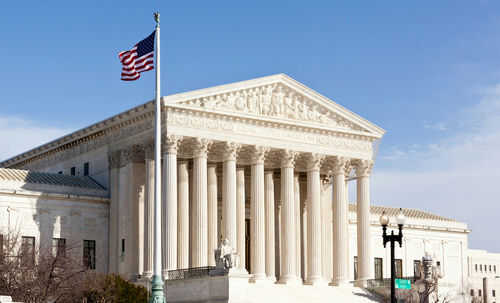
The Supreme Court just stopped New York Democrats from redrawing Rep. Nicole Malliotakis’ district in time for 2026—blocking a race-based court-ordered map change that would have reshaped one of NYC’s only GOP-held seats.
Quick Take
- On March 2, 2026, the U.S. Supreme Court voted 6–3 to pause a New York court order that would have forced new lines for the 11th Congressional District.
- The stay keeps the current Staten Island–Brooklyn district map in place for the 2026 midterms, giving Malliotakis electoral certainty.
- New York’s state courts had ruled the district violated the state constitution by diluting Black and Latino voting power, but the Supreme Court signaled major constitutional concerns with the remedy.
- Justice Samuel Alito’s concurrence framed the state court’s approach as unconstitutional race-based decision-making under the Fourteenth Amendment.
SCOTUS freezes a late-cycle redraw ahead of the 2026 midterms
Washington intervened on March 2, 2026, when the U.S. Supreme Court granted a stay blocking New York from carrying out a state-court-ordered redraw of the 11th Congressional District, represented by Republican Rep. Nicole Malliotakis. The vote was 6–3, and the practical effect is straightforward: the 2024 Legislature-enacted map stays in place for the 2026 election. The justices also requested further responses as the emergency appeal continues.
The district at the center of the fight combines Staten Island with portions of Brooklyn, a configuration widely understood to favor Republicans and to protect one of the few remaining GOP-held seats in New York City. For voters, the stay means the ballot lines and the basic political terrain are now settled for 2026, even if the underlying legal dispute continues beyond this election cycle. Redistricting lawsuits can drag on; election calendars do not.
How New York’s courts ordered a new map—and why the state lost at SCOTUS
New York’s state litigation moved quickly before the Supreme Court stepped in. A trial judge in late January 2026 ruled the district violated the New York constitution by diluting the voting power of Black and Latino residents and directed the Independent Redistricting Commission to produce a new map on a tight deadline. A state intermediate appellate court unanimously affirmed that ruling on February 19 and refused to pause the redistricting order, setting up the emergency request to SCOTUS.
The Supreme Court’s stay did not decide the final merits, but it did telegraph what the conservative majority viewed as a major constitutional problem: a court-ordered remedy that elevates race as the controlling principle in drawing district lines. In his concurring writing, Justice Samuel Alito described the state court’s approach as “unadorned racial discrimination” and argued that state courts cannot authorize violations of federal rights under the Supremacy Clause and Equal Protection Clause framework.
Equal protection concerns collide with vote-dilution claims
Supporters of the New York challenge argued the existing configuration weakens minority electoral influence and sought a remedy aimed at increasing that influence—often described in the record as a “crossover” concept. That sets up the legal tension: voting-rights advocates point to dilution, while the Supreme Court has repeatedly treated race-based line drawing with deep skepticism. This case was framed less like standard partisan gerrymandering and more like a direct fight over race-conscious redistricting.
Justice Sonia Sotomayor’s dissent centered on process and federalism rather than Republican-versus-Democrat talking points. She criticized the majority for intervening in a state election-law dispute after the Court has often emphasized that federal courts should avoid micromanaging state election rules. Her argument, in plain terms, was that the Court is applying different standards depending on which side is asking for emergency relief. The majority, however, treated the alleged constitutional violation as immediate and irreparable.
Political fallout: one NYC seat stays put, and 2026 matchups solidify
For Malliotakis, the outcome is clear: she is positioned to run again under the same district lines, and experts noted the current map remains the operative one for 2026 even if litigation continues. For New York Democrats, the stay blocks a late-stage effort that could have reshuffled multiple contests and forced strategic decisions about where incumbents and challengers run. Reporting also highlighted downstream effects on other New York City races that might have been altered by a new map.
From a constitutional perspective, the stay reflects a broader reality voters have watched for years: courts will scrutinize any remedy that appears to sort Americans by race, even when it’s packaged as an attempt to “fix” representation. The decision does not end redistricting warfare in New York, but it does stop a midstream rewrite for 2026 and reinforces that Equal Protection limits apply even when state courts believe they are pursuing a preferred outcome.
Sources:
SCOTUS Sides With Malliotakis in Redistricting Case, Blow to NY Dems
Supreme Court issues stay in Malliotakis redistricting dispute
Supreme Court blocks ruling that ordered New York to redraw a congressional district
Supreme Court grants Republicans’ request to pause order to redraw New York congressional map
Supreme Court Official Opinion (25A914)