A Cold War bomber just crashed on a California test range, and Washington’s vague answers are already raising hard questions about readiness and risk.
Story Snapshot
- A U.S. Air Force B-52 Stratofortress crashed shortly after takeoff at Edwards Air Force Base in California.
- Officials say the bomber went down around 11:20 a.m. local time and sparked a large fire and debris field.
- The base confirms the crash and emergency response, but has released no information yet on crew status or cause.
- The accident highlights the strain on an aging bomber fleet that has suffered serious mishaps in past decades.
B-52 goes down minutes after takeoff over California desert
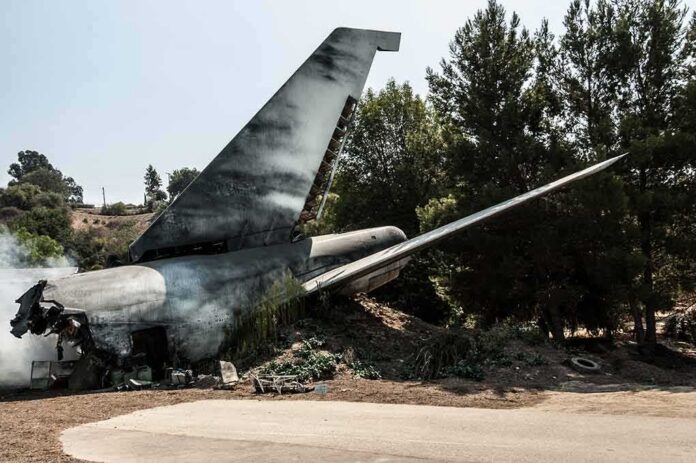
On Monday morning, a United States Air Force B-52 Stratofortress crashed shortly after takeoff on the airfield at Edwards Air Force Base in Kern County, California, according to an official base post on social media.[3] The statement said the bomber went down at about 11:20 a.m. local time and confirmed that emergency crews responded to the scene right away.[1] Local outlets reported a tall plume of smoke and a wide debris field visible across the high desert.[1]
Reporters and live aerial footage showed fire trucks and emergency vehicles clustered around what appeared to be wreckage and scorched ground on the expansive test range.[3] News crews stressed that officials have not yet said whether any of the crew survived, were injured, or were killed.[1] Broadcasters repeated that almost all current information comes from the short Edwards Air Force Base statement and brief on-air descriptions, with no detailed press conference so far.[3]
What we know so far — and what is still not clear
Edwards Air Force Base confirmed only a few core facts: the aircraft was a United States Air Force B-52 Stratofortress, the crash happened on the base airfield shortly after takeoff, and the time was 11:20 a.m. Officials emphasized that emergency crews “immediately responded” and that “the situation is ongoing,” promising more information when available.[3] At this point, there is no confirmed tail number, mission description, or explanation of why the bomber went down so soon after liftoff.
Local coverage from Los Angeles and Chicago stations repeated that casualty information is still unknown and that the Air Force has not released crew details.[1] Commentators noted that a B-52 is normally a manned bomber, not a drone, which means service members were almost certainly involved.[3] That silence on human cost, while standard before families are notified, leaves room for rumor online and adds to the unease many viewers feel watching the live crash scene with no answers.
An aging bomber with a long and deadly accident history
The Boeing B-52 Stratofortress has been the backbone of American long-range bombing and nuclear deterrence since the 1950s, with a long record of combat and training missions. Public accident databases and historical lists show many serious B-52 mishaps over the decades, including crashes during takeoff, landing, training, and airshow practice.[3] Some involved pilot error and risky low-level maneuvers, while others traced back to mechanical issues or trim and control problems in flight.
One widely studied example is the 1994 Fairchild Air Force Base crash in Washington state, where a B-52 banked too steeply during an airshow practice, stalled, and slammed into the ground, killing all four crew members. Investigators later found the pilot had a history of pushing the aircraft beyond safe limits and that leadership failed to correct his behavior. Another accident, near Guam in 2008, was blamed on improper stabilizer trim settings that left the bomber in a nose-low descent that the crew could not recover from at low altitude.
Why this matters for readiness, safety, and transparency
Conservative readers watching this latest crash will see more than a single tragic mishap. They see a symbol of how much we still rely on aged Cold War hardware and how often Washington delays tough decisions on modernization while spending freely elsewhere. The B-52 fleet has been upgraded many times, yet it remains a platform designed in another era, now working harder than ever under high training and test demands. Every accident raises fresh questions about maintenance, crew training, and command oversight.
Receipts
1. Edwards AFB confirms B-52 crash shortly after takeoffhttps://t.co/b30sTRpG1J
2. Live aerial footage showing debris field and emergency responsehttps://t.co/rt620gaiKv
3. Additional crash scene footagehttps://t.co/DSC5IjZU06
4. B-52 modernization program…
— P a u l ◉ (@SkylineReport) June 15, 2026
At the same time, the information flow follows a familiar pattern. The Air Force releases a short statement, confirms the minimum, and then goes quiet until formal investigations and family notifications are finished.[3] That cautious approach protects privacy and the integrity of safety boards, but it also frustrates citizens who want timely, clear answers about how their tax dollars and their sons and daughters are being used. For now, all we truly know is that a major bomber has been lost, and America is owed a full, honest accounting when the facts are ready.
Sources:
[1] Web – Breaking: B-52 Stratofortress Crashes After Takeoff From Edwards AFB, …
[3] Web – Boeing B-52 Stratofortress | Bureau of Aircraft Accidents Archives