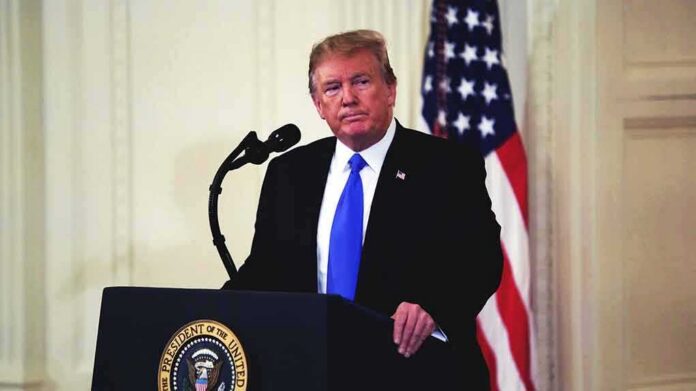
For the first time ever, Wall Street’s opening bell rang from the Oval Office as President Trump launched his new $1,000-per-child “Trump Accounts” for American families.
Story Snapshot
- President Trump hosted Nasdaq and the New York Stock Exchange for a joint Oval Office opening bell to launch Trump Accounts.
- Every eligible child born from 2025 to 2028 receives a $1,000 government seed deposit invested in the stock market.
- More than 6 million families have already signed up through the Internal Revenue Service’s new Trump Accounts form.
- Parents and grandparents can add up to $5,000 a year, building long-term, private wealth instead of more government programs.
Historic Oval Office Bell Rings Signal a Different Kind of Kids’ Program
President Trump turned the Oval Office into a symbol of Main Street investing when officials from Nasdaq and the New York Stock Exchange rang the opening bell from his desk for the first time in history. The ceremony marked the official launch of Trump Accounts, tax-favored investment accounts for minors. It tied Wall Street’s daily start to a new effort to help ordinary families build savings for their children instead of growing government. The event underscored Trump’s core message: America’s kids deserve ownership, not dependency.
The timing and backdrop were chosen carefully. The launch fell on July 4, 2026, the 250th anniversary of the United States. Trump used the nation’s birthday to introduce a program framed as an “American Dream starter” for the next generation. By hosting both exchanges together in the Oval Office, he sent a clear signal that the stock market should serve families across the country, not just hedge funds and global elites. For many supporters, it felt like taking Wall Street back from the woke crowd and putting it to work for their grandchildren.
How Trump Accounts Work for Parents, Grandparents, and Kids
Under the Trump Accounts program, the United States Department of the Treasury deposits $1,000 into an account for every eligible child born between January 1, 2025, and December 31, 2028. Families enroll using a dedicated Internal Revenue Service form and app, and more than 6 million have already signed up ahead of the launch. After the initial deposit, parents, grandparents, and others can contribute up to $5,000 per year until the year before the child turns 18, providing a steady path to build long-term savings and investment.
Money in Trump Accounts is automatically invested in a broad stock market fund, the SPDR Portfolio S&P 500 exchange-traded fund. That means kids’ accounts own tiny shares of hundreds of major American companies instead of risky fads or political pet projects. The White House Council of Economic Advisers argues this structure gives young Americans a “jump-start” on saving and teaches basic investing through real-life experience. Unlike past left-wing programs that rely mostly on more spending and bureaucracy, this design leans on market growth and personal contributions to build wealth over time.
Costs, Criticism, and the “Grift” Narrative from the Left
Some critics in legacy media have tried to fold Trump Accounts into their long-running “grift” storyline around Trump’s finances and donors. They question claims that the program “costs the government nothing,” since the Treasury’s $1,000 deposit for each eligible child is a real expense, even if future investment gains offset part of it. Others raise concerns about early withdrawal penalties that apply if account holders tap funds before later adulthood, arguing this may limit access for young adults who face high costs of living.
Yet, so far, there is no serious, sourced counter-evidence that challenges the core facts behind Trump Accounts. No watchdog group has produced a forensic audit showing misuse of the deposits, false enrollment numbers, or illegal personal enrichment. The main attacks rely on broader frustration with Trump’s wealth, not on documented flaws in the program’s mechanics. For many conservative families who have watched Washington pour tens of billions into confusing child-care bureaucracies over decades, the idea of a simple, transparent investment account for their kids feels like a welcome break from the usual D.C. games.
A Break from 80 Years of Patchwork Child Programs
Trump Accounts also sit in a larger story about how Washington has handled children’s needs. For more than 80 years, the federal government has built a patchwork of child programs like Head Start and the Child Care and Development Block Grant, often adding costs and rules but delivering mixed results. These initiatives regularly promise to be “self-sustaining” while still requiring large taxpayer spending that later draws scrutiny from auditors and economists. Families see the chaos: dozens of overlapping programs, each with different rules, and no clear path to wealth-building.
FOR THE FIRST TIME FROM THE OVAL: President Donald J. Trump rings the NYSE and Nasdaq opening bell to officially launch https://t.co/se7180V2pt!
Investing in America's next generation! 💰🇺🇸
— karen Hopps (@Hopps00156) July 6, 2026
In that context, Trump Accounts mark a clear shift. Instead of more subsidies shaped by government planners, the program gives families a direct asset they control, built on stock ownership and private contributions. Supporters view this as a constitutional, pro-liberty answer to endless calls for new federal entitlements: the state helps kids start, but parents and markets do the heavy lifting. For conservatives tired of runaway spending, woke priorities, and federal overreach into family life, the Oval Office bell ringing for Trump Accounts looked less like a stunt and more like a turning point toward personal responsibility and real opportunity.
BREAKING: President Trump rings the NYSE and NASDAQ opening bell from the Oval Office, for the first time ever, to celebrate the official kickoff of Trump Accounts. pic.twitter.com/885KIXEOpS
— Alpha Q (@CrouthamelMike) July 6, 2026
Sources:
youtube.com, home.treasury.gov, washingtonexaminer.com, thehill.com, apnews.com, trumpaccounts.gov, corporate.vanguard.com, whitehouse.gov, facebook.com, bipartisanpolicy.org, firstfocus.org, ffyf.org, gsppi.berkeley.edu