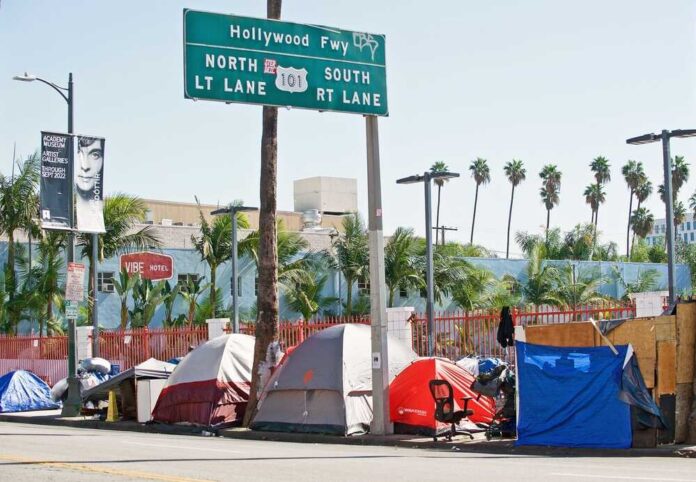
A Los Angeles mayoral debate over homelessness and public safety turned into a blunt referendum on whether the city’s billion-dollar “compassion” system is actually fixing anything.
Quick Take
- Spencer Pratt used the debate stage to demand “zero encampments,” mandatory addiction treatment, and audits of homeless-service spending.
- Mayor Karen Bass defended her Inside Safe program, citing a reported 17.5% reduction in street homelessness, while critics pointed to a reported 40% return-to-street rate.
- Nithya Raman attacked costs and positioning, pressing a more left-wing critique as Los Angeles approaches the 2028 Olympics deadline.
- The exchange highlighted a national political fracture: enforcement-first vs. housing-first, and whether government-funded NGOs are accountable to taxpayers.
Pratt’s “Zero Encampments” Pitch Targets Disorder and Spending
Spencer Pratt, a former reality TV personality running as an outsider, pressed a simple message: Los Angeles should stop tolerating street encampments, open drug use, and what he framed as a system that rewards failure. During the debate, he argued for mandatory treatment for people addicted to fentanyl and methamphetamine, and he vowed to audit homeless-service organizations to trace where public dollars go. His approach put public order and accountability at the center of the race.
Pratt’s message landed because it connected two frustrations Angelenos often voice in the same breath: visible street chaos and massive government spending that doesn’t seem to change it. The research material describes Los Angeles as spending more than $1 billion annually on homelessness, while residents still see encampments, petty crime, and open-air drug markets. Pratt also floated involving federal agencies like the IRS and ICE, a politically charged promise that signals enforcement rather than the status quo service-provider model.
Bass Defends Inside Safe, but the Recidivism Question Looms
Mayor Karen Bass leaned on her record, defending Inside Safe as a citywide strategy that places people into temporary shelter such as motels while working toward longer-term housing. In the debate coverage summarized in the research, Bass cited a reported 17.5% drop in street homelessness tied to the program. That figure matters politically because most big cities have struggled to show any measurable decline, even after years of expanded budgets and new agencies.
Critics, including Pratt in the debate framing, focused on a reported 40% rate of people returning to the streets after placement. If that number is accurate and persistent, it raises a basic governance problem: taxpayers may be funding churn instead of stability. Bass’s defenders can reasonably argue that addiction, mental illness, and housing scarcity make permanent exits difficult, but voters still want results they can see. The debate showcased how the same statistics can be read as progress—or as proof the model needs a reset.
Raman’s Left-Wing Critique Collides With an Enforcement Mood
City Councilwoman Nithya Raman, identified in the research as a Democratic Socialist, approached the issue from a different angle—criticizing cost and execution while keeping faith with the broader progressive theory that homelessness is fundamentally a housing and affordability crisis. Raman’s positioning matters because it reflects a wider urban-policy playbook: resist aggressive policing, emphasize services and tenant protections, and treat encampment removal as a last resort. With the Olympics approaching, she also faced the practical reality that the city will be pressured to clear visible encampments.
The debate dynamic described in the research suggests Raman was squeezed between Bass’s defense of incremental progress and Pratt’s demand for immediate enforcement. That squeeze mirrors what’s happening nationally: many voters still support compassion in theory, but they are increasingly skeptical of policies that look like permissiveness. For conservatives, the key question is whether government is protecting law-abiding families’ right to safe sidewalks and public spaces, or prioritizing a bureaucracy that excuses disorder while collecting ever-larger budgets.
The Palisades Fire Adds a Competence Test Beyond Homelessness
The homelessness clash did not occur in a vacuum. The research ties Pratt’s candidacy to the Palisades Fire that burned more than 23,000 acres and destroyed thousands of structures, including Pratt’s home, with reported fatalities. In that context, the election becomes a broader competence test: residents aren’t just evaluating compassion policy, they are evaluating whether city leadership can manage core functions like emergency preparedness, infrastructure, and basic public safety under stress.
Some details remain unclear in the research, including precise dating references that appear inconsistent across summaries, and the debate’s exact timing beyond an April–May window. What is clear is the political effect: crises stack. When voters see homelessness worsening, fentanyl deaths rising, and disaster response questioned, they become more open to outsiders who promise disruption. That shift is not uniquely conservative or liberal; it reflects a shared sense that government systems protect institutions first and citizens second.
Why This Debate Resonates Nationally in 2026
The Los Angeles debate also fits a national pattern: voters are tired of slogans and want measurable outcomes tied to clear responsibility. Pratt’s audit talk appeals to taxpayers who suspect “grift” but rarely see clean accounting; Bass’s numbers appeal to voters who want proof that programs can work; Raman’s affordability critique reflects real economic pain in high-cost cities. The hard truth is that each viewpoint collides with constraints—limited housing supply, addiction, mental illness, and public tolerance for disorder.
Spencer Pratt slugs it out over homelessness, cost of living in LA Mayor's debate with Karen Bass and Nithya Raman https://t.co/WzDfYzuMgT pic.twitter.com/SXNlmX5VAi
— New York Post (@nypost) May 7, 2026
For conservatives watching from outside California, Los Angeles functions as a warning label for what happens when leadership normalizes encampments and public drug use while budgets climb. For liberals, the city reflects the failure to deliver enough housing and treatment capacity despite years of promises. The debate didn’t settle the argument, but it clarified the stakes: who will be held accountable for outcomes, how quickly enforcement will be used, and whether voters will keep funding systems that can’t prove they are reducing suffering or restoring public order.
Sources:
la-mayoral-candidate-spencer-pratt-vows-zero-encampments-homeless-no-fentanyl-streets
los-angeles-mayor-debate-nbc-2026-updates