
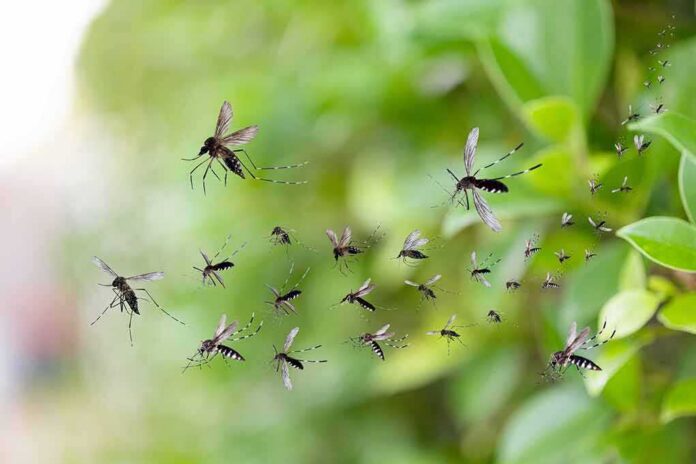
President Trump signed an executive order demanding federal agencies wipe out 90% of Washington, D.C.’s invasive mosquitoes and cut the tick population in half by 2028, using tech instead of chemical sprays.
Story Snapshot
- President Trump signed the order on September 29, 2026, targeting disease-carrying pests in the nation’s capital.
- The order sets a goal of cutting invasive mosquito populations by 90% and ticks by 50% by 2028.
- Four federal agencies must submit a plan within 60 days using non-chemical, technology-driven methods.
- The order specifically names the Asian tiger mosquito and Egyptian mosquito as top targets.
Trump Targets D.C.’s Disease-Carrying Pests
President Trump signed an executive order titled “Eliminating Disease-Carrying Pests And Restoring Enjoyment Of The Great Outdoors” on September 29, 2026. The order takes direct aim at Washington, D.C.’s invasive mosquito and tick problem, a nuisance that has plagued residents and tourists for decades in the swampy federal city.
The order calls the campaign a matter of public health and quality of life. It directs officials to bring back the ability of Americans to enjoy the outdoors in the nation’s capital without swatting bugs or worrying about disease. This is a rare federal move into a problem usually left to city governments and private pest control companies.
Four Agencies Get Marching Orders
The order puts four agencies in charge of the mission. The Secretary of the Interior, the Secretary of Agriculture, the Administrator of the Environmental Protection Agency, and the Administrator of General Services must work together. They also have to consult with the Secretary of Health and Human Services before moving forward.
Interior Secretary Doug Burgum and Agriculture Secretary Brooke Rollins are named as key players tasked with building the plan. Within 60 days of the signing, these officials must develop and implement a citywide campaign. The clock is already ticking toward the 2028 deadline set by the president.
Specific Species, Specific Numbers
The order does not deal in vague goals. It names the Asian tiger mosquito and the Egyptian mosquito by name, along with other invasive species that have taken hold in the District. Officials must cut those populations by 90% within two years.
Ticks get a separate target under the same order. Agencies must reduce the District’s tick population by 50% by the same 2028 deadline. Health officials link both pests to the spread of dangerous diseases, giving the campaign a public safety angle beyond simple annoyance.
No Chemical Sprays, New Technology Instead
The order breaks from the old playbook of blanket pesticide spraying. It demands safe, effective, non-chemical, and technology-enabled methods instead. That approach fits a wider shift already happening in vector control research, where scientists have spent years testing tools like sterile-insect releases and lab-engineered techniques as alternatives to spraying.
Federal agencies are being pushed to invest in what the White House calls pioneering approaches to pest management. Researchers note that newer control methods still require careful testing and local tailoring rather than a single top-down fix, but the order treats D.C. as a testing ground for the administration’s technology-first strategy.
Why This Matters for D.C. Residents
Washington’s swampy terrain near the Potomac and Anacostia rivers has made it a breeding ground for mosquitoes for generations. Locals and visitors alike have long complained about the bugs ruining outdoor monuments, parks, and events during the humid summer months.
President Trump’s order treats this everyday frustration as a federal priority worth cabinet-level attention. For a conservative base tired of government inaction on basic quality-of-life issues, the move signals that even small, practical problems in the nation’s capital are getting direct presidential focus and a hard deadline for results.
The order gives agencies just 60 days to submit their plan, meaning the public should see concrete details on methods and funding well before the end of the year. Whether the 90% and 50% targets are met by 2028 will become a measurable test of the administration’s promise to modernize government action on everyday problems.
Sources:
reason.com, whitehouse.gov, washingtonexaminer.com, washingtonpost.com, usatoday.com, academic.oup.com