As Americans absorb another overseas war, the fight over “America First” is suddenly being tested at home by whether Washington will actually remove dangerous criminal illegal aliens—or keep letting sanctuary policies gamble with your family’s safety.
Story Snapshot
- ICE carried out coordinated arrests of illegal immigrants convicted of serious violent and sex crimes on the same day Markwayne Mullin was confirmed and sworn in as DHS Secretary.
- DHS officials framed the operations as a public-safety-first enforcement push despite ongoing funding strain and partisan conflict in Congress.
- ICE leadership has sharply criticized California’s detainer noncompliance, citing thousands of ignored requests and thousands of criminal non-citizens released into communities.
- The cases highlighted include convictions for child sexual abuse, rape, gross sexual imposition, and domestic assault, underscoring the stakes of enforcement priorities.
Nationwide ICE arrests coincide with Mullin taking over DHS
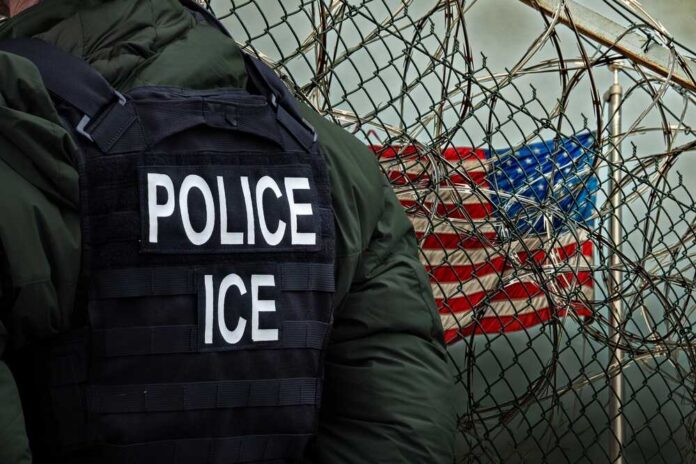
ICE officers executed a set of targeted arrests across multiple states as Senator Markwayne Mullin was confirmed and sworn in as President Trump’s new Homeland Security secretary. DHS-linked details described arrests in Utah, Ohio, New York, and Texas involving illegal immigrants previously convicted of crimes including sexual abuse of a child, rape, gross sexual imposition, child endangerment, and assault of a family member. DHS officials presented the timing as a signal of continuity and urgency under new leadership.
DHS acting leadership emphasized deportation as the intended endpoint for non-citizens in the country unlawfully who commit serious crimes. That message lands at a moment when many conservative voters are split and exhausted—watching resources and attention flow to a new Middle East conflict while basic law-and-order expectations at home still feel negotiable in blue jurisdictions. The available reporting does not provide the exact date of the “Monday” referenced, but it does describe the arrests as aligned with the day Mullin took office.
“Americans First” enforcement meets funding fights and sanctuary resistance
Federal immigration enforcement is operating under political pressure and funding uncertainty, according to reporting that described DHS funding as strained or lapsed while operations continued. Mullin’s public posture, as summarized in the reporting, focused on putting “the American people first” and urging an end to partisan bickering over DHS resources. For voters who remember years of “woke” priorities and spending blowouts, the key question is simpler: will Congress fund the core job of protecting communities?
ICE and DHS messaging also draws a bright line between border politics and public safety: remove criminal offenders regardless of the broader debate over asylum or immigration levels. The reporting describes DHS highlighting a statistic that a large share of ICE arrests involved people with U.S. criminal convictions. That claim has been politically potent, but readers should note that the broader national picture can vary by time period and enforcement priority; the current article’s examples focus specifically on offenders already convicted of severe crimes.
California detainer dispute spotlights federal-state collision
California’s stance on ICE detainers remains a central fault line. ICE leadership, through a letter referenced in local reporting, cited more than 33,000 detainers ignored and said thousands of criminal non-citizens were released into communities after January 20, including individuals tied to homicides, assaults, and other serious offenses. The reporting also listed cases where offenders were later re-arrested by federal authorities after earlier releases, illustrating how detainer refusals can turn into repeated enforcement cycles.
Those details matter because detainers are not an abstract paperwork fight; they are a coordination tool meant to transfer custody so convicted offenders don’t get a head start back into the public. The reporting’s case summaries included individuals accused or convicted of sexual offenses against children and other violent crimes, and it described ICE later apprehending some for removal. The same reporting notes an official response from California leadership but does not fully quote it, limiting verification of the state’s rebuttal.
What this means for conservatives watching a war abroad and instability at home
In 2026, many MAGA voters feel boxed in: a hot war with Iran, high energy costs, and renewed skepticism toward foreign commitments have collided with a promise to avoid new wars. Domestic enforcement stories like these cut through because they are measurable and immediate—either violent offenders are removed or they aren’t. The reporting indicates DHS is leaning into public-safety arrests as a high-clarity priority, even while larger immigration and budget battles remain unresolved.
The strongest, most verifiable takeaway from the available sources is narrow but significant: ICE is prioritizing arrests of illegal immigrants convicted of severe crimes, and federal officials are escalating criticism of sanctuary noncooperation—especially in California—using detainer and release figures to argue communities are being put at risk. What is still unclear from the provided reporting is how quickly funding and legal disputes will be resolved, and whether DHS can sustain consistent nationwide operations while Washington remains politically fractured.
Sources:
‘Americans first’: ICE sweeps up child predators, rapists across US as Mullin takes helm of DHS