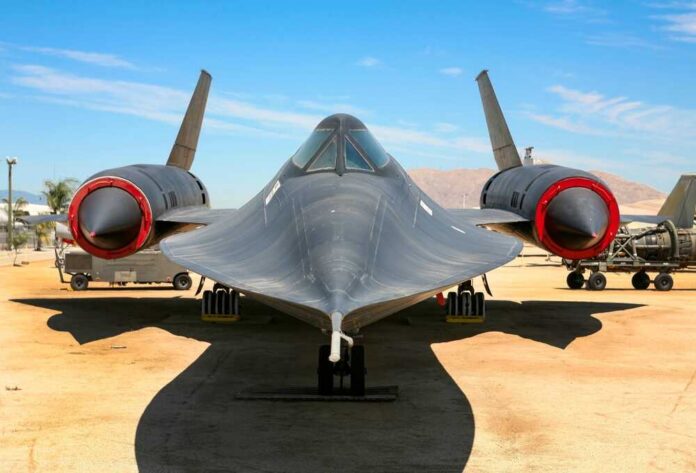
Bill Weaver survived being ripped from an SR-71 Blackbird at Mach 3.18 and 78,800 feet, a miracle that embodies American ingenuity and grit against impossible odds.
Story Highlights
- Lockheed test pilot Bill Weaver endured airframe disintegration without ejection, saved by pressurized suit and automatic parachutes.
- Recon systems specialist Jim Zwayer perished from neck injury in the same 1966 New Mexico crash over remote terrain.
- Engine inlet unstart during high-speed banked turn caused violent yaw, roll, and total aircraft breakup in seconds.
- Incident drove critical SR-71 safety upgrades, including automatic inlet restart systems still influencing aviation today.
The Fateful Flight on January 25, 1966
Lockheed test pilot Bill Weaver and reconnaissance systems specialist Jim Zwayer flew SR-71 Blackbird #952 from Edwards AFB. They refueled mid-air, accelerated to Mach 3.18, and climbed to 78,800 feet over New Mexico. The mission tested an aft center-of-gravity setup to reduce trim drag and boost high-Mach efficiency. This configuration traded aircraft stability for performance gains at extreme altitudes. Unstarts, sudden shockwave disruptions in engine inlets, posed known risks during such maneuvers.
Catastrophic Unstart and Mid-Air Breakup
During a programmed 35-degree right banked turn, the right engine inlet unstarted, switching from automatic to manual mode. This caused abrupt thrust loss, violent yaw to the right, uncontrolled roll, and extreme pitch-up. G-forces overwhelmed the stability augmentation system within two to three seconds. The titanium airframe shattered completely, with the nose section separating. Weaver blacked out as forces ripped him from the cockpit. His ejection seat stayed in the wreckage—no intentional ejection occurred.
Weaver’s pressurized suit maintained integrity against near-space vacuum and friction heat. A stabilizing drogue chute deployed automatically, followed by the main parachute at 15,000 feet. He regained consciousness during descent, facing a frozen faceplate and oxygen deprivation. Physics dictated no survival at Mach 3 speeds and 78,000 feet, yet suit and chute systems prevailed. Zwayer suffered a fatal broken neck during the violent separation.
Rescue and Immediate Aftermath
Weaver landed on a remote New Mexico plateau. Local rancher Albert Mitchell spotted him, packed up his personal Hughes helicopter, and extracted Weaver first. Mitchell returned for Zwayer’s body, confirming the neck injury killed him instantly. Debris scattered across 150 square miles. Weaver reached Tucumcari hospital for evaluation. This marked the first SR-71 incident requiring bailout, pre-USAF handover during Skunk Works testing under Kelly Johnson.
Legacy of Innovation from Near-Disaster
Weaver’s survival spurred Lockheed engineers to revolutionize SR-71 operations. They developed the Symmetry Engine Start (SES) system for automatic inlet restarts during unstarts, enabling control retention in turns. Battery-powered heated faceplates prevented freezing. Digital inlet controls minimized asymmetric thrust risks. These fixes prevented repeats across 32 Blackbirds built, though 12 were later lost. The event underscored tradeoffs in pushing Mach 3+ reconnaissance supremacy amid Cold War demands. Weaver flew 30 years at Lockheed, testing F-104s, A-12s, YF-12s, and SR-71s, retiring as division manager. No evidence supports claims of a flight two weeks later with a ‘pilot ejected’ light; research confirms this as the defining incident.
In 2026, as President Trump’s second term prioritizes American strength without endless foreign entanglements, Weaver’s story reminds us of bold private innovation—Lockheed’s Skunk Works delivering unmatched tech for national security. Test pilots like Weaver risked all for limited-government triumphs in aviation, not bureaucratic overreach. This Cold War legend fuels pride in self-reliant American engineering over globalist waste.
Sources:
An SR-71 Blackbird Totally Disintegrated at Mach 3 and the Pilot Was Ripped Out of the Aircraft
How an SR-71 that Disintegrated at Mach 3 Led to the Automatic Inlet Restart System
SR-71 Pilot Explains How He Survived Blackbird Disintegration at Speed Mach 3.2
SR-71 Disintegrated, Pilot Free Fell From Space & Lived to Tell
Hacker News Discussion on SR-71 Incident