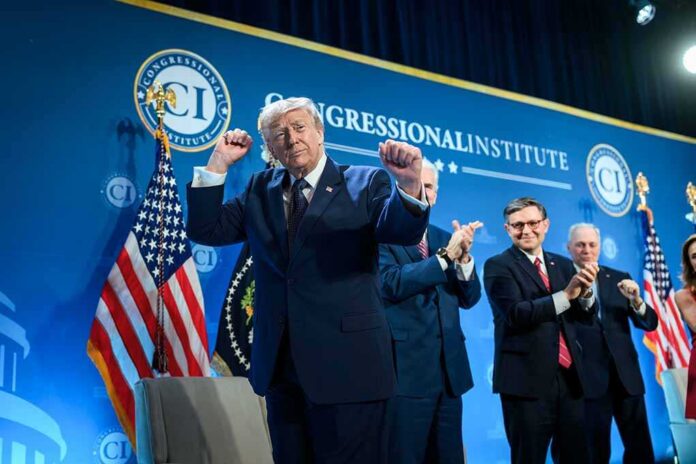
President Trump says he is ready to work with the same Democrats who just took his Congress away from him, and he thinks a healthcare deal could be on the table.
Quick Take
- Democrats swept the 2026 midterms, flipping both the House and Senate in a historic rebuke of Trump’s party.
- Trump called healthcare cooperation with Democrats a “real possibility” and said results could beat working with Republicans.
- Trump also warned he will use his veto power freely once Democrats take control in January.
- Political science research suggests this kind of bipartisan talk rarely leads to real legislative cooperation.
Democrats Sweep Midterms in Historic Rebuke
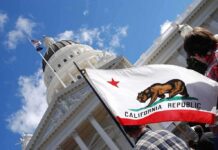
Democrats won control of both the House and Senate in the 2026 midterm elections, delivering what multiple networks called a historic rebuke of Trump’s Republican Party. The party flipped seven Senate seats, including Iowa, Kansas, Ohio, Maine, North Carolina, South Carolina and Texas. Democrats are projected to hold 257 House seats, a gain of 43, marking one of the biggest swings in recent memory.
Trump watched the results come in from the White House on election night. He told reporters he would respect the outcome and said he planned to work alongside the incoming Democratic majority rather than dig in against it from day one.
Trump Signals Openness to Deal-Making
Speaking at a White House event after his Asia trip, Trump struck an upbeat tone about the months ahead. “There’s a real possibility that we get a lot of great things done, especially on healthcare,” he said, adding he was “open to great healthcare” even if it does not look exactly like what Democrats want. He went further, suggesting bipartisan results “could end up better than dealing with the Republicans.”
That comment stands out for conservatives who spent the first half of Trump’s term watching Republican infighting slow down his agenda. Trump has also told reporters he expects to be “unbelievably productive” with the new Democratic Congress, framing divided government as an opportunity rather than a dead end for his second-term priorities.
Veto Power Remains Trump’s Trump Card
Trump has not thrown away his leverage. He pledged on November 20 to veto Democratic legislation he dislikes once the new Congress is sworn in, but he framed that veto power as a starting point for negotiation rather than a wall. He said Democrats may realize they need his signature to get anything passed, giving him real say over what makes it into law.
That strategy fits a long pattern in American politics. Presidents from both parties have used the veto as a bargaining chip when the opposing party controls Congress, forcing lawmakers to write bills with enough concessions to earn a signature instead of a rejection. Bill Clinton used the same approach against a Republican Congress in the 1990s.
History Suggests Caution on Bipartisan Promises
Political scientists who study presidential rhetoric warn that friendly talk toward the opposition often means less than it sounds like. One peer-reviewed study found presidents increasingly use rhetoric about the other party to rally their own base and shape future elections, not to build actual compromise, especially when their own party’s majority is shaky or gone entirely. For conservative voters tired of empty Washington promises, that is a useful reality check.
Other research found that purely political appeals to bipartisanship have little measurable effect on how Congress actually votes. Lawmakers respond more to what is in a bill and whether backing it carries political risk, not to a president’s friendly tone. Healthcare may be the test case, since year-end health packages often need bipartisan support to move at all.
For now, Trump’s words offer a rare moment of calm after a brutal election night for Republicans. Whether that optimism turns into an actual healthcare deal, or simply sets up another round of veto standoffs, will depend on what Democrats put on his desk starting in January.
Sources:
youtube.com, rmb.reuters.com, cbc.ca, nbcnews.com, edition.cnn.com