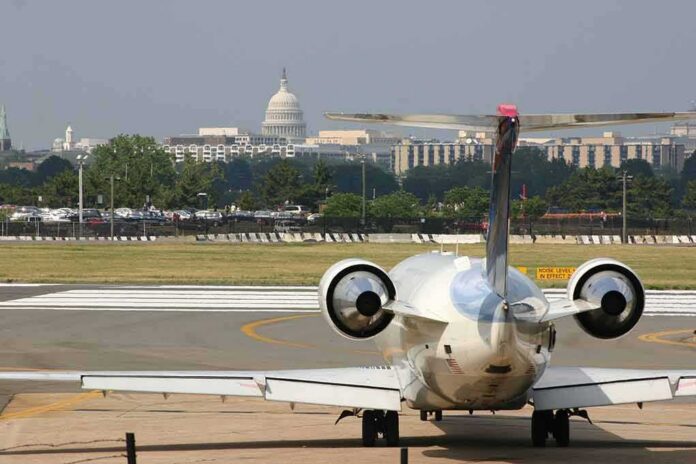
A Coast Guard C-37A carrying the Homeland Security secretary landed safely on one engine at Reagan National after the pilot declared an emergency.
Story Highlights
- The pilot reported a right-engine failure and requested an immediate landing at Reagan National.
- The plane landed safely; airport crews inspected it before it left the runway.
- Officials said 14 people were on board; no injuries were reported.
- The jet type is a Coast Guard C-37A, used for senior officials.
Pilot Declares Emergency After Engine Failure Near Washington
Air traffic control audio captured the Coast Guard pilot reporting a lost right engine and declaring an emergency while approaching Ronald Reagan Washington National Airport. The pilot asked for an immediate landing and noted there were 14 people aboard with ample fuel for the approach. The jet proceeded to land safely on one engine. Officials and media reports identified the passenger group as including the Homeland Security secretary, with all aboard unharmed after touchdown.
Multiple outlets reported the aircraft as a Coast Guard C-37A, a Gulfstream V variant often used for senior travel and command missions. The landing occurred at Reagan National, where the airport authority said fire and rescue personnel met the aircraft. Crews inspected the jet on the runway before it taxied clear for further checks. These details match the standard emergency response at a busy airfield inside the national capital region.
Calm Crew Performance Praised After Safe Single-Engine Landing
The Homeland Security secretary publicly praised the Coast Guard pilots, saying they handled the single-engine landing with steady professionalism and without panic. He added the crew later told him it was a first for them, underscoring the unique stress of losing an engine so close to Washington’s tight airspace. The praise aligns with the outcome: a controlled approach, a stable touchdown, and a clean exit from the runway. No injuries were reported among the 14 people aboard.
The decision to declare an emergency gave the pilot in command clear priority to land and coordinate with controllers. That step allows rapid routing, runway access, and rescue staging if needed. The quick landing at Reagan National limited air time on a single engine and kept risk low for passengers and people on the ground. Airport responders’ prompt inspection on the runway added a second layer of safety before the aircraft moved.
Fleet Age And Readiness Questions Provide Useful Context
The Coast Guard has worked to modernize parts of its aviation fleet after years of missed availability targets and aging airframes. A Government Accountability Office review found the service did not meet its 71 percent aircraft availability goal from fiscal years 2018 to 2022, pointing to readiness gaps across units. The Department of Homeland Security also noted that one command-and-control jet had surpassed 20 years in service and faced avionics obsolescence, reinforcing the push to refresh aircraft supporting senior missions.
RAW VIDEO: U.S. Coast Guard C-37A carrying DHS Secretary makes an emergency single-engine landing at DCA after losing its right engine.
POV from a DCFD fireboat responding on the Potomac.
14 aboard. All safe. https://t.co/dyJevnHHfd
— Donald Trump Jr Q (@Trump_Jr_Q0) September 3, 2026
Federal guidance explains that aviation incidents are typically reviewed by the Federal Aviation Administration and the National Transportation Safety Board, with the National Transportation Safety Board leading when appropriate. That process means early public details often come from radio audio, airport statements, and passengers before any formal docket appears. In this case, the established facts are clear: a declared emergency, a single-engine approach, a safe landing at Reagan National, and all passengers unharmed.
Sources:
feedpress.me, kfoxtv.com, wcvb.com, koco.com, news9.com, washingtonexaminer.com, washingtonpost.com, facebook.com