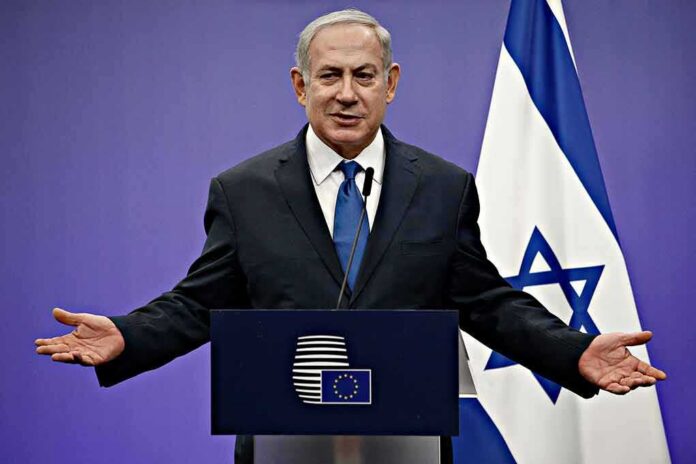
Israeli opposition figures now claim Benjamin Netanyahu is “too pro‑Palestinian,” pointing to his past words about a conditional Palestinian state that he has repeatedly said he never retracted.
Story Snapshot
- Opponents cite Netanyahu’s 2009 speech backing a demilitarized Palestinian state under strict conditions.
- Netanyahu later said he never withdrew that position, while calling statehood “unachievable” at the time.
- Major outlets long noted his Bar‑Ilan remarks as an embrace of two states, within firm red lines.
- Claims of him being “pro‑Palestine” rely on conditional language, not an open‑ended promise.
What Netanyahu Actually Said At Bar‑Ilan
On June 14, 2009, Prime Minister Benjamin Netanyahu said Israel would accept a Palestinian state if the Palestinians recognized Israel as the Jewish state and if the new state was demilitarized. He also tied this to strict security needs for Israel. Those conditions set a hard ceiling on risk to Israeli citizens. The core line was “a demilitarized Palestinian state” alongside Israel, but only if recognition and security boxes were checked.
Analysts and transcripts show the same core points: recognition, demilitarization, and Israeli security. This was not a blank check. It was a narrow offer meant to prevent a one‑state spiral or foreign pressure, while holding to non‑negotiable security red lines. A respected reference summarized the framework as willingness to accept a Palestinian state only if it met those firm conditions, including defensible borders and a solution to refugees outside Israel.
How The Position Was Described Over Time
When Netanyahu delivered the speech, major media described it as an embrace of the two‑state concept, but noted his limits on recognition and security. That framing has stuck ever since, even as debate raged over sincerity and follow‑through. The New York Times called the moment a surprise to some supporters and a key shift in tone, while still outlining the narrow terms he set from the start.
Years later, Netanyahu told National Public Radio he had not retracted the Bar‑Ilan speech. He said a two‑state deal was “unachievable” under the circumstances then, but he stood by the conditions he laid out in 2009. That statement undercuts claims he flipped back and forth on the core text. It also shows he linked any path to statehood to real‑world security facts, not wishful thinking.
Why Opponents Now Say He Is “Too Pro‑Palestinian”
Opposition leaders and campaign ads now pull the Bar‑Ilan line to say Netanyahu is soft. They point to the two‑state phrasing while downplaying the strict conditions. The tactic is political. It treats a conditional stance as an open endorsement. The record shows a narrow, security‑first blueprint, not a free pass to a sovereign armed neighbor. The plain text and later descriptions back that reading, with terms designed to shield Israel’s safety.
In a campaign advertisement released on October 2, 2026, the right-wing Israeli party "Yisrael Beiteinu" accused Prime Minister Benjamin Netanyahu of "agreeing to the establishment of a Palestinian state" and labeled him "pro-Palestinian." This attack originated from within… https://t.co/VF886ggjus pic.twitter.com/PnmCH27yE0
— THE WORLD CORRESPONDENT (@TheWorldCorresp) October 4, 2026
For American readers, the fight mirrors our own media wars. One quote gets stripped of its “ifs,” then used to hit a rival. The facts say Netanyahu tied any Palestinian state to recognition of Israel as the Jewish state and to total demilitarization. That is not “pro‑Palestine” in the activist sense. It is hard‑edge conditionality. It is the kind of red‑line offer that puts security first, like many conservatives expect from allies in a dangerous region.
Sources:
reddit.com, gov.il, israeled.org, haaretz.com