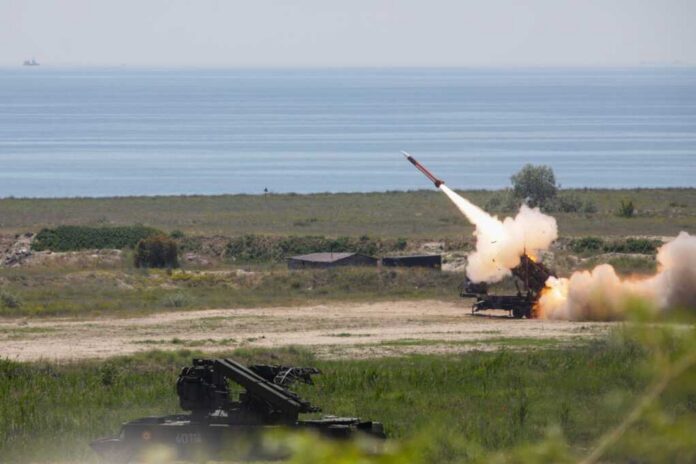
A Chinese-made missile in Iranian hands may have just humbled a frontline American F-15E Strike Eagle, sharpening the threat from the Beijing–Tehran axis that patriots have warned about for years.
Story Snapshot
- U.S. investigators say a Chinese-made shoulder-fired missile likely brought down a U.S. F-15E over southwestern Iran, with both crew surviving ejection.[1][2][3]
- Reports indicate Iran may also have received a Chinese YLC-8B long-range radar designed to detect stealth aircraft, raising alarms about Chinese help targeting U.S. jets.[1][2][3]
- The incident marks the first time in decades a U.S. fighter has been downed by enemy fire, challenging assumptions about American air superiority.[2][3]
- China denies irresponsible arms exports, while U.S. officials caution that details remain under investigation and the evidence available to the public is still limited.[1][2][3]
What U.S. Officials Now Suspect Brought Down the F-15E
According to multiple reports summarizing an NBC News investigation, American officials and sources familiar with the probe believe the F-15E Strike Eagle lost over southwestern Iran in April was likely hit by a Chinese-made shoulder-fired missile operated by Iranian forces.[1][2][3][6] These weapons, known as man-portable air defense systems, are roughly seven feet long, weigh about forty pounds, and are designed so a single fighter can carry, aim, and fire them at low-flying aircraft.[2][3] Investigators reportedly judge such a Chinese system as the most probable cause of the shootdown, though the Pentagon has not publicly named a specific model.[1][3][6]
Reports describe this as the first time in many years that a United States fighter aircraft has been brought down by hostile fire, turning what was once a hypothetical threat into a hard reality.[2][3] President Donald Trump stated soon after the incident that the jet had been hit by a shoulder-launched missile, even before the later suggestion that the weapon was Chinese-made.[2][3] Both crew members ejected safely over Iranian territory and survived, but the loss of a multi-million-dollar front-line strike fighter to a relatively cheap, man-carried missile highlights how vulnerable even advanced aircraft can become when hostile regimes field modern portable air defenses.[2][3][6]
How Chinese Radar and Missiles May Be Empowering Iran
Beyond the missile itself, U.S. intelligence is reportedly examining whether Iran obtained a Chinese YLC-8B long-range early-warning radar designed to detect stealth aircraft and improve tracking of advanced fighters like the F-15E.[1][2][3] Sources cited in these reports say the radar may have been provided early in the conflict, potentially enhancing Iran’s ability to spot and cue targets for its air-defense network, including portable missile teams.[1][3] American officials quoted in the NBC-based coverage stress that any Chinese assistance did not decisively change the battlefield balance but acknowledge it could have improved Tehran’s situational awareness.[1]
Analysts note that modern Chinese man-portable air defense systems, such as missiles in the FN family, use infrared guidance to engage aircraft at low and medium altitudes, with open-source data indicating engagement ranges of roughly five to six kilometers and altitudes over four thousand meters.[3] If similar systems were in Iranian hands near the flight path of the Strike Eagle, they would have had both the reach and the technology to threaten a jet operating in contested airspace.[3][6] This combination—improved radar warning tied to mobile missile teams—fits a broader pattern in which hostile states leverage relatively affordable Chinese technology to erode long-standing American air advantages without matching U.S. capabilities plane-for-plane.[1][3][6]
Unanswered Questions, Denials, and What Is Still Under Investigation
Despite the strong language in media reports, U.S. officials are still formally investigating the circumstances of the April shootdown and have not publicly released debris analysis or a definitive weapons identification.[1][2][3] Much of the public narrative rests on anonymous sources summarized by outlets that repeatedly emphasize terms like “likely” and “may have,” which signal confidence in a general class of weapon while acknowledging that specific proof has not been made public.[1][2][3][6] This is consistent with past incidents where early intelligence-based assessments circulate widely before any detailed technical report is declassified, leaving citizens dependent on secondhand descriptions rather than direct evidence.[1][3]
NBC News reports, citing three sources, that a US F-15E fighter jet shot down in southwestern Iran in April may have been downed by a Chinese-made missile. China denies providing weapons to Iran.https://t.co/QoZCh1I2VO
— World News (NewsBrowse) (@NewsBrowseEN) June 1, 2026
Iranian authorities have not issued any detailed technical statement confirming or denying the use of Chinese-made missiles or radar in this incident, and no competing Iranian forensic narrative has been presented to the public.[1][2][6] A spokesperson for the Chinese Embassy responded to questions by insisting that China acts “prudently and responsibly” on arms exports, follows its export-control laws and international obligations, and opposes what it calls “groundless smear and ill-intentioned association.”[2] With the investigation ongoing and key data still classified, the strongest open-source picture is that American officials consider a Chinese-made man-portable missile the most plausible weapon, while questions about the exact supply chain, radar role, and broader China–Iran military pipeline remain only partially answered.[1][2][3][6]
Sources:
[1] Web – US Officials Suspect Iran Used Chinese Missile To Bring Down F-15E …
[2] Web – Chinese-made shoulder-fired missile reportedly shot down F-15 …
[3] Web – Chinese Missile Likely Downed US F-15 Fighter Jet In Iran: Report
[6] YouTube – How Chinese Tech Downed a US F-15 Strike Eagle!