
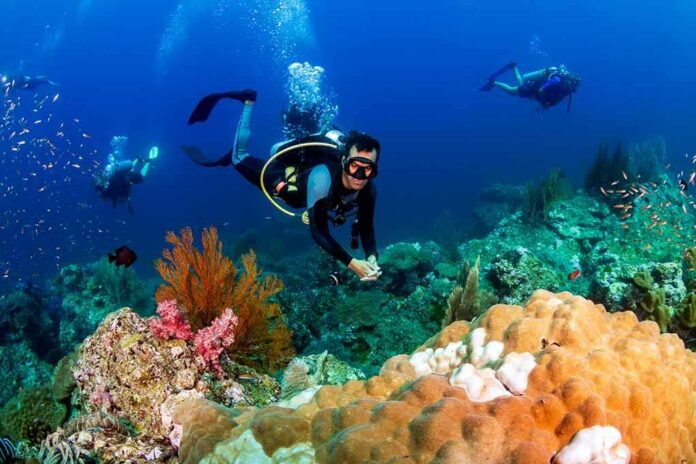
Nearly half of the world’s reef-building coral species are now classified at elevated risk of extinction, with heat stress from warming seas driving most of the danger.
Story Snapshot
- Scientists report 44% of assessed reef-building coral species are threatened.
- Projected ocean heat over the next 30 years is the top driver of risk.
- Bleaching from high temperatures weakens and can kill corals.
- Atlantic reefs show about half of species at elevated risk.
Global Reassessment Finds 44% of Assessed Coral Species Threatened
International Union for Conservation of Nature experts updated the global Red List for warm-water reef-building corals. The group assessed 892 species and had enough data to classify 774. Of those, 340 landed in threatened categories, which equals 44 percent. The total reflects species rated Vulnerable, Endangered, or Critically Endangered. The organization reported a worsening trend since the prior global review in 2008, underscoring a long slide in coral health across many regions, not a one-year blip.
Red List categories show relative extinction risk, not a forecast that nearly half will go extinct. The 44 percent figure could shift with better data on species that lack records. The share would be lower if all data-poor species prove stable, and higher if many are also at risk. The new results still point to broad stress on reefs worldwide, and they align with a rise in widespread bleaching across recent decades reported by multiple scientific teams.
Heat-Driven Bleaching Identified as the Primary Threat
Scientists tie the largest share of risk to climate-change-driven ocean warming. They report that projected heat stress over the next 30 years is the key driver behind risk for most of the species in the highest-risk groups. Warm water causes bleaching, which happens when corals lose their symbiotic algae. Repeated or severe bleaching weakens corals and can cause death. Researchers also note other local pressures, including disease, runoff, and fishing, that can worsen stress.
Research summaries explain the biology in plain terms. Corals rely on algae that live in their tissues and provide energy. Heat breaks that link. When waters stay too hot for too long, corals push out the algae and turn white. If heat lasts, corals starve and die. Scientists say this pattern is now more common and more intense in many regions. That makes future heat exposure a strong predictor of risk, based on observed bleaching and loss events to date.
Regional Findings Show Broad, Not Uniform, Risk
Regional studies match the global picture while showing differences by ocean basin. A peer-reviewed study of Atlantic shallow-water reef-building corals found about half of the species at elevated risk. The analysis estimated that 39 species, or roughly 46 percent of those assessed, were threatened. The authors linked risk mainly to climate pressures while noting local stressors. This mirrors the global result but also shows that some regions face even higher relative risk than the worldwide average.
The global update used data through 2020, before the widespread bleaching reported during 2023 through 2025. University reporting on the assessment notes that timing gap. Current risk could be higher or lower depending on how reefs fared in that period, but the reassessment did not include those newer data. That means future reviews may adjust categories as fresh surveys and heat records come in from that global bleaching event.
Why This Matters for Food, Coasts, and Security
Coral reefs support fisheries that feed families and sustain local jobs. Healthy reefs protect coasts from storms by breaking waves. They also draw tourism that funds small businesses. When reefs bleach and die, fish stocks fall, shorelines face more erosion, and local economies suffer. Policymakers weigh these costs when setting priorities for energy, fishing, and water quality. The new risk flags suggest communities should plan now to guard food security and coastal safety as heat stress grows.
44% of assessed reef-building coral species are threatened with extinction, up from about a third in 2008.
Corals face a faster rise in extinction risk than any other fully assessed group, a new study in @Nature study finds.https://t.co/ZciLWHnCyG#IUCNRedList @cordioea pic.twitter.com/6AGjPVbEiO
— IUCN (@IUCN) October 15, 2026
Scientists outline practical steps that can help buy time. They point to cutting local pollution and runoff, improving fishing rules, and restoring reefs where possible. These actions cannot stop heat-driven bleaching by themselves, but they can boost resilience so reefs recover faster after hot spells. The Red List signals where help is most urgent. Agencies and local leaders can use the results to target support, track progress, and protect the most vulnerable species and places.
Sources:
youtube.com, iucn.org, iucn.nl, nhm.ac.uk, apnews.com