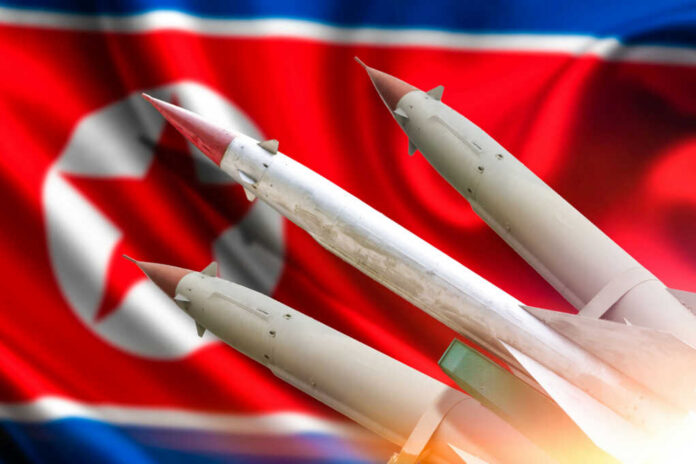
North Korea’s latest shots into the Yellow Sea were less about physics and more about politics—loud messages written in contrails at dawn. [1]
Story Snapshot
- South Korea reported several North Korean missiles launched toward the Yellow Sea at about 7 a.m. local time. [1]
- Seoul framed the event as a weapons demonstration, not a one-off technical drill. [1]
- Initial public details were thin, fueling a familiar lag between launch facts and strategic interpretation. [1]
- Recent Korean Peninsula launch patterns point to calibrated coercion over routine testing. [1]
What Happened And Why It Matters Right Now
South Korea’s Joint Chiefs of Staff reported North Korea fired several missiles toward the Yellow Sea, setting off another round of pre-breakfast crisis management in Seoul and alert-posture checks among allies. Officials called it a weapons demonstration, a phrase that shifts the event from lab work to theater—military signaling aimed at shaping adversary decisions. That label suggests Pyongyang wanted audiences in Seoul, Washington, and Beijing to watch, calculate, and worry, even as intelligence agencies worked to confirm the exact systems and flight profiles. [1]
Regional reporting frequently arrives with more heat than light in the opening hours. Early accounts often describe “unidentified projectiles,” leaving room for confusion over whether a given launch was ballistic, cruise, or short-range, and whether it exercised new capability or simply repeated a play from last season’s script. That ambiguity itself can serve North Korea’s purposes, injecting uncertainty into alliance planning cycles and tempting pundits to over- or under-interpret the intent before the facts settle. [1]
The Pattern: Demonstrations, Not Accidents
Launches into surrounding seas are not rare outbursts; they are recurring instruments of statecraft. Pyongyang stacks them alongside artillery barrages, submarine claims, and parade unveilings to keep pressure on sanctions coalitions and to pry at seams between allies. South Korea’s characterization of the Yellow Sea event as a weapons demonstration fits that pattern. Demonstrations test radars and reactions as much as engines and guidance, probing who scrambles, who stays put, and how fast warnings flow through the alliance. [1]
Coverage habitually outpaces confirmation, and that timing favors the provocateur. North Korea acts; allied militaries verify; media narrate; markets and publics react. The tactical facts—range, altitude, maneuvering—often arrive last. In this case, officials acknowledged limited immediate detail while still emphasizing the signaling dimension. That blend—thin telemetry, strong message—has become a hallmark of North Korean coercive diplomacy, where ambiguity is not a bug but a feature calibrated to complicate deterrence calculus without triggering open conflict. [1]
Counter-Claims And The Limits Of Certainty
Some analysts argue these are routine tests or defensive checks, noting that initial reports rarely lock down system identity and performance. That caution is warranted; the most responsible first-day summaries document launches and quote official characterizations while flagging gaps in public data. In the Yellow Sea case, South Korea’s military led with the weapons demonstration framing but also noted that intelligence agencies continued analyzing. The absence of full technical disclosure should temper sweeping conclusions, but it does not erase the strategic messaging Seoul perceived. [1]
🚨 North Korea fired multiple unidentified projectiles from its west coast toward Yellow Sea, South Korea
Early assessments suggest possible short-range ballistic missiles and rocket artillery systems aimed at testing missile-defense penetration capabilities#黒牢城 #yogibo pic.twitter.com/MFLcVTS7DZ
— Defense24/7 (@Defense247) May 26, 2026
American conservative common sense applies here: judge by incentives and track record. A regime that times tests to diplomatic calendars and domestic anniversaries, that couples launches with propaganda claims, and that measures outside reactions like a focus group is not simply tinkering in a laboratory. The safer bet is calibrated provocation short of war, designed to win concessions, split allies, or extract headlines that elevate regime prestige at home. That assessment aligns with South Korea’s read on this event. [1]
What To Watch Next: Signals Of Escalation Or Containment
Several indicators will tell whether this demonstration was a standalone message or the first note in a larger chorus. Watch for follow-on launches in different theaters, such as the East Sea, that broaden the stress test on allied defenses. Monitor whether Pyongyang pairs kinetic activity with diplomatic demands or domestic propaganda spikes. Track allied exercises, sanctions enforcement, and missile defense posture adjustments, which can either harden deterrence or be spun by Pyongyang as justification for the next “response” in a familiar action-reaction loop. [1][3]
Sources:
[1] Web – North Korea launches cruise missiles into Yellow Sea in latest …
[3] YouTube – Iran Ally Launches Ballistic Missile Near U.S. Military Hub In East …