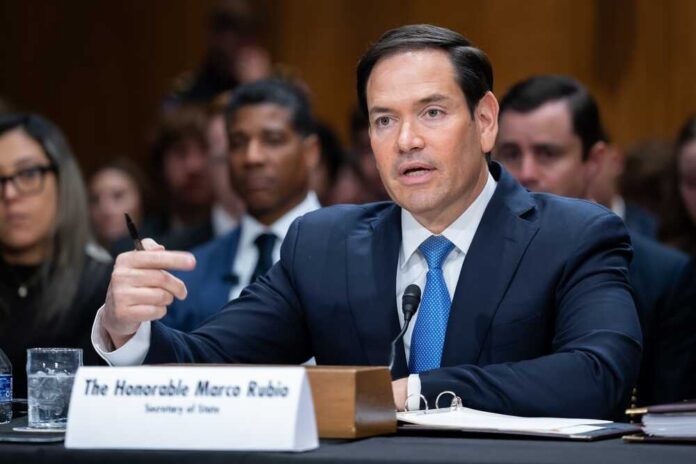
“Stop supporting Israel!” a protester shouted as security halted a House hearing, thrusting Marco Rubio’s defense of U.S. policy into the center of a combative fight over war powers, foreign aid, and transparency.
Story Snapshot
- A protester interrupted a House hearing as Secretary of State Marco Rubio defended the administration’s foreign policy priorities [7].
- Rubio asserted the Iran war is effectively over and rejected the War Powers Act framework, drawing challenges from senators in parallel proceedings [1][4][9].
- Democrats pressed Rubio on delayed briefings and budget cuts, including concerns tied to Ebola response and World Health Organization funding [3].
- Rubio faced questions about time-limited waivers that allowed Russian oil sales while sanctions remained in place [3].
Protest Disruption Highlights Capitol Hill Tensions
House proceedings paused when a protester yelled “Stop supporting Israel!” as Secretary of State Marco Rubio defended the administration’s posture, mirroring heated scenes outside Senate rooms the same day [7]. Coverage documented demonstrations labeling Rubio a “terrorist,” underscoring how activist theatrics now routinely intrude on oversight work. The interruption framed the hearing’s stakes: whether America projects strength and clarity in wartime, or yields the national conversation to street pressure and slogans that reduce complex policy to moral outrage without evidentiary backing [7].
Hearing coverage shows Rubio standing firmly behind a foreign policy built on U.S. national interests, economic security, and sovereignty, presenting results-focused claims while rejecting accusations that the approach lacks compassion or legality [1][6]. Rubio characterized the Iran conflict as effectively concluded, signaling a transition to deterrence and maritime security operations. That position immediately collided with critics who demanded formal legal rationales and fuller intelligence briefings, illustrating the recurring struggle between executive urgency and congressional oversight demands during active crises [1][4].
War Powers, Blockade Claims, and Legal Scrutiny
Senators pressed Rubio on the legal basis for operations tied to Iran, including a blockade posture and the administration’s view that the War Powers Act is unconstitutional [1][9]. Skeptics argued that calling the war “over” while maintaining coercive pressure invites questions about ongoing authority and reporting. The dispute centered on process and proofs, not only outcomes: lawmakers asked for legal memoranda and intelligence details, while Rubio insisted the posture deterred aggression and protected shipping without unnecessary escalation [1][4][9].
Critics did not offer primary-source rebuttals to operational claims about degraded Iranian missile and drone capabilities in the available coverage, leaving assertions about battlefield effects largely unanswered in open session [1][4]. That evidentiary gap favors the administration’s narrative in the short term, even as senators requested more documentation. The back-and-forth reflects a familiar Washington pattern: the executive emphasizes deterrence and speed; Congress fights to document legality and measure strategic effectiveness before writing the next check [1][3][5].
Budget Fights, Ebola Concerns, and Aid Priorities
NPR’s account captured Democratic objections to proposed State Department reductions, including a cited forty-four percent cut and eliminating World Health Organization funding during an Ebola outbreak [3]. Lawmakers questioned whether trimming multilateral channels and slowing some releases—such as a cited forty million dollars through a vaccine alliance—could undercut lifesaving work in Africa. Rubio answered that aid must be targeted to succeed and that insecurity, not indifference, limits distribution in war zones, but critics argued priorities were narrowing away from acute crises [3].
Secretary of State Marco Rubio will appear on Capitol Hill today for his first public testimony before lawmakers since the Trump administration launched the war in Iran.
Two more hearings are scheduled for Wednesday. https://t.co/Rkn29mpdsO
— The Washington Post (@washingtonpost) June 2, 2026
Sanctions policy drew additional heat as senators referenced time-limited waivers that had permitted Russian oil sales, offering Moscow financial breathing room amid war, and asked whether such licenses would continue [3]. Rubio faced a classic sanctions paradox: restrict revenue without spiking global prices or punishing allies. The hearing record, as summarized publicly, did not include Treasury license files or detailed revenue estimates, leaving both sides to argue principles while the underlying data remains outside open view [3].
Transparency Delays and the Oversight Clash
Lawmakers complained that the State Department delayed responses on European force posture and Romania’s visa program while falling behind on briefings for Ukraine and Iran, transforming a policy debate into an institutional one about respect for Congress [3]. That critique carries weight because it is procedural and verifiable, not merely partisan. Rubio’s defenders counter that wartime pace and classified sensitivities constrain disclosures, but delayed documentation risks alienating even persuadable senators who want facts before funding [3].
What Conservatives Should Watch Next
Three tests now matter. First, the administration’s promise of deterrence must hold in the Gulf, with safe shipping and de-escalated threats validating Rubio’s claims [1][4]. Second, the State Department should deliver overdue briefings and legal justifications to lock in congressional backing without surrendering executive authority in emergencies [3][9]. Third, budget reforms must prove they cut bureaucracy, not frontline outcomes, by channeling aid where it is secure, accountable, and consistent with American interests and taxpayer respect [3].
Sources:
[1] Web – Marco Rubio Went to Capitol Hill Today, and the Smackdown Was Brutal
[3] YouTube – Sec. Marco Rubio testifies before Senate panel on State …
[4] Web – Marco Rubio faces tough questions about Ebola, Iran and more at …
[5] YouTube – Rubio testifies on Capitol Hill for the 1st time since start of Iran …
[6] Web – Hearings & Meetings – U.S. Senate
[7] YouTube – Secretary of State Marco Rubio Testifies at U.S. Senate
[9] YouTube – Secretary Rubio testifies before the Senate Committee on Foreign …