
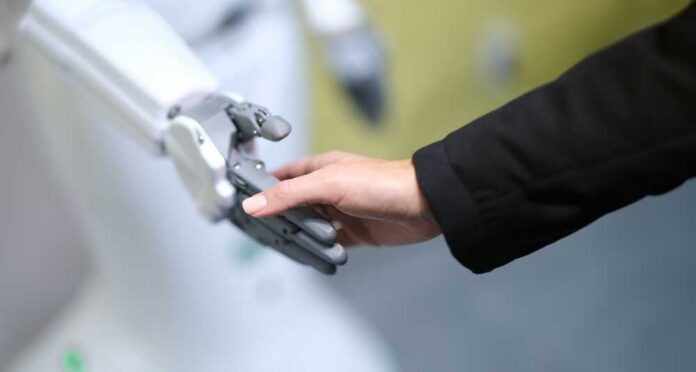
China’s humanoid robots have obliterated the human half-marathon world record, completing the 21-kilometer course in under 51 minutes—nearly three times faster than last year’s debut and raising urgent questions about American competitiveness in the global robotics race.
Quick Take
- Honor’s autonomous robot “Flash” finished the Beijing E-Town Half-Marathon in 50 minutes 26 seconds, demolishing the human world record of 57:20 set by Jacob Kiplimo last month
- The winning robot was nearly 3x faster than 2025’s inaugural winner, signaling exponential advancement in Chinese robotics technology within a single year
- Over 100 robot teams competed alongside 12,000 humans on parallel tracks, with Honor sweeping the top three positions and demonstrating clear technological dominance
- The race showcased autonomous navigation capabilities and advanced cooling systems derived from smartphone technology, highlighting China’s innovation momentum in a critical tech sector
- This development underscores the widening gap between American and Chinese robotics capabilities, raising concerns about U.S. technological leadership and economic competitiveness
A Stunning Display of Chinese Technological Advancement
On April 19, 2026, Honor’s humanoid robot completed the Beijing E-Town Half-Marathon course in 50 minutes 26 seconds using autonomous navigation, surpassing Jacob Kiplimo’s human world record of 57:20 established in Lisbon just weeks earlier. The robot’s performance represented a watershed moment: it finished ahead of the human event winners—Zhao Haijie (1:07:47) and Wang Qiaoxia (1:18:06)—by substantial margins, demonstrating that autonomous machines have crossed a critical threshold in athletic performance benchmarking.
The scale of improvement from 2025 to 2026 cannot be overstated. Last year’s inaugural race saw Tiangong Ultra’s robot complete the course in 2 hours 40 minutes 42 seconds amid numerous technical failures, with only 6 of 20 teams finishing. This year, over 100 robot teams competed, and Honor’s winning time was nearly three times faster—a trajectory that signals exponential capability gains rather than incremental progress. Such acceleration raises legitimate concerns about whether American robotics development can maintain competitive parity.
Engineering Innovation Behind the Victory
Honor engineer Du Xiaodi explained that the robot’s design deliberately emulated elite human runners’ biomechanics to sustain speed over the full distance. The winning robot stands 1.69 meters tall with 90-95 centimeter legs and incorporates liquid cooling technology derived from smartphone engineering—a practical adaptation that demonstrates how cross-sector innovation accelerates advancement. The robot’s autonomous navigation capability, representing approximately 40-50% of this year’s field, contrasts sharply with 2025’s predominantly remote-controlled competitors, indicating a decisive shift toward independent machine decision-making.
This engineering approach reflects a broader strategy: Chinese firms are not simply building faster machines but are systematizing athletic performance through biomechanical analysis and thermal management. The cooling system’s effectiveness proved critical for maintaining consistent pace over 21 kilometers, addressing a fundamental challenge that separates theoretical capability from sustained real-world performance. Such technical sophistication suggests these robots could transition from exhibition events to practical applications in logistics, disaster response, and hazardous environments where human workers face danger or fatigue constraints.
The Competitive Context and What It Means for America
The Beijing E-Town Half-Marathon occurs within a larger U.S.-China technological competition intensified by American chip export restrictions imposed in 2023. Chinese humanoid robotics surged precisely in response to these constraints, with state-backed innovation accelerating development timelines. Honor’s Huawei affiliation and the participation of over 100 teams signal that China’s robotics sector operates at industrial scale, not as isolated research projects. This ecosystem-level advantage compounds over time, allowing rapid iteration and capability diffusion across competing firms.
Humanoid Robot Smashes Human Half Marathon Record in Beijing — Nearly 3x Faster Than Last Year! (VIDEO)! https://t.co/IqdqAmOG9w #gatewaypundit via @gatewaypundit
— 🍊Orwell Was Right🍊 (@PMgeezer) April 20, 2026
American policymakers and technology leaders should recognize this event as a data point in a concerning trend: Chinese firms are demonstrating faster innovation cycles, achieving autonomous capabilities sooner, and scaling production more aggressively than Western competitors. The robots’ performance validates cooling and navigation technologies applicable far beyond athletic demonstrations. If China establishes dominance in humanoid robotics—a sector with immense commercial and defense implications—the consequences for American economic competitiveness and national security extend well beyond a single race in Beijing.
Implications for Workers and the Future Economy
While celebrating engineering achievement, citizens across the political spectrum should confront an uncomfortable reality: machines are rapidly approaching or exceeding human capability in physically demanding tasks. This transition will reshape labor markets, potentially displacing workers faster than retraining programs can accommodate. Beijing tech workers, logistics employees, and others in physically demanding sectors face genuine uncertainty about long-term employment prospects as robotics capabilities accelerate. The question is not whether automation will advance but whether American workers and communities will be prepared for the economic disruption ahead.
Both conservative and progressive Americans share legitimate concerns about whether government and industry are adequately planning for this transition. Conservative emphasis on individual initiative and market solutions must confront the reality that workers cannot simply “retrain” faster than technology disrupts entire sectors. Progressive concern for worker welfare must acknowledge that restrictive policies on automation may only cede technological leadership to competitors without protecting jobs. The Beijing race serves as a clarion call: American leadership requires honest acknowledgment of the challenge and strategic coordination between government and industry to ensure workers and communities are not left behind in the robotics revolution.
Sources:
Chinese robot breaks human world record in Beijing half-marathon
Humanoid robot surpasses human half-marathon world record in Beijing
Humanoid robots race past humans in Beijing half-marathon, showing rapid advances
Beijing E-Town Half-Marathon results and analysis
Humanoid robot wins half-marathon in China, beats world record