
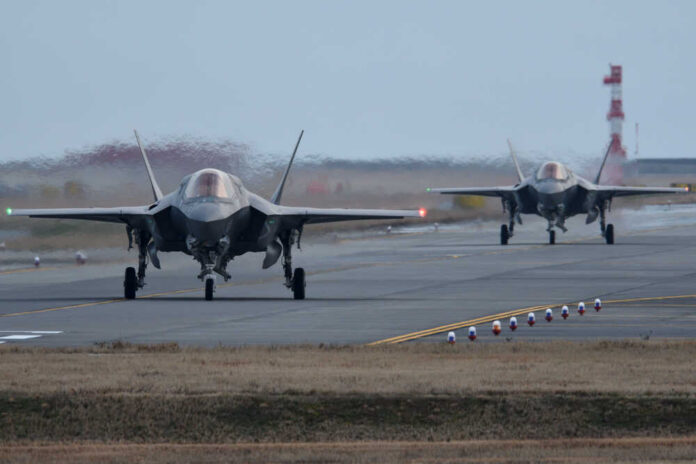
As America fights Iran, the Pentagon is taking delivery of brand-new F-35s that can fly—but aren’t ready to fight.
Quick Take
- Reports say some Lot 17 F-35s are being accepted without the next-generation AN/APG-85 radar because certification is delayed.
- To keep production moving, aircraft are reportedly shipped with ballast in the nose to maintain balance and allow training flights.
- Lawmakers and defense reporters warn these jets are not “combat-coded,” creating a readiness gap at the worst possible time.
- The Joint Program Office says the jets are built to accommodate the new radar, but details and timelines remain limited for security reasons.
Radar-less F-35 deliveries expose a readiness problem during wartime
Defense outlets report that new F-35 Joint Strike Fighters from Lot 17 production are arriving without the planned AN/APG-85 radar, a key piece of the Block 4 modernization effort. Instead of halting production, the aircraft are reportedly delivered with ballast to preserve flight characteristics, making them airworthy for training but not combat-coded. In a shooting war with Iran, that difference matters: training aircraft don’t deter enemies or protect Americans in contested airspace.
Reporting indicates the timeline stretches back months, with early accounts suggesting radar-less deliveries began as far back as mid-2025 and continued into 2026. A late-February 2026 acceptance flight for a radar-less F-35B at Lockheed Martin’s Fort Worth facility was widely cited as a turning point because it signaled formal movement toward fleet delivery. The operational impact depends on how many aircraft are affected, but estimates range from a limited batch to potentially more than 100.
What the APG-85 delay means—and why “ballast” is a red flag for taxpayers
The APG-85 is described as a next-generation AESA radar intended to improve detection, tracking, and resilience in electronic warfare compared with the APG-81. Because the radar is government-furnished equipment, delays land squarely in the government’s integration and certification lane, not just the airframe manufacturer’s. Still, the practical result looks the same to voters: extremely expensive aircraft delivered in a configuration that cannot be used for the mission Americans assume they’re buying.
Several reports emphasize that an F-35 is not totally “blind” without its main radar because it can use other sensors and networked data, including datalinks, to build a picture of the battlespace. That is a real mitigation—until it isn’t. Network dependence becomes a vulnerability when facing capable jamming, cyber interference, or degraded communications. Wartime planners have to assume the enemy will attack the links first, and an aircraft optimized for the toughest environments should not be forced into a work-around posture by procurement delays.
Congressional oversight focuses on combat-coded capacity, not press releases
Rep. Rob Wittman, who chairs the House Armed Services subcommittee covering tactical air and land forces, has warned publicly that the situation leaves “lots of aircraft” not ready for a fight. That warning aligns with the core facts reported across multiple defense publications: the aircraft can fly and train, but combat coding requires the right hardware and certified software. The oversight question is straightforward—how many near-term combat sorties are being traded away to keep a production line moving?
TR-3 and Block 4 delays add pressure as the war expands demands on the fleet
Radar delivery problems are unfolding alongside broader modernization turbulence, including continued reporting about TR-3 software instability and Block 4 schedule slips. Even readers who support a strong military can see the constitutional and political issue here: wartime urgency often becomes the excuse for rushing spending while lowering performance standards. If the government is accepting jets for “training” that were sold to the public as decisive combat power, the burden is on the Pentagon to explain timelines, costs to retrofit, and how it will prevent a hollow-force moment.
At minimum, the reporting indicates the services are trying to balance two realities at once: they need airframes to keep pilot pipelines moving and to transition squadrons from legacy aircraft, but they also need combat-ready jets now. That tradeoff becomes especially hard to justify in 2026’s strategic environment, where Americans are watching another Middle East war unfold and asking whether Washington can deliver competence without sliding into open-ended commitments. On this issue, transparency and accountability are not partisan—they’re prerequisites for national defense.
Sources:
Flying Blind: Why New F-35 Lightening II Stealth Fighters Are Arriving Without Radars
Reports Suggest F-35s Delivered Without Radar
The Military Is Preparing to Accept Deliveries of F-35s Without a New Advanced Radar Installed
Are F-35s Being Delivered To The USAF Without Radars? Sure Seems Like It
Exclusive: US poised to accept new F-35s without radars, sources say
F-35 Lightning II Stacks Up J-20 Mighty Dragon (2026)
New F-35 Lightening II Stealth Fighter Update Has Chronic Stability Deficiencies
F-35s Flying Blind: U.S. Air Force