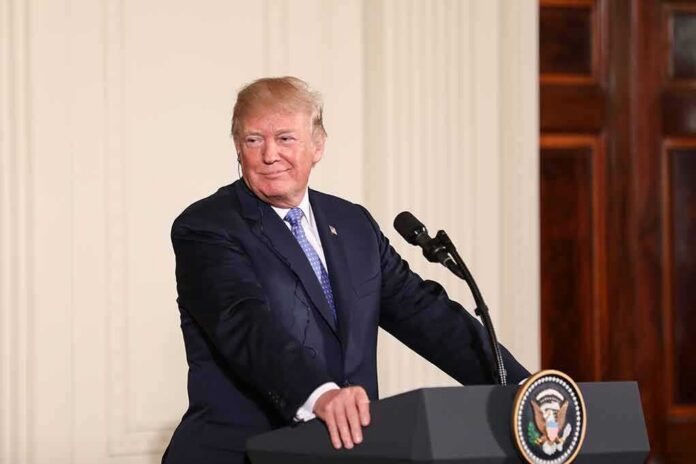
President Trump said a united Ireland would be “fantastic,” drawing sharp unionist pushback and fresh debate over who gets to decide the region’s future.
Story Highlights
- Trump said he would “love to see” Irish unification and called it “fantastic.”
- Unionist leaders replied that only voters in Northern Ireland can decide its status.
- The Good Friday Agreement sets the consent rule for any constitutional change.
- United Kingdom leaders reiterated support for the consent principle amid the uproar.
Trump Praises Irish Unity While Meeting Irish Leadership
President Trump, during a visit to Dublin, said a united Ireland would be a “fantastic thing” and that he would “love to see” it, adding he believes it will happen “eventually.” He delivered the remarks alongside Ireland’s prime minister during press availability, which ensured maximum attention at home and abroad. Trump spoke about unity in positive terms and framed it as a likely outcome, not just a distant hope, which raised policy questions and political alarms.
Coverage across networks and international outlets repeated Trump’s language and tone. Some reports highlighted his suggestion that if unification is bound to come, it might as well come sooner. Others noted that while the United States has long backed peace and stability, it has typically avoided leaning into one eventual outcome. The moment in Dublin, paired with on-camera clips and follow-up quips, kept the comment in headlines and stirred fresh discussion in London and Belfast.
Unionist Response: Decisions Rest With Northern Ireland Voters
Democratic Unionist Party leader Gavin Robinson replied that Northern Ireland’s constitutional future belongs to its people, not to comments from Washington, London, or Dublin. He stressed that elections matter and that Northern Ireland is part of the United Kingdom by the settled democratic will of its people. His message matched a long record of unionist and parliamentary statements that the path of the region must be chosen by voters there, not by outside actors or pressure.
United Kingdom officials echoed the legal baseline. Recent statements from Downing Street and the Northern Ireland Secretary said they stand behind all parts of the Good Friday Agreement, including how and when a border poll could occur. That stance does not pick a side on unity. It simply restates that any change requires consent through a lawful process. In short, even loud global voices do not move the legal lock that guards Northern Ireland’s status.
The Consent Principle: How Change Would Actually Happen
The Belfast and Good Friday Agreement sets a clear test. Any change in Northern Ireland’s status must be approved by a majority there in a vote. Most expert explainers further note that the island’s people, North and South, hold the right of self-determination, which implies matching consent in the Republic of Ireland as well. This framework keeps peace first and blocks sudden shifts. It places final say with voters, not presidents, prime ministers, or pundits.
Trump reiterates support for united Ireland, says won’t talk about Scotland ‘yet’ https://t.co/MJZrNwuupx
— CTV News (@CTVNews) September 13, 2026
For conservative readers, the lesson is simple: guard the process, not the noise. Trump praised Irish unity while also elevating a national identity theme many on the right understand. But the law still rules the outcome. The consent principle protects local choice, limits overreach, and keeps foreign or elite pressure from forcing change. That approach aligns with core values of sovereignty, self-government, and respect for democratic votes rather than top-down deals.
Sources:
youtube.com, the-independent.com, bbc.com, newscord.org, committees.parliament.uk