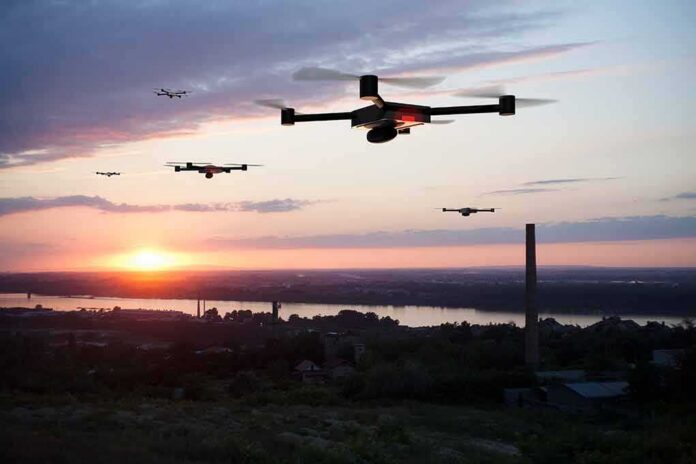
U.S. intelligence says Iran restarted drone production during the April ceasefire and is rebuilding faster than expected, raising fresh threats to American forces and allies.
Story Highlights
- U.S. intelligence reports Iran resumed drone manufacturing during a six-week April ceasefire.
- Analysts say Iran’s military industry is recovering faster than prior estimates.
- CNN reports Iran could restore full drone attack capacity within six months.
- Satellite images show Iran repairing and fortifying key military sites.
Intel Signals Rapid Rebuild Of Iran’s Drone Programs
Reuters and CNN reported that U.S. intelligence found Iran restarted parts of its drone manufacturing during a six-week ceasefire that began in early April 2026. Officials familiar with assessments said Iran’s broader military industrial base is rebuilding at a pace that exceeds earlier estimates, a trend that could restore regional strike pressure if left unchecked. CNN added that thousands of Iranian drones remain, about half of pre-strike capacity, with full attack capability possible within six months.
These findings matter for U.S. troops, partners, and energy routes. Drones threaten bases, shipping, and cities across the Middle East. Faster rebuild speed means the window to deter, disrupt supply chains, and harden defenses is short. The Trump administration now must weigh tighter sanctions, targeted interdictions, and stronger air defenses for allies. The goal is simple: deny Iran the parts, cash, and safe havens that turn plans into swarms.
Imagery And Field Damage Tell A Two-Sided Story
Satellite images reviewed by Reuters showed Iran repairing and fortifying sites after earlier strikes, including logistics compounds and likely command nodes. Crews cleared debris and added protective measures, signaling a focus on resilience under fire. The Institute for the Study of War said key drone infrastructure, such as the Shahed Aviation Industries facility in Esfahan and the Ali Akbar Drone Base in Ahvaz, took real damage, confirming serious hits on production lines that Iran would need to rebuild.
This mix of confirmed damage and visible repairs fits a known pattern. Modern drone networks spread work across many nodes. When large plants take hits, smaller shops, storage sites, and dispersed assembly lines can restart output with imported parts. Analysts say Russia has supported this recovery by sending drone components, further shortening Iran’s path back to the battlefield. That is why a strike campaign alone is rarely enough if the supply chain stays open.
What The Numbers Mean For U.S. Policy And Deterrence
CNN’s report that Iran retained roughly half its drone stock, plus estimates of a six-month path to full attack capability, frames a clear risk calendar for commanders and diplomats. If Iran can reconstitute this fast, the United States and partners must move even faster to block parts, expose front companies, and help allies shoot drones down at lower cost. The mission is to protect Americans, defend trade lanes, and keep pressure on Tehran’s enablers in Moscow.
President Trump’s team can tighten energy and finance sanctions, surge counter-drone systems to high-risk bases, and expand maritime patrols. Washington can also lead joint interdictions against component smuggling and share real-time tracking with partners. Precision strikes have impact, but lasting results come from choking the inputs that keep assembly lines alive. The strategy should pair hard power with relentless economic and legal pressure.
Iran’s Boasts And The Limits Of Public Data
Iranian officials have bragged about big gains. One senior defense figure claimed a threefold increase in drone capacity, while a state-linked summary cited rapid repairs, relocations, and even a tenfold surge within months. These statements show intent and confidence, but they come from regime voices. Public sources do not provide audited factory counts or shipment logs that confirm such large jumps. The strongest open evidence is still U.S. intelligence reporting and satellite imagery snapshots.
Cheap Drones, Dry Taps: Iran’s New War -BLUF: The United States achieved extensive, measurable target destruction but did not convert air superiority into a self-enforcing political settlement.
Iran demonstrated that a weaker force can answer strategic bombing through… pic.twitter.com/r543YJsFLE— debuglies (@debugliesnews) August 14, 2026
For readers asking what comes next, watch for three markers. First, more interdictions of electronics and engines bound for Iran. Second, added air defenses and radar coverage at partner sites. Third, continued strikes on high-value nodes if Iran surges output or targets Americans. Peace through strength is not a slogan here. It is the only way to keep our troops safe, protect trade, and uphold American security in a tough neighborhood.
Sources:
zerohedge.com, reuters.com, gulfnews.com, washingtoninstitute.org, foxnews.com, aa.com.tr, understandingwar.org