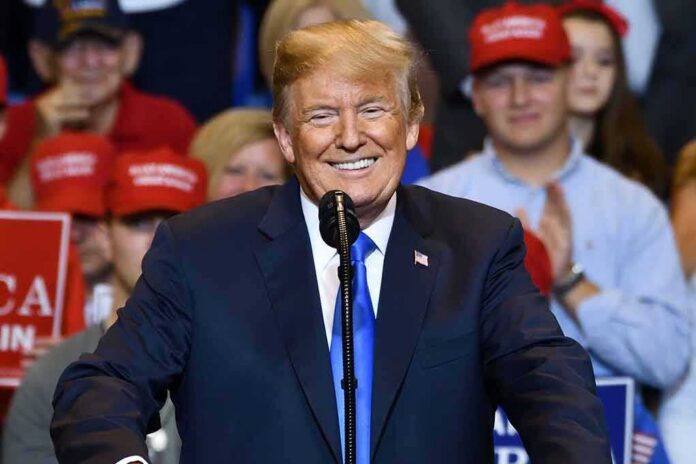
President Trump blasted “AI doomer” warnings as a hoax and vowed to keep America leading the technology race.
Story Highlights
- Trump said AI extinction fears are exaggerated and politically driven, calling himself the “hoax buster.”
- Trump stressed keeping U.S. leadership in AI rather than slowing down, pointing to competition with China.
- Nvidia’s Jensen Huang also rejected end-of-world claims, saying they are not grounded in science.
- Researchers and tech leaders have raised stark warnings, keeping pressure on the White House to show results.
Trump Labels AI Doom Claims a Hoax, Defends U.S. Leadership
Reuters reported President Trump said “very negative forces” were pushing exaggerated fears about artificial intelligence, which he framed as a political effort to slow U.S. progress. He said the robots are not taking over and called himself the “hoax buster,” tying his message to restoring common sense in tech policy. He argued the United States should keep the lead in AI, not kneecap its own industry with panic or premature bans that hand wins to rivals.
CNBC added that Trump dismissed extinction scenarios and focused on staying ahead of China. That means faster building, more data centers, and less red tape, he said. He did not deny that risks exist, but said fear-based regulation hurts workers, families, and national security. He urged critics to judge policies by results: lower costs, better jobs, and stronger defense. He stressed clear rules that target crimes and abuse without strangling innovation.
Industry Pushback on “End-of-World” Rhetoric
Axios reported Nvidia Chief Executive Jensen Huang echoed skepticism toward apocalyptic claims, saying predictions that AI will end humanity are not grounded in science. His view backed Trump’s case that the right response is building responsibly, not freezing progress. Their alignment suggests a coalition between the White House and key industry leaders who want practical safeguards, strong competition, and faster deployment where it helps energy, health, and defense.
Reuters also reported Trump said existing tools can already police the industry. He pointed to laws against fraud, hacking, and child exploitation, along with sector rules for health, finance, and defense. He argued that Washington should enforce those first before writing sweeping new controls. That stance reflects a limited government view: punish real harms, protect civil liberties, and avoid open-ended mandates that grow bureaucracy and raise costs for small businesses.
Safety Advocates Escalate Warnings and Demand Tougher Rules
CNN and other outlets covered a separate wave of warnings from current and former researchers at major labs. They argue that fast, powerful systems could see misuse or lose control, with risks that grow as models scale. Their view shaped recent pushes for emergency pause powers, heavier liability, and licenses for high-risk systems. These proposals would give regulators broad authority over research and deployment, which alarms many conservatives who see room for overreach.
The Center for AI Safety previously rallied hundreds of signatories to call extinction risk a global priority, ranking it with pandemics and nuclear war. That message keeps pressure on lawmakers to act first and ask questions later. But it does not prove that current systems are on an extinction path today. The call is a warning, not a technical audit. It asks for broad action without offering a clear, testable threshold for emergency powers or shutdowns.
What the Evidence Shows—and What It Does Not
Reuters reported Trump’s critics cite named insiders who fear runaway systems or misuse. They point to resignation letters and public posts. Yet the supplied reporting shows no primary technical proof that today’s models are on a verified path to human extinction. There is no government safety audit in the record proving present controls are either fully sufficient or fatally weak. That evidence gap supports Trump’s call to enforce existing laws while growing American capability.
Former Google DeepMind Researcher Warns AI Could “Kill Us All”
Former Google DeepMind researcher Bilal Chughtai has become the latest AI safety expert to publicly warn that rapidly advancing artificial intelligence could pose an existential threat to humanity.
Chughtai, who… pic.twitter.com/6UlTD6LhNT
— BitBiased.AI (@BitBiasedAI) September 15, 2026
Here is the policy bottom line for readers. America should not surrender to fear or to foreign rivals. The administration can pursue three tracks at once: keep U.S. industry on top, enforce current laws hard against actual abuse, and order transparent, time-bound assessments from independent experts. That approach protects families, free speech, and constitutional limits, while stopping real harms. It beats open-ended control schemes that raise prices, crush small firms, and export power to bureaucrats.
Sources:
cnbc.com, reuters.com, cnn.com