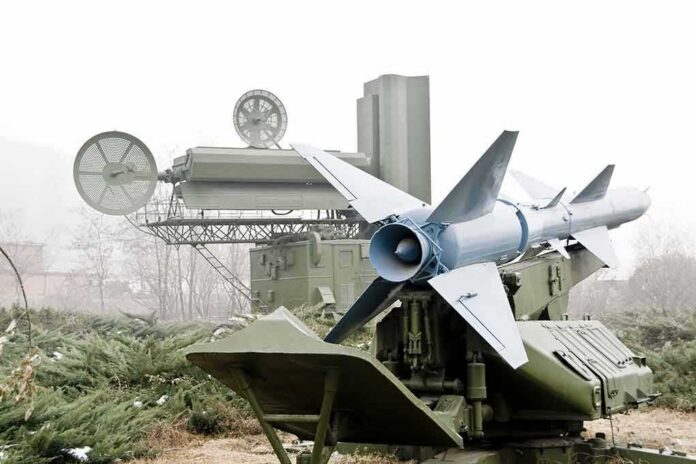
Russia’s vaunted S-400 is still unproven against America’s F-22 and F-35, and battlefield losses keep exposing its limits.
Story Highlights
- Russia advertises the S-400 as a “stealth killer,” but no verified test against U.S. fifth-gen jets exists.
- Ukraine has struck S-400 sites, showing real gaps in Russia’s air defense on the ground.
- Analysts say the S-400 struggles with jamming, small targets, and some missile types.
- Takeaway: U.S. airpower and smart tactics still outmatch Moscow’s propaganda.
Russia’s Sales Pitch Meets a Harder Reality
Russian state outlets have long claimed the S-400 can detect and destroy stealth aircraft. TASS reported the system is meant to hit attack and stealth planes, and other air targets, as Moscow rolled out new regimental sets years ago. Those messages fed a global push to market and export the battery. But one core fact remains firm today: no publicly verified combat engagement has ever tested an S-400 against a United States F-22 Raptor or F-35 Lightning II. That gap matters more than hype.
Nations bought the pitch anyway. Russia delivered systems to foreign buyers and boasted about range upgrades and new missiles to extend reach. The goal was clear: deter North Atlantic Treaty Organization (NATO) airpower and scare pilots out of contested skies. Yet advertising is not combat. The United States designs fifth-generation tactics to break kill chains, blind radars, and strike from standoff. Without verified S-400 kills against fifth-gen jets, Russia’s claims stay in the talk stage, not the proof stage.
Combat Record in Ukraine Shows Vulnerabilities
Ukraine’s strikes have damaged Russia’s S-400 units and radars, reducing local air-defense coverage. Satellite images and field reports documented destroyed launchers and key radar sets, leaving one site nonoperational near Novorossiysk. Separate reporting said Ukraine eliminated an advanced system in Crimea, a major blow in a critical area for Russian operations. Another strike inside Russia’s Belgorod region further degraded defenses north of Kharkiv, undercutting Moscow’s layered shield. These events reveal weaknesses in protection and positioning.
Independent analysts and reporters have flagged systemic issues. One review described the S-400 as formidable on paper but not living up to the hype in Ukraine, with trouble intercepting some ballistic targets and other potential gaps that better forces could exploit. A separate analysis quoted a U.S. expert saying the system has major weak points, can be vulnerable to electronic jamming, and may be confused by small, slow targets like drones. These findings match the battlefield pattern: Ukraine uses drones, decoys, jamming, and timing to peel back layers and hit high-value nodes.
What This Means for U.S. Airpower and Deterrence
For U.S. readers, the lesson is simple. America’s edge rests on well-trained crews, strong supply lines, and tactics that do not advertise themselves. President Trump’s defense team continues to back readiness, innovation, and industrial strength so our pilots and systems stay ahead. Russia’s claims about a “stealth killer” do not change that. If a system cannot protect itself from drones and missiles on its home turf, it will not stop a full U.S. air campaign that blends stealth, jamming, cyber, and standoff strikes.
🇷🇺🇰🇵 50,000 North Korean Troops for Russia?
Russia may invite up to 50,000 North Korean soldiers to fight in Ukraine in exchange for advanced military technology, reportedly including the S-400 air defense system.
If true, tens of thousands of North Korean troops could be… pic.twitter.com/IXpEv00vBP
— Defense Intelligence (@DI313_) August 21, 2026
This debate also shows why Congress must fund a bigger, smarter arsenal and resist globalist distractions. Our adversaries push propaganda to scare allies and split NATO. The right answer is resolve and facts. The record shows no verified S-400 kill on an F-22 or F-35, while real combat has exposed cracks in Russia’s integrated air defenses. American airpower remains the gold standard when leaders back it with focus, accountability, and the will to win.
Sources:
eurasiantimes.com, cnbc.com, csis.org, united24media.com, euromaidanpress.com, wsj.com, reuters.com, lemonde.fr