When a student debate needs road closures, mass policing and shuttered pubs to go ahead, remarks about critics being “cooked” without security say less about ideology than about the hard edge of campus risk management in the age of polarised speech.
At a Glance
- The Oxford Union’s Islam debate with Tommy Robinson went ahead under a major security operation, with streets closed and protests outside.
- President Arwa Elrayess, a Muslim student of Palestinian heritage, told critics that without security “you’d be cooked,” reflecting genuine safety concerns rather than a threat.
- Local officials, police and Muslim groups all warned that Robinson’s invitation posed risks to public order and Muslim students’ safety.
- The episode encapsulates a wider pattern: controversial far‑right or anti‑Islam events now routinely sit at the intersection of free speech, targeted communities’ fear, and heavy policing.
What Happened Around the Oxford Union Islam Debate
The Oxford Union’s decision to host a debate on the motion “This House Believes the West is Right to be Suspicious of Islam,” with Tommy Robinson speaking in favour, instantly moved the event out of the realm of routine student politics and into a city‑wide security operation. Robinson, long associated with anti‑Muslim activism, drew intense opposition from faith leaders, campaigners and student groups who argued that his platforming at Oxford would endanger Muslim communities and inflame local tensions.
Thames Valley Police confirmed a “significant policing operation” in central Oxford on the day of the debate. St Michael’s Street, where the Union sits, was closed to vehicles and pedestrians for several hours, and reporting from local and national outlets described a heavy police presence, early pub closures and businesses “shutting up shop” in anticipation of unrest. Council leader Susan Brown publicly stated the event would require “extensive police resources and road closures” and argued that the Union should pay for the “large-scale security operation,” underlining that this was not a standard campus talk but a genuine public‑order concern.
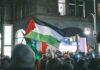
Outside the chamber, several hundred protesters gathered, many chanting anti‑fascist slogans and calling for “no platform” for Robinson. Videos from the scene capture chants such as “Nazis off our streets” and “Refugees are welcome here,” alongside placards framing Robinson as a fascist whose speech targets migrants, Muslims and people of colour. Inside, the debate proceeded under strict control, and the motion was ultimately defeated by a relatively narrow margin of 57 votes against to 41 in favour, as reported by Middle East Eye and others.
Arwa Elrayess: A Controversial President in a Controversial Room
Presiding over this fraught event was Arwa Hanin Elrayess, a 20‑year‑old politics, philosophy and economics student, the first Palestinian and first Arab woman elected president of the Oxford Union. Her election in Trinity Term 2026 was widely reported as a symbolic milestone, and she has described her presidency as an effort to uphold the Union’s tradition of free speech while refusing to shy away from confronting far‑right and anti‑Muslim narratives.
In interviews before the debate, Elrayess argued explicitly that bringing Robinson into the chamber was about subjecting his ideas to scrutiny rather than legitimising them. “I wanted this debate to be held because we have seen what happens when people’s anger goes unaddressed,” she told Middle East Eye, casting the event as a way to channel intense emotions into structured argument. During the debate itself, she spoke on the opposing side, challenging Robinson’s reading of Quranic verses and insisting that free speech and debate are “not something I do despite being a Muslim, it is something I do because of it.”
At the same time, Elrayess has been under national scrutiny for earlier WhatsApp comments about Hamas and resistance movements, which some media outlets framed as endorsing terrorism. She described the 7 October Hamas attack as “proportional” to decades of Palestinian oppression and argued that resistance groups are typically branded terrorists by the West, then retrospectively hailed as heroes once liberation is achieved, citing the IRA and PLO as examples. In subsequent interviews she has insisted that these remarks were decontextualised and used as part of what she called a pattern of “denigration and vilification of Palestinians.” This backdrop matters because it shaped how different audiences heard every word she uttered in the Robinson debate—supporters saw a president willing to confront anti‑Islam rhetoric head‑on; critics saw someone they already viewed as extreme now presiding over a combustible event.
“Without Security, You’d Be Cooked”: What the Remark Signalled
The line that drew online ire—Elrayess telling Islam critics that without security they would be “cooked” by the mob—sits squarely in the space between those perceptions. The wording is stark, even abrasive, and in isolation it can be recast as gloating over the vulnerability of Robinson’s supporters or of those who share his suspicions about Islam. But set against the documented security environment, the remark reads far more like blunt risk assessment than incitement.
First, multiple institutional actors had already framed the event as a security risk. Thames Valley Police’s operation closed streets and screened entry; businesses closed early; council leaders complained about resource burdens. Second, Muslim organizations including the Oxford University Islamic Society warned in formal statements that extending a platform to figures whose reputations rest on targeting minority communities “is not without consequence,” describing Robinson’s invitation as a “direct threat” to Muslim students’ safety. Third, a prior attempt to host Robinson at the Union was cancelled on cost and security grounds, with the Union stating it could not afford the required measures and Robinson accusing the institution of bowing to intimidation.
In that context, Elrayess’s “you’d be cooked” formulation tracks closely with the practical reality that it was only the visible, large‑scale security operation which made it feasible for Robinson and his supporters to assemble in that space at all. Far‑right and counter‑protest mobilisation in small medieval city centres like Oxford can turn very quickly; her language may have been inelegant, but the point—that absent security, some attendees would likely face serious risk of harassment or violence—is supported by the level of concern expressed by police and civic authorities themselves.
There is no evidence in the reporting that she encouraged any violence or expressed a wish that critics of Islam be harmed. Rather, she appears to have been highlighting a reality shared by many public‑order professionals: when a figure associated with anti‑Muslim agitation is brought into a city with a sizable Muslim population and a vocal anti‑fascist presence, robust security becomes the price of free speech.
The Broader Pattern: Free Speech, “No Platform,” and Security Escalation
The Oxford episode is best understood within a wider pattern that has emerged across universities and civic spaces: controversial invitations to far‑right or anti‑Islam speakers trigger simultaneous claims of principled free speech, urgent warnings about safety, and practical demands for policing that can reshape the public environment. In this case, faith leaders, local imams and bishops signed an open letter calling Robinson an “untimely and divisive” presence and urging the Union to cancel his appearance. Activist groups framed the invitation as a failure of the Union’s duty of care, arguing that Muslim students and residents would bear the brunt of any escalated tensions.
Supporters of the debate, including some free‑speech advocates, cast the protests and pressure campaigns as censorship, warning that universities were losing their capacity to host difficult conversations and expose controversial views to rigorous challenge. The Union’s decision, mid‑evening, to suspend entry to the Robinson debate on safety grounds drew criticism that it had failed to defend free speech fully. That decision, however, was consistent with the Union’s own statement that attendee welfare and staff safety compelled limits even in the context of its historic commitment to open debate.
Security costs have become a practical flashpoint in these disputes. Reports that Thames Valley Police quoted around £80,000 for security at an earlier planned date for the Robinson debate illustrate how expensive “free speech” can be when it requires city‑centre policing on that scale. Critics argue that this produces a de facto veto: events that would demand such operations simply become unviable. Supporters counter that if controversy alone becomes grounds for cancellation, the most disruptive voices—whether protesters or provocateurs—will wield disproportionate power over which ideas can be aired.
Why Remarks Like Elrayess’s Become Lightning Rods
Against this backdrop, it is not surprising that a clipped, vivid remark about Islam critics being “cooked” without security went viral. Short phrases can be detached from the full narrative and repurposed to fit pre‑existing frames: for some, Elrayess is already marked as an apologist for violent resistance; for others, she is a symbol of marginalised voices taking their place in elite institutions and refusing to be cowed. The same sentence will read either as a threat, a warning, or a weary statement of fact, depending on which of those prior stories a listener is carrying.
For an expert observer, the substantive point is clear: the remark is anchored in a documented reality of escalated risk around the Robinson debate. Police operations, prior cancellations, business closures and formal safety warnings from Muslim organisations all corroborate her underlying claim that such an event, without strong security, could have turned ugly for some participants. The legitimate debate is not over whether there was danger, but over how institutions like the Oxford Union should weigh that danger against their commitment to open discourse—and how presidents and officers should speak about it in ways that neither downplay risk nor inflame mistrust.
Confirmed. Oxford Union President Arwa Elrayess (Palestinian Muslim) introduced Tommy Robinson with:
“Stephen, there is a crowd outside rioting against you tonight, and without the protection and generosity of a Muslim Palestinian president and a largely South Asian executive…— CaliLumberJack (@CaliLumberJack) August 2, 2026
Sources:
twitchy.com, cherwell.org, bbc.com, middleeasteye.net, speakola.com, news.sky.com, 5pillarsuk.com, youtube.com, bbc.co.uk, instagram.com, spectator.com, facebook.com, reddit.com, itv.com, telegraph.co.uk