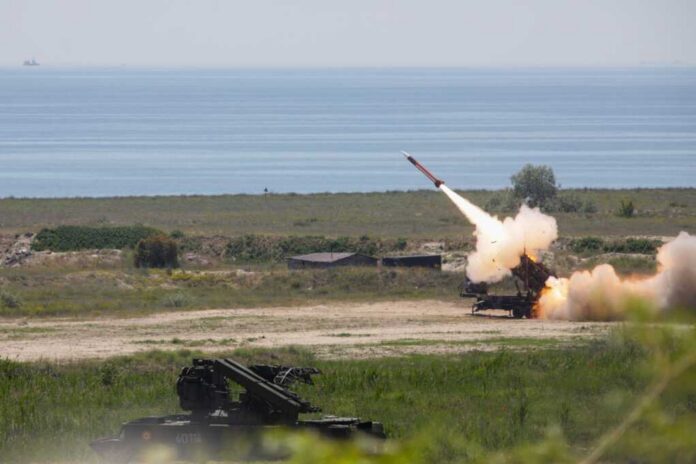
Turkey’s new 6,000‑kilometer “Yildirimhan” missile claim puts most of Europe in theoretical range while Washington still lacks clear answers about how real this threat actually is.
Story Snapshot
- Turkey unveiled a 6,000 km “Yildirimhan” missile at the SAHA 2026 defense expo in Istanbul, claiming intercontinental reach.[1][5][7]
- The declared range would put most of Europe, large parts of Asia, and much of Africa within reach from Turkish territory, including key United States allies.[1][2]
- Some reporting suggests the system on display may have been a model, raising questions about how operational the missile really is.[4][5]
- Unverified but loudly advertised capabilities risk reshaping strategic calculations in Europe, the Middle East, and within the North Atlantic Treaty Organization.[2][5][7]
Turkey’s 6,000 km Claim: What Ankara Says It Has Built
Turkish officials used the SAHA 2026 defense and aerospace exhibition in Istanbul to showcase a missile labeled “Yildirimhan,” described in press reports as Turkey’s first intercontinental ballistic missile with a stated range of 6,000 kilometers.[1][5][7] Coverage citing the Turkish Ministry of National Defense’s research and development center says the missile can reach hypersonic speeds, reportedly up to around Mach 25, and carry a payload of roughly three thousand kilograms, using four liquid-fuel rocket motors and nitrogen tetroxide oxidizer rather than the solid fuel common in earlier Turkish systems.[2][3][7]
Reports based on ministry data and Turkish media emphasize that this is the longest‑range missile Ankara has ever presented, far beyond the short‑ and medium‑range designs such as the Bora, Tayfun, and similar platforms previously associated with Turkish forces.[2][6] Turkish commentators quoted in friendly outlets frame Yildirimhan as the maturation of an indigenous missile ecosystem, a step that they argue moves Turkey into an exclusive club of states with claimed intercontinental capabilities, and symbolically proves that Ankara can design its own strategic strike systems without Western technology transfers.[2][5]
How Much Of This Is Reality, And How Much Is Show?
Independent observers caution that, as of now, the 6,000 kilometer figure rests entirely on Turkish assertions rather than documented flight tests or telemetry that outside analysts can verify.[1][5] One outlet explicitly described the SAHA display as a “model of 6,000‑km missile,” suggesting that what the public saw may have been a mock‑up or exhibition piece rather than an operational, field‑ready weapon.[4] None of the available reporting shows confirmed long‑range test launches, accuracy data, or evidence of a full deployment concept such as basing mode, survivability, or hardened launch facilities.[1][4][5]
Defense reporting that is more cautious still repeats the range and payload claims but uses qualifiers like “reportedly” or “according to the defense ministry,” underlining that outside journalists are essentially relaying official talking points, not independently established facts.[1][3][5] Analysts familiar with global missile-development patterns note that governments often unveil ambitious systems at expos, blending real prototypes with aspirational specifications, while keeping the hard data classified. That pattern makes it difficult for Washington, Brussels, or Jerusalem to judge whether Yildirimhan is already a near‑term operational threat or mainly a signaling tool meant to bolster Turkey’s prestige and bargaining power.[5]
Why This Matters For Europe, NATO, And The United States
If Yildirimhan’s advertised range proves credible, planners across Europe, the Middle East, and North Africa would have to factor Turkish long‑range strike into every major contingency scenario.[2][7] A 6,000‑kilometer envelope from Turkish territory would cover most European capitals, parts of Western Russia, Israel, and many North Atlantic Treaty Organization facilities in the Mediterranean region, even if the missile carried only a conventional warhead.[1][2][7] That reach would give Ankara a powerful tool to pressure neighbors, complicate alliance planning, and bargain over issues from Syria and energy routes to migration and defense basing.[2][5]
You’re saying Turkey has no capability to intercept ballistic missiles, but just a week ago it didn’t even have an intercontinental ballistic missile either. Its defense is improving fast with systems like Hisar and Siper.
— Yusuf (@yusufSezer71) May 16, 2026
At the same time, the ambiguity around how real this capability is can itself be destabilizing.[5] Loud claims of hypersonic, intercontinental reach stir fears in European and Middle Eastern capitals, which may respond by accelerating their own missile and air‑defense programs, spending more taxpayer money, and deepening dependence on multinational institutions instead of focusing on strong, sovereign national defenses. For American conservatives already wary of global entanglements, the situation underscores why the United States must insist on clear intelligence, tough scrutiny of allied and partner behavior, and missile defenses that protect the homeland and our closest allies without writing blank checks for unproven foreign systems.[5]
Sources:
[1] Web – Turkey unveils 6,000km-range ballistic missile at defence show
[2] YouTube – Turkey’s New ICBM Yildirimhan With 6,000 km Range …
[3] YouTube – Missile Unveiled by Turkey Has a Range of 6,000 Kilometers
[4] Web – Turkey displays model of 6,000-km missile at İstanbul defense expo
[5] Web – Turkey rolls out intercontinental missile with purported 6,000-km …
[6] Web – Turkey unveils high-speed ballistic missile with 6000-km range
[7] Web – Turkey unveils new Yildirimhan ICBM with 6000km range