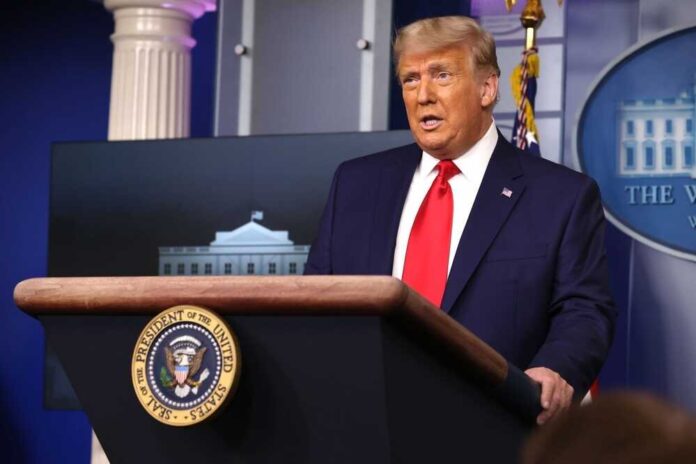
President Trump’s call for a record-breaking $1.5 trillion defense budget represents the largest military spending proposal in American history.
Story Highlights
- Trump proposes historic $1.5 trillion defense budget for FY-2027, a 50% increase over current levels
- Plan calls for tariff revenues to fund the $500 billion increase, making foreign nations contribute to American defense
- Initiative aims to build “dream military” capable of deterring China, Russia, and other threats in dangerous times
- Proposal sets up critical test between America First defense hawks and traditional fiscal conservatives in Congress
Trump’s Bold Vision for Military Supremacy
President Trump announced via Truth Social that America’s defense budget “should not be $1 Trillion Dollars, but rather $1.5 Trillion Dollars” for fiscal year 2027. This dramatic proposal emerged after what Trump described as “long and difficult negotiations” with political representatives, indicating serious internal discussions about America’s defense posture. The plan represents a fundamental shift from the Biden administration’s weak approach to national security, prioritizing military strength over bloated social programs that have weakened America’s global standing.
Trump’s justification centers on building what he calls a “dream military” capable of protecting America during “very troubled and dangerous times.” This reflects the harsh reality facing our nation after four years of Biden’s foreign policy disasters, from Afghanistan’s humiliating withdrawal to China’s growing aggression in the South China Sea. The proposal acknowledges that America can no longer afford the luxury of military weakness while hostile regimes expand their capabilities and threaten our allies.
Watch: https://www.youtube.com/watch?v=s06R-Yx5YHo
Innovative Tariff-Based Funding Strategy
The most innovative aspect of Trump’s proposal involves funding the additional $500 billion through customs tariffs, effectively requiring foreign nations to contribute to American defense capabilities. This brilliant strategy turns international trade into a tool for national security, ensuring that countries benefiting from access to American markets help pay for the military that protects global commerce. Unlike the Biden administration’s reckless spending that burdened American taxpayers, this approach shifts costs to foreign exporters while strengthening domestic manufacturing.
This tariff-funding mechanism represents classic Trump negotiating strategy, using America’s economic leverage to advance national security interests. The approach contrasts sharply with traditional Republican concerns about deficit spending, instead creating a self-funding model that grows stronger as America reasserts its trade dominance. Foreign competitors who have exploited unfair trade relationships would finally contribute to the military strength that maintains global stability.
Strategic Response to Growing Global Threats
The proposed $1.5 trillion budget acknowledges the reality that America faces unprecedented threats from multiple directions simultaneously. China’s rapid military modernization, Russia’s ongoing aggression, and Iran’s destabilizing activities across the Middle East require American responses that the Biden administration’s inadequate defense spending simply cannot provide. Trump’s proposal recognizes that peace through strength remains the only reliable path to avoiding costly conflicts that weak deterrence inevitably invites.
Trump proposes massive increase in 2027 defense spending to $1.5T, citing ‘dangerous times’ https://t.co/2pmroRmXQp
— The Lowell Sun (@LowellSun) January 7, 2026
This budget would enable critical investments in advanced technologies including hypersonic weapons, artificial intelligence, space-based defense systems, and naval capabilities essential for countering China’s military buildup. The proposal also addresses the defense industrial base weaknesses exposed during recent conflicts, ensuring America can produce munitions and equipment at the scale required for great power competition. Such investments represent insurance against the far greater costs of military weakness when adversaries calculate they can challenge American interests with impunity.
Congressional Battle Lines and Political Reality
Trump’s proposal sets up a defining battle within the Republican Party between America First defense hawks and traditional fiscal conservatives concerned about government spending. However, this debate misses the fundamental point that national defense represents the government’s primary constitutional responsibility, unlike the countless unconstitutional programs that consume federal resources. The proposal forces Congress to prioritize genuine national needs over bloated bureaucracy and wasteful social engineering.
Sources:
Trump calls for record $1.5 trillion defense budget, a 50 percent jump
Trump proposes $1.5 trillion defense budget for 2027, funded by tariffs
Trump proposes $1.5 trillion defense budget for 2027