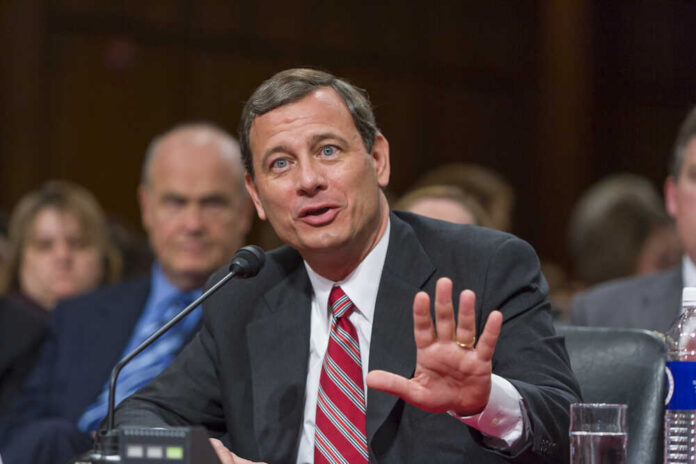
Chief Justice John Roberts just reminded Washington that “new world” politics don’t rewrite the Constitution—putting President Trump’s birthright-citizenship order on a collision course with 130 years of precedent.
Story Snapshot
- The Supreme Court heard arguments April 1, 2026, on Trump’s executive order aimed at narrowing birthright citizenship.
- The order would limit citizenship for U.S.-born children unless at least one parent is a U.S. citizen or lawful permanent resident.
- Roberts pushed back on the administration’s “new world” rationale, stressing constitutional text does not change with modern travel.
- Multiple reports indicate a majority of justices—across ideological lines—appeared skeptical of overturning or narrowing the long-standing rule.
Roberts Draws a Bright Line Between Policy Goals and Constitutional Text
Chief Justice John Roberts’ central message at the April 1 hearing was simple: modern policy problems cannot substitute for constitutional language. The Trump administration argued that global travel and “birth tourism” create incentives the Fourteenth Amendment never contemplated. Roberts countered with the line now defining the case—“It’s a new world. It’s the same Constitution”—signaling discomfort with rewriting the Citizenship Clause to fit present-day pressures.
Solicitor General D. John Sauer pressed the government’s view that today’s realities—billions of people “one plane ride away”—make the traditional reading of citizenship too expansive. Several justices pressed Sauer for a limiting principle that would be both workable and rooted in law rather than a policy preference. Reports describe the Court searching for a “principled” way to address concerns without hollowing out the basic rule Americans have lived under for generations.
What Trump’s Executive Order Tries to Change—and Why It’s So Hard
President Trump’s executive order, announced on the first day of his second term, would deny automatic citizenship to some children born on U.S. soil unless at least one parent is a citizen or lawful permanent resident. That goal collides with the long-standing understanding that birth on U.S. territory generally confers citizenship, with narrow historical exceptions such as children of foreign diplomats and hostile occupying forces.
The government’s problem is not that voters have concerns about illegal immigration—those concerns are real and widely documented—but that the Supreme Court is not a legislature. The Fourteenth Amendment’s text includes the phrase “subject to the jurisdiction thereof,” and for more than a century it has been read broadly in practice. Changing that default rule through an executive order places the entire dispute on a steep uphill legal grade, especially given the Court’s obligation to apply the Constitution consistently.
The 1898 Precedent at the Center: Wong Kim Ark
The case directly challenges the Supreme Court’s 1898 decision in United States v. Wong Kim Ark, which established that a child born in the United States to non-citizen parents is a U.S. citizen. That precedent has become a bedrock rule shaping everything from passports to Social Security numbers. Because the Court typically treats long-settled precedent with caution, the administration must show more than a new policy urgency—it must show a legal basis strong enough to justify disrupting settled expectations.
Congress also matters here. Reports note that in 1940 and again in 1952, Congress repeated the Fourteenth Amendment’s citizenship language in nationality statutes, a signal that lawmakers accepted the prevailing interpretation rather than rejecting it. That historical record complicates any argument that the modern reading is merely an accidental mistake. For constitutional conservatives who prioritize separation of powers, the dispute underscores a difficult truth: major national changes generally require Congress, not unilateral executive action.
What the Justices’ Skepticism Signals—and What It Doesn’t
Media accounts from multiple outlets describe a clear pattern: justices from different wings of the Court appeared unconvinced the administration had a clean legal pathway to narrow the Citizenship Clause without creating chaos. Roberts reportedly described aspects of the government’s approach as “very quirky,” questioning how narrow historical exceptions could justify excluding a broad category like “the whole class of illegal aliens.” That skepticism suggests the Court is weighing practical consequences alongside constitutional method.
At the same time, oral-argument skepticism is not a final ruling, and the Court has not issued a decision. The justices’ questioning does, however, spotlight the tension many conservative voters feel: frustration with illegal immigration and perceived loopholes, alongside a desire for constitutional stability and predictable rule of law. If the Court rejects the executive order, it will likely reinforce that even popular enforcement goals must be pursued through the constitutional process—principally legislation.
Political Stakes: Immigration Anger Meets War Weariness and Broken Promises
The timing lands in a volatile political moment. Trump’s base has been split on foreign policy—especially over potential U.S. involvement in an Iran conflict and the scope of support for Israel—while also remaining furious about inflation, energy costs, and years of progressive governance. That internal division makes domestic issues like immigration even more central, because many voters want competence and constitutional order at home instead of open-ended commitments abroad.
For constitutionalists, the biggest takeaway is that this case tests more than immigration policy. It tests whether the executive branch can use an order to reshape a core constitutional promise and force the judiciary to ratify it. The Court’s early tone suggests a warning to both parties: durable change comes from legislation and constitutional amendments, not from trying to stretch a few words past their long-settled public meaning.
Limited social-media research provided did not include a qualifying English X/Twitter URL directly tied to the case, so no secondary insert is included.
Sources:
New World, Same Constitution: Justices Seem Hesitant to Overturn Birthright Citizenship
Supreme Court Justices Hear Landmark Birthright Citizenship Case
Supreme Court considers a historic case about who is and isn’t born a citizen