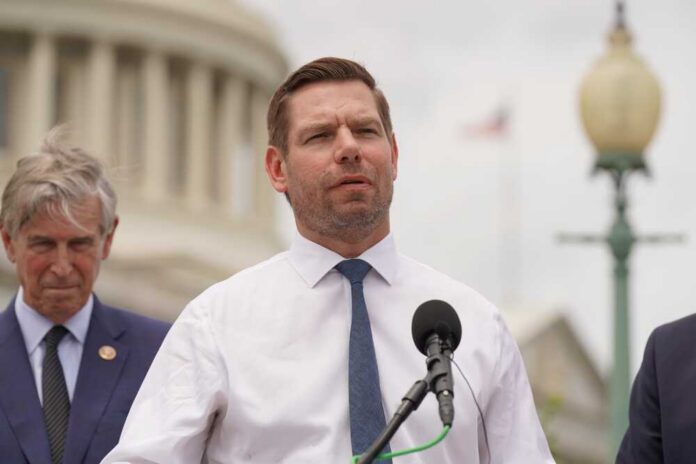
FBI Director Kash Patel’s push to release decade-old investigative files on Rep. Eric Swalwell is reigniting conservatives’ deepest worry about Washington: a federal law-enforcement apparatus that can be steered into politics by whoever holds power.
Quick Take
- Kash Patel has directed FBI personnel to locate, redact, and prepare older investigative files tied to Rep. Eric Swalwell and suspected Chinese operative Christine Fang.
- The underlying counterintelligence matter dates back more than a decade and produced no criminal charges; a House Ethics review later took no action.
- FBI leadership’s reported plan has triggered internal concerns about exposing sources and methods and burning resources on a closed-era inquiry.
- Swalwell and top Democrats are calling the move “weaponization,” while the FBI has disputed key details of the reporting.
What Patel Is Reportedly Ordering—and Why It’s News Now
FBI Director Kash Patel has reportedly instructed the bureau’s San Francisco office to locate and redact investigative material tied to a more than decade-old probe involving Rep. Eric Swalwell and Christine Fang, described in reporting as a suspected Chinese intelligence operative. The effort is notable because the matter did not result in charges and because it is unfolding while Swalwell runs for governor of California, raising predictable questions about timing and motive.
Multiple outlets characterize the files as stemming from a counterintelligence investigation into Fang’s political outreach in the early-to-mid 2010s. Reporting describes Fang as having helped Swalwell’s 2014 reelection effort through fundraising activity and by connecting an intern to his office. Swalwell has said he was briefed by the FBI in 2015, cooperated, and severed ties. The core factual dispute today is less about new evidence and more about whether releasing old non-charging files serves the public interest.
What the Record Shows: A Closed-Era Probe, No Charges, and a Later Ethics Review
The available reporting presents a consistent baseline: the investigation into Fang’s political relationships is old, and no criminal case was brought against Swalwell. A Republican-led House Ethics Committee review in 2023 ended without further action, according to the same accounts. That history matters because it frames what “release the files” would actually mean—publicizing investigative materials from a counterintelligence episode that was assessed, briefed, and effectively concluded years ago.
Patel’s reported instructions have also raised practical and institutional issues inside the FBI. News coverage describes rank-and-file concerns that public release could expose sensitive sources and methods, and that agents are being tasked to chase administrative work tied to a politically combustible narrative rather than active threats. The FBI, through a spokesperson, has pushed back by calling at least one major story “incorrect” without publicly detailing what, specifically, is wrong—leaving Americans with a familiar fog of insinuation and denial.
Democrats’ “Weaponization” Claims—and the Standard Conservatives Should Apply
Democratic lawmakers have gone on offense, arguing Patel’s move amounts to political interference and a misuse of federal investigative power. Rep. Jamie Raskin has accused the FBI director of wasting resources and violating civil-service norms meant to separate law enforcement from partisan elections. Rep. Adam Schiff has echoed claims of “weaponization,” and other Democrats have amplified similar criticisms. Those claims are not proof by themselves, but they reflect how quickly these fights become about institutional legitimacy, not just one politician.
Conservatives have their own reason to demand a clear standard here. If the executive branch can revive and publicize old investigative files timed to a campaign—especially files tied to a matter that produced no charges—then the precedent does not stop with a Democrat in California. The constitutional concern is straightforward: federal power must be cabined by process, transparency, and equal application, not by political convenience. If Patel has strong legal grounds and a defined public-interest rationale, the administration should articulate it plainly.
What Happens Next: Redactions, Possible Release, and Trust in Federal Institutions
Reporting indicates the files are being prepared for potential release, but no public release has been confirmed. Swalwell has publicly described the story as “decade-old” and “closed,” and he has framed the development as an attempt to damage his gubernatorial run. Meanwhile, some accounts mention discussions about whether to contact Fang, who is believed to be in China, including ideas involving a U.S. visa—details that remain uncertain amid the FBI’s dispute of reporting.
The bottom line for a conservative audience is not to reflexively defend or condemn any one official, but to insist on durable rules. Washington has a long history of “process crimes,” leaks, and selective disclosures that destroy public confidence and punish ordinary Americans while insiders skate. If the Trump administration is now responsible for federal actions, it inherits responsibility to prove restraint and fairness—especially when the target is a political opponent and the material is old, sensitive, and previously non-charging.
Sources:
Keystone Kash Patel’s Pathetic FBI Play on Eric Swalwell to Please Donald Trump Exposed
FBI director reportedly pushes to release files probe of Eric Swalwell